
SEO for photographers comes down to three moves:
- optimizing your homepage for "[your city] + [your specialty] photographer"
- publishing high-quality service and blog pages that match how clients actually search
- and showing up in other places Google ranks (e.g. Maps, directories, Reddit, and Instagram)
Instead of telling you to "write good content" or "use tools X, Y and Z", we pulled real website traffic data and search data from three working photographers' websites and analyzed live Google results for four different photography searches. You'll see exactly which pages drive their traffic, why, and how to create your own ideal strategy.
Key Takeaways
- You don't need too much authority (backlinks & mentions) to rank: One Atlanta photographer in our analysis ranks #3 for "atlanta event photographer" with a Domain Rating of just 3.2.
- Venue and location content is the highest-leverage blog strategy: A San Francisco wedding photographer captures searches with up to 1,900 monthly searches simply by naming her wedding galleries after the venues where she shot them.
- Your website is only one of five assets that rank: Live SERP analysis shows Google Maps listings, marketplaces like The Knot, Reddit threads, and Instagram profiles all ranking on page one for photography searches, often above individual websites.
- Google Business Profile now feeds AI Overviews: For corporate photography searches, Google's AI Overview pulls its "top photographers" list directly from Google Business Profiles, complete with reviews and call buttons, making your profile more valuable than ever.
- Clients splurge on photography and search on Google: According to Zola's wedding data, the photographer is the #1 vendor couples are willing to splurge on (57% of couples), and Google is the top way couples use to research.
How is SEO for Photographers different from SEO for other domains
Most SEO advice is written for SaaS companies and e-commerce stores targeting hundreds of keywords with ranking difficulty scores of 60+. Photography is usually nothing like that. The keywords that book clients (e.g. "san francisco wedding photographer," "atlanta event photographer," "film wedding photographer") are local or niche, and the sites competing for them are other small portfolio sites, not corporations with content teams.
This means that even if you're only getting started, you can start getting traffic in a relatively short amount of time (2-3 months). In our data below, sites with 44 to 85 total ranking keywords generate hundreds of monthly visits from people actively looking to hire.
There's a second difference that matters as well. For most industries, ranking means ranking your website (home page, service pages, blog pages). For photographers, Google's results page is a patchwork of surfaces: Google Maps, Google Business Profile, marketplaces, forums, social profiles, and now Google AI Overviews. A good SEO strategy here is to rank your website, but to also be present in as many of those surfaces as possible. Below, we'll analyze each one with actual examples.
Bottom line: Photography SEO is one of the few remaining niches where a solo business owner can outrank everyone in their market within 6–12 months. The competition is significantly thinner than in other industries, the intent is high, and the playbook below is built from what's actually working.
What Real Photography Websites Rank For
Let's look at three real photography websites. For each one, we pulled live data from Ahrefs Site Explorer: overall traffic, the pages earning that traffic, and the keywords behind them. Each site demonstrates a different winning strategy.
Case Study 1: A Girl and A Camera → The Venue Content Strategy
A Girl and A Camera Photography is Jennifer Michelson's San Francisco wedding photography site. Here's the snapshot:
| Metric | Value |
|---|---|
| Domain Rating | 27 |
| Organic keywords | 85 |
| Monthly organic traffic | ~731 visits |
| Referring domains | 391 |
Her homepage does the heavy lifting for local intent, pulling roughly 545 visits per month across 64 keywords:
| Keyword | Monthly Volume | Position |
|---|---|---|
| san francisco wedding photographer | 600 | #4 |
| wedding photographers in san francisco | 150 | #2 |
| san francisco wedding photography | 100 | #2 |
| san francisco photographer | 300 | #4 |
| wedding photographer bay area | 150 | #2 |
But here's the part most photographers miss. Her blog is library of informational blog posts and real wedding galleries named after the venues where she shot them:
- "A Wedding at the Gorgeous Lodge at Marconi in Tomales Bay" ranks for "lodge at marconi" → a keyword with 1,900 monthly searches
- "The Mountain Terrace: A Wedding in the Redwoods" ranks for "the mountain terrace" → 1,300 monthly searches
- "Gorgeous Gardener Ranch Wedding" ranks #6 for "gardener ranch"
- "Getting Married at SF City Hall: A Photographer's Guide" ranks for "san francisco city hall photos" (600 monthly searches)
- "Nestldown Wedding Under the Redwoods" ranks #2 for "nestldown photos"
Think about who searches "lodge at marconi wedding." It's an engaged couple evaluating that venue, someone who hasn't hired a photographer yet and is about to see Jennifer's best work shot in that exact location. This is the single smartest content play in wedding photography: Google is the top way couples research venues, and venue-name keywords put you in that research moment with almost zero competition.
Pro Tip
After every wedding, publish a gallery post titled "[Venue Name] Wedding" with 800+ words about the venue (e.g. light, logistics, favorite photo spots). You'll build a venue library that compounds: every future couple researching that venue finds you first.
Distribute this across other platforms too, such as Medium, Instagram, TikTok etc. You never know how a young couple will find your content.
Case Study 2: Kate Bunny Hampson → The Niche Positioning Strategy
Kate Bunny Hampson is a London-based wedding photographer, and her data allows us to understand a different strategy, compared to the previous case study:
| Metric | Value |
|---|---|
| Domain Rating | 36 |
| Organic keywords | 64 |
| Monthly organic traffic | ~804 visits |
| Referring domains | 760 |
Unlike Jennifer, Kate's homepage isn't her top traffic page. Two dedicated service pages are:
| Page | Top Keyword | Volume | Position | Monthly Traffic |
|---|---|---|---|---|
| /film-wedding-photographer/ | film wedding photographer | 450 | #2 | 281 |
| /london-wedding-photographer/ | london wedding photographer | 800 | #4 | 227 |
| Homepage | film wedding photography | 250 | #1 | 85 |
| /top-uk-wedding-photographer/ | uk wedding photographers | 90 | #5 | 53 |
Notice what she did. Instead of one homepage trying to rank for everything, she built separate landing pages for each way clients describe her:
- by niche ("film wedding photographer")
- by city ("london wedding photographer")
- and by region ("uk wedding photographer").
Each page can be fully optimized for its own keyword without diluting the others (also known as keyword cannibalization, when 2 or more pages rank for the same keyword).
Her niche choice proves to be valuable. "Film wedding photographer" is a style keyword, that doesn't target a specific location, meaning she attracts destination clients worldwide who specifically want analog film. In fact, 28% of couples requested film or film-style photography in 2025, and Kate positioned herself directly in front of that trend. Her supporting blog posts ("Engagement Photos on 35mm Film," "35mm Film Elopement") reinforce the theme and pick up long-tail searches.
Key Insight: If you shoot a distinctive style (e.g. film, documentary, editorial, drone) build a dedicated page for "[style] + photographer." Style keywords have national or global reach, and far fewer photographers compete for them than for "[city] photographer."
Case Study 3: David & Jess → Proof You Don't Need Too Much Authority (Too Many Backlinks)
David & Jess are Atlanta photographers, and their site has the most encouraging data of the three:
| Metric | Value |
|---|---|
| Domain Rating | 3.2 |
| Organic keywords | 44 |
| Monthly organic traffic | ~229 visits |
| Referring domains | 454 |
A Domain Rating of 3.2 is, to be 100% honest with you, almost nothing. This site has essentially no backlink authority. And yet:
- Their /atlanta-event-photography page ranks #3 for "atlanta event photographer" (200 monthly searches) and drives 94 visits/month
- Their homepage ranks #5 for "atlanta photographers" (300 monthly searches)
- Location-specific blog posts like "Ponce City Market Photographer Tips" and "West Midtown Atlanta Headshots" rank #3 and #11 for hyper-local searches, respectively
This is where photography SEO differs from almost every other industry. Local service keywords are decided far more by relevance and proximity than by raw domain authority. A focused service page ("Atlanta Event Photography") on a brand-new site can beat established competitors who never built such a dedicated page.
This is what we can learn from all three case studies: Homepage for your main "[city] + [specialty]" keyword. Dedicated service pages for each niche and location you serve. Informational blog posts and blog posts named after venues and photo locations.
Your Website Is Not the Only Thing That Ranks
We searched four photography keywords on Google and screenshotted the actual search results. In every single one, individual websites share page one with Google Maps, marketplaces, Reddit, Instagram, and AI Overviews. Each of those is a surface you can be present in (usually for free).
Search 1: "san francisco wedding photography"
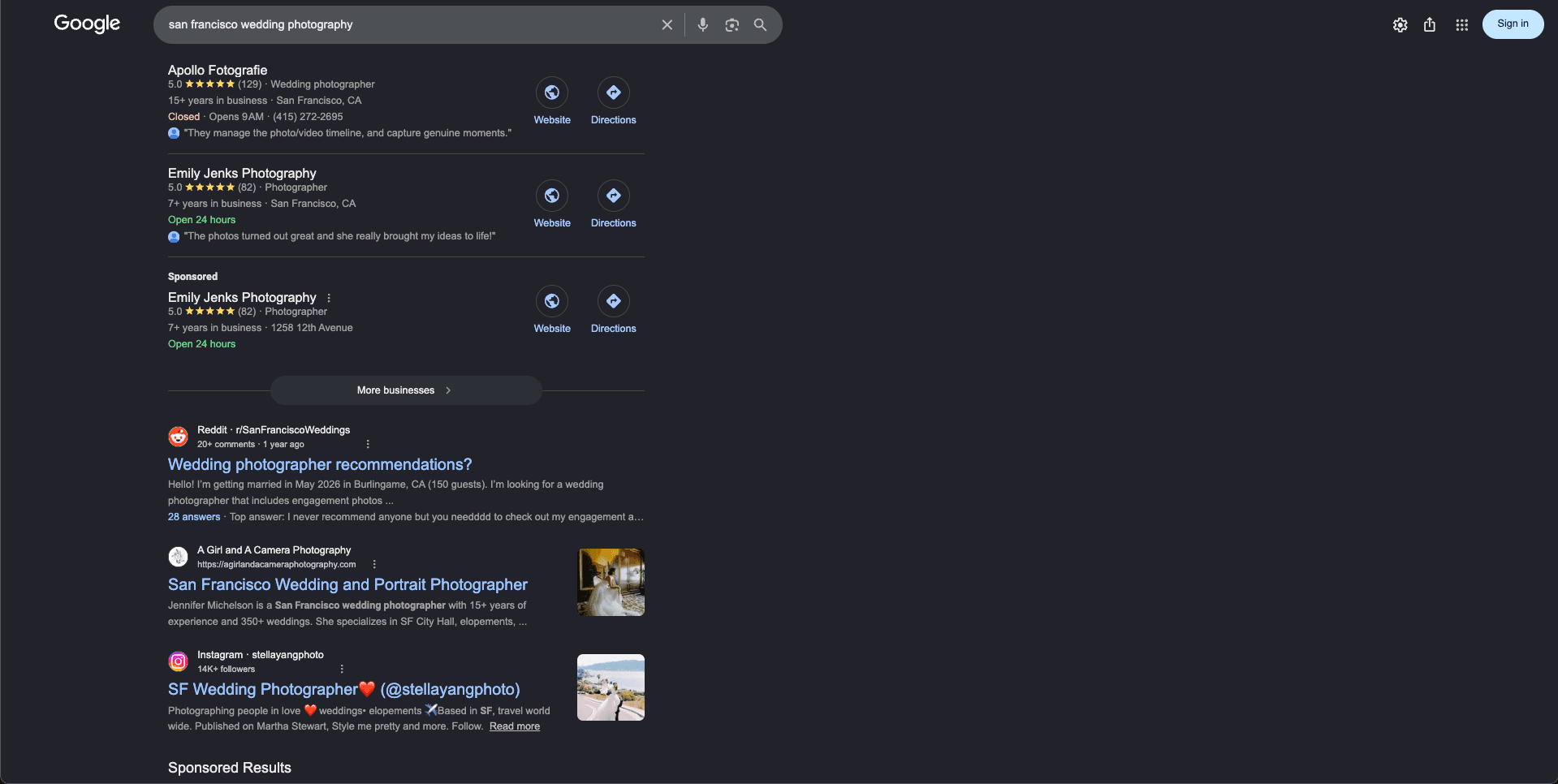
Look at what's actually on page one for this search:
- The local Map pack leads with Apollo Fotografie (129 reviews) and Emily Jenks Photography (82 reviews) — both 5.0-star profiles with review snippets pulled directly onto the results page
- A sponsored Map listing — Emily Jenks appears a second time as a paid local ad
- A Reddit thread from r/SanFranciscoWeddings titled "Wedding photographer recommendations?" with 28 answers ranks prominently
- A Girl and A Camera Photography — the same site from our case study — is the first traditional website result
- An Instagram profile (@stellayangphoto, 14K followers) ranks as its own organic result, bio and all
That's five different surfaces, and only one of them is a traditional website. A photographer with a great website but no Google Business Profile, no Reddit presence, and no Instagram is competing for exactly one of the five slots.
The Reddit result is quite interesting. Google now ranks discussion threads for almost every "recommendation" style query, and the top answer in that thread is effectively a free, high-trust referral seen by hundreds of couples per month. Being genuinely helpful in threads like r/SanFranciscoWeddings (answering venue questions, sharing advice, being recommendable) can prove to be a great SEO channel. Make a YouTube video where you talk thorugh those things and you'll basically have 0 competition.
The Instagram result is interesting for the same reason. Stella Yang's profile ranks because her bio reads like a well-optimized title tag: "SF Wedding Photographer" plus a press mention ("Published on Martha Stewart"). With social media inspiring 91% of couples according to Zola's First Look Report, an Instagram bio with your city and specialty spelled out is both a social asset and a search asset.
Search 2: "san francisco wedding photographer"
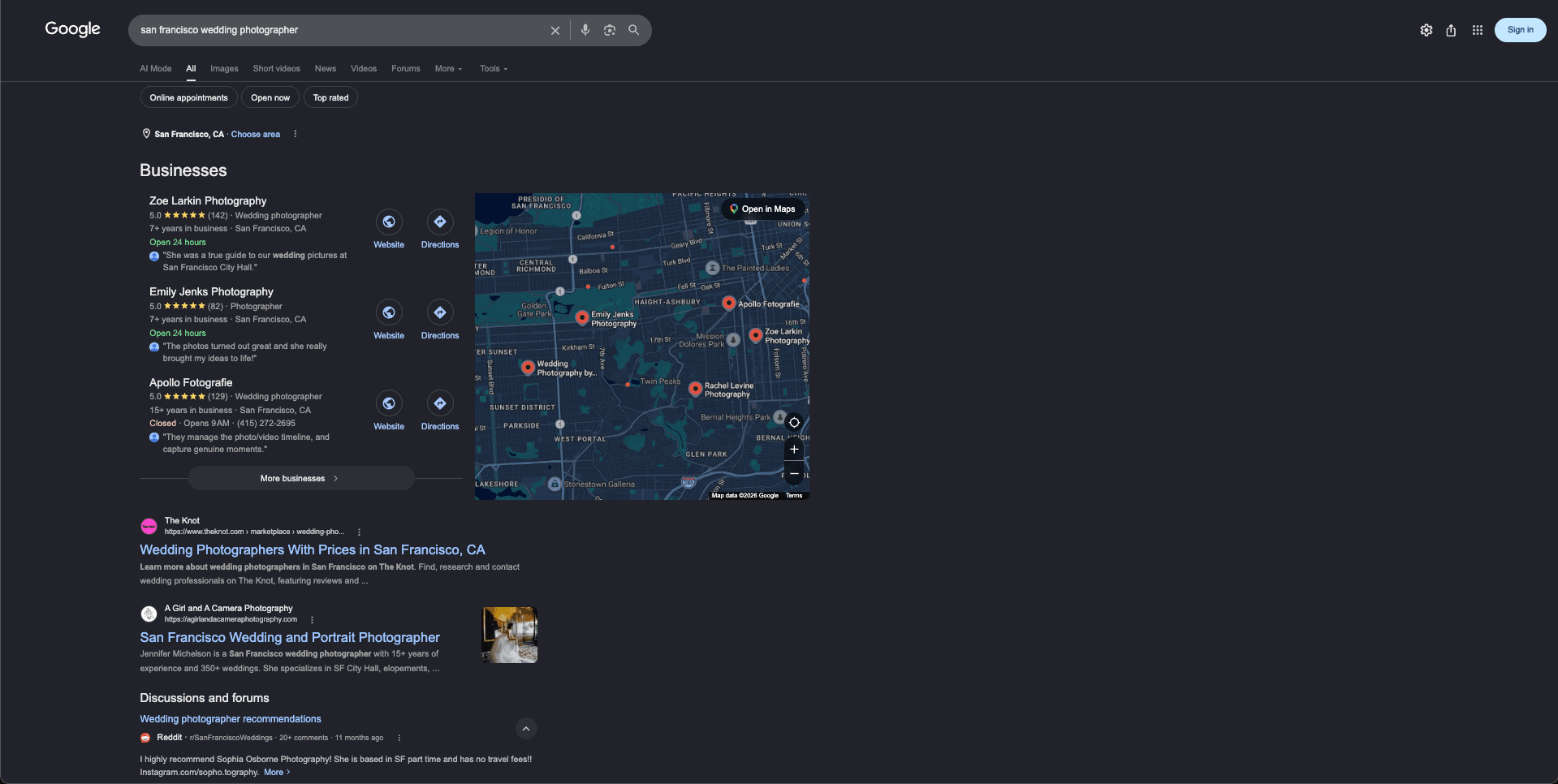
Change one word, "photography" to "photographer", and the page changes significantly:
- The Map pack expands to three businesses (Zoe Larkin, Emily Jenks, Apollo Fotografie) with a full map, filters for "Online appointments," "Open now," and "Top rated"
- The Knot's marketplace page ("Wedding Photographers With Prices in San Francisco, CA") ranks as the first organic result — a directory, not a photographer
- A Girl and A Camera ranks again as the top individual website
- A "Discussions and forums" block surfaces another Reddit thread, where the visible top comment is a direct recommendation of a specific photographer by name and Instagram handle
There are 2 insights here. First, when a marketplace like The Knot outranks every individual photographer, being listed there means you can be present inside a page-one result, that would otherwise be hard to rank for. Second, notice that all three Map pack businesses show 5.0 ratings with 82–142 reviews; that's the review volume the top of this market actually has, which tells you your target.
Search 3: "san francisco corporate photographer"
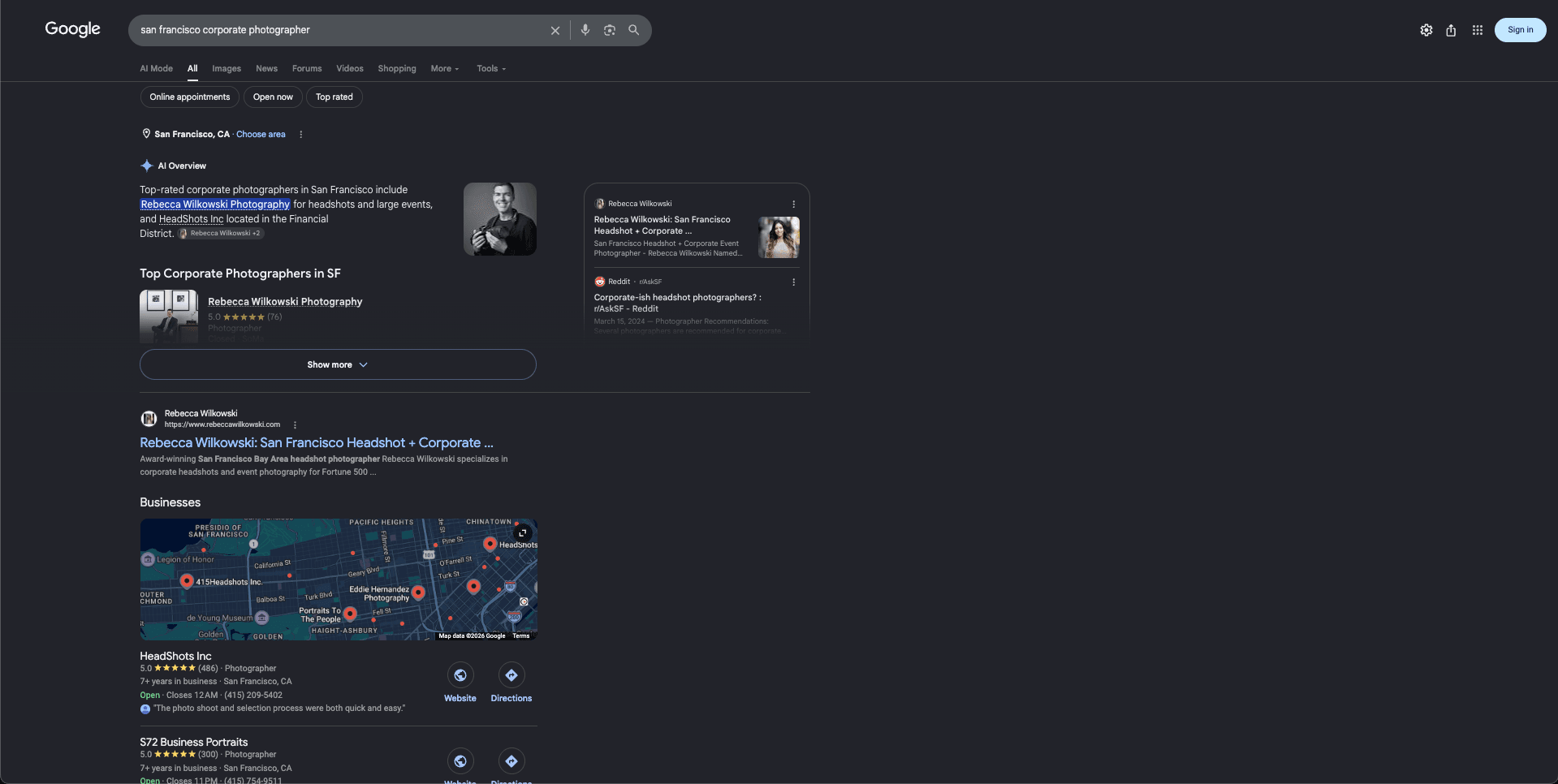
Corporate photography searches show where Google is heading. The first thing on the page isn't the Map pack, it's a Google AI Overview that names specific businesses: "Top-rated corporate photographers in San Francisco include Rebecca Wilkowski Photography for headshots and large events, and HeadShots Inc located in the Financial District."
Directly below the AI Overview, Rebecca Wilkowski's own website ranks #1 organically, and only then comes the Businesses map. Her site title, "Rebecca Wilkowski: San Francisco Headshot + Corporate Event Photographer", is a masterclass in title tag writing: name, city, and both service keywords in one line. The AI Overview also cites a Reddit thread from r/AskSF asking about corporate headshot photographers, reinforcing the forum point from above.
Search 4: "san francisco corporate photography"
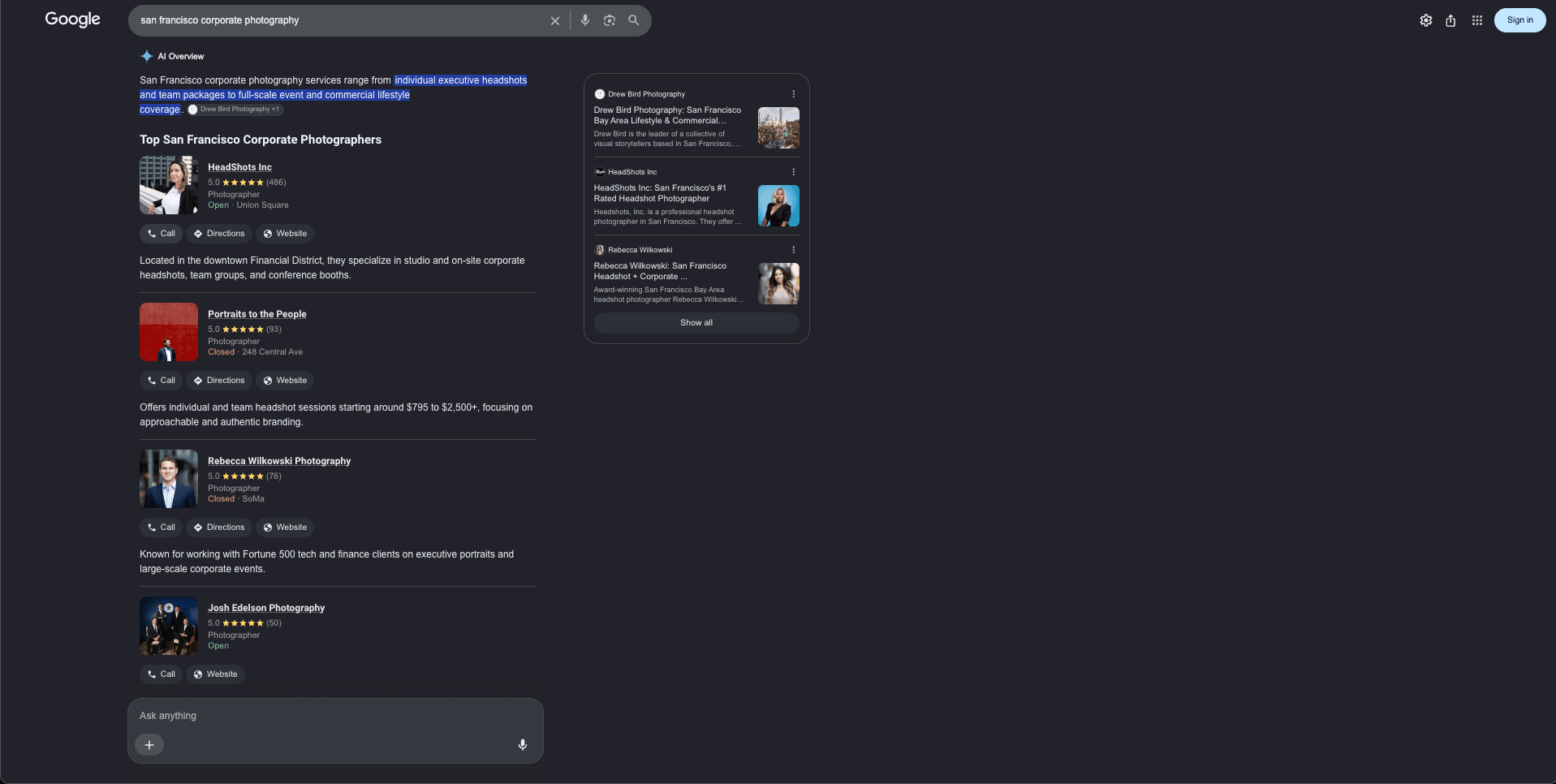
Open the AI Overview fully and you can see exactly where Google gets its answer. The Overview presents a ranked list, "Top San Francisco Corporate Photographers", and each entry shows a star rating, review count, open/closed status, and Call, Directions, and Website buttons. These are Google Business Profile listings, restructured into an AI answer.
This means that your Google Business Profile is no longer just a Maps asset. It's the data source Google's AI uses to decide who gets named as a "top photographer" in the answer box above every other result. The photographers appearing here (HeadShots Inc with 486 reviews, Portraits to the People with 93, Rebecca Wilkowski with 76) earned those AI citations through profile completeness and review volume. Google's own documentation on AI features in Search confirms there's no special markup to appear in AI Overviews. The same fundamentals (helpful pages, strong profiles, great reviews) decide it.
Pro Tip
The AI Overview descriptions mention specifics, such as "located in the Financial District," "starting around $795 to $2,500+," "working with Fortune 500 tech and finance clients." Add exact and detailed facts like neighborhood, starting prices, and notable clients on your website and profile. Specific, extractable facts are what AI answers are built from.
The Five Surfaces Every Photographer Should Occupy
Putting all four SERPs together, here's your visibility checklist ranked by effort and payoff:
| Surface | What Ranks | Effort | 💡 Priority For |
|---|---|---|---|
| Google Business Profile | Map pack + AI Overviews | Low | Every photographer, first |
| Your website | Organic results + AI citations | High | Every photographer |
| Social Media (e.g. Instagram) | Profile ranks for "[city] photographer" | Medium | Wedding, portrait, lifestyle |
| Marketplaces (The Knot, Zola, Yelp) | Their category pages rank for you | Low | Wedding & event photographers |
| Reddit / Quora / forums | Recommendation threads | Medium | All niches, ongoing |
How to Do SEO for Your Photography Website: Step-by-Step
Now that you've seen what works, here's the exact strategy to implement it.
Step 1: Pick Your Primary Keyword (City + Specialty)
Your primary keyword is almost always "[city] + [specialty] photographer". This is the phrase a ready-to-hire client types. Choose one and commit your homepage to it.
- Wedding: "austin wedding photographer"
- Corporate: "chicago corporate photographer" or "chicago headshot photographer"
- Family/portrait: "denver family photographer"
- Style-based (if distinctive): "film wedding photographer," "documentary wedding photographer"
The good news is these keywords are far less competitive than they sound. Remember: David & Jess rank #3 in Atlanta with a Domain Rating of 3.2. Check both the "photographer" and "photography" variants. As our SERP screenshots showed, they produce different results pages, and you'll want to note which shows an AI Overview, which shows the Map pack first, and who's currently winning.
Step 2: Optimize Your Homepage Like a Landing Page
Portfolio-first homepages with no text are the #1 reason photography sites don't rank. Google can't rank what it can't read. Your homepage needs:
- A meta title tag and a meta description tag with your keyword → "Rebecca Wilkowski: San Francisco Headshot + Corporate Event Photographer" is the model: name + city + services
- An H1 title that says what you do and where → "San Francisco Wedding Photographer" beats "Welcome" every time
- 400-800 words of text → who you shoot, where you're based, what areas you serve, what makes your approach different
- Compressed images with descriptive file names and alt text → follow Google's image SEO best practices; "golden-gate-park-engagement-session.jpg" tells Google something, "IMG_4032.jpg" tells it nothing
- Fast load times → image-heavy sites are slow by default (this is why compressed images are recommended); test yours with PageSpeed Insights and export web-sized images
- LocalBusiness structured data → add LocalBusiness schema markup so Google explicitly understands your name, area, and services
Step 3: Build a Service Page for Every Niche and Location
This is Kate Bunny Hampson's playbook. One page per distinct offer:
- /[city]-wedding-photographer
- /[city]-corporate-photography
- /[city]-headshots
- /[style]-photographer (film, documentary, editorial)
- /[nearby-city]-photographer for each additional area you serve
Each page gets its own title tag, H1, 500+ words, and a gallery of relevant work. David & Jess's /atlanta-event-photography page, a simple dedicated page, outranks their entire homepage for event searches. Don't cram five services onto one page and hope Google figures it out.
Step 4: Publish Venue and Location Content After Every Shoot
This is Jennifer Michelson's playbook, and it's one of the highest-ROI blogging strategy in photography:
- Shoot a wedding/session at a venue or location
- Publish a gallery post titled with the venue name → "Lodge at Marconi Wedding: [Couple] in Tomales Bay"
- Write 600–1,000 words so search engines can understand → what the light is like, where the best portrait spots are, logistics couples ask about
- Interlink it to your homepage and relevant service page
Every post targets a venue keyword ("lodge at marconi," 1,900 searches/month) that venue websites barely optimize for and other photographers ignore. Corporate and portrait photographers can run the same play with office districts, event spaces, and photo locations — exactly like David & Jess's "Ponce City Market Photographer Tips" post ranking #3.
Step 5: Build Your Google Business Profile Into a Review Machine
Given what we saw in the corporate photography SERPs, treat your Google Business Profile as seriously as your website:
- Complete every field: categories, service areas, hours, services with prices, description
- Upload your actual portfolio work as profile photos, and keep adding monthly
- Ask every single client for a review: the photographers winning the Map pack and AI Overviews have 76–486 reviews; make the ask part of your gallery-delivery email
- Reply to every review: engagement is part of how Google determines local ranking
As a bonus, claim your free listing on Bing Places. This takes five minutes of work and you can start appearing in a second search engine's local pack.
Step 6: Get Listed Where Google Already Ranks Directories
You saw The Knot ranking #1 organically for "san francisco wedding photographer." It will be hard to outrank that listing. So join it! Depending on your niche:
- Wedding: The Knot, Zola, WeddingWire
- All niches: Yelp, local chamber of commerce, city-specific "best photographer" roundups
- Corporate: LinkedIn company page, B2B directories in your metro
Directories also give you consistent citations (name, address, phone), which reinforce your local rankings.
Step 7: Show Up on Reddit, Quora, and Instagram
Google shows forum and social results more and more for recommendation-style queries. Your play:
- Join your city's wedding/photography subreddits and answer questions genuinely (venue advice, timeline tips, vendor questions). Never spam; the photographers recommended in those threads earned it by being known and liked
- Write your Instagram bio like a title tag → "[City] Wedding Photographer" first, personality second, press mentions if you have them
- Post location-tagged work consistently → profiles rank in Google, and 91% of couples draw inspiration from social media
Fair warning: Reddit communities detect self-promotion instantly and ban for it. Contribute for months, not days. The goal is to be the photographer other people recommend, not the one recommending themselves.
Best SEO Tools for Photographers
You only need three tools, and two of them are free. The free tools give you data, but you still have to put in the work. The paid tool can do the work for you.
Google Search Console (Free, Your Data Source)
Google Search Console shows you exactly which queries your site appears for, your average position, your click-through rates, and any indexing problems. Set it up ASAP. It's how you'll know whether the strategy above is working. It won't tell you what to write next or write it for you, but the insights are golden.
Bing Webmaster Tools (Free, The Second Opinion)
Bing Webmaster Tools does the same job for Bing, and it includes its own keyword research and site scanning tools at no cost. Bing's share of search is smaller, but its users skew toward desktop and corporate environments, which is relevant if you shoot headshots and corporate events. Like Search Console, it hands you data and leaves the work to you.
SEOForge (Paid, The Execution Engine)
Google Search Console and Bing Webmaster Tools can tell you that you're ranking #14 for "gardener ranch wedding," but it can't research the fifty other venue keywords in your area, plan a content calendar around them, or write the posts. That execution layer is what SEOForge automates:
- Keyword research → finds the "[venue] wedding," "[city] [specialty]" and long-tail keywords in your market, with difficulty and volume
- Content planning → turns them into a prioritized publishing calendar, so you always know what page or post comes next
- Article writing → drafts the venue guides, location posts, and service pages automatically, so an evening of editing replaces a weekend of writing
I've taken my 10+ years of experience in SEO, and more recently AI Search, to develop SEOForge. The platform integrated directly with Google Search Console. You can use SEOForge to research keywords, create a content plan, and generate high-quality content. A photographer shooting every weekend doesn't have 10 hours a week for content. This is how the strategy in Step 4 actually gets executed.
Common Photography SEO Mistakes to Avoid
Mistake 1: An Image-Only Portfolio Site
Aa homepage with a full-screen slideshow and 40 words of copy gives Google nothing to rank. Keep the visuals, add 400–800 words of location and service copy as well. Every case study site in this guide pairs galleries with real text.
Mistake 2: One Page Trying to Rank for Everything
"Weddings, portraits, corporate, and family; all on one Services page" means ranking for none of them. The fix: one dedicated page per service and per location, each targeting one keyword, as in Step 3.
Mistake 3: Blogging Without Search Intent
"5 Reasons to Print Your Photos" and "My 2025 Year in Review" have no search demand from potential clients. The fix: name posts after venues, locations, and questions clients actually search. Compare traffic on those posts to venue-titled galleries and the difference is stark — venue posts in our data pull 40–55 visits/month each; generic posts pull zero.
Mistake 4: Ignoring Reviews Until It's Too Late
The Map pack photographers in our screenshots have 82–486 reviews. If you ask for reviews only when you remember, you'll have twelve after five years. The fix: build the review ask into your delivery workflow — every client, every time, with a direct link.
Mistake 5: Huge, Slow Images
Uploading 8MB full-resolution files makes your site crawl, and page experience affects both rankings and whether visitors stay. The fix: export web versions (under ~500KB), use modern formats like WebP, and verify with PageSpeed Insights.
Frequently Asked Questions
What is SEO for photographers?
SEO for photographers is the practice of optimizing your website, Google Business Profile, and other online profiles so potential clients find you when they search phrases like "[city] wedding photographer" or "[venue] wedding." It combines local SEO (Maps, reviews, citations), on-page SEO (service pages, venue content), and presence on ranking surfaces like directories, Reddit, and Instagram.
How long does SEO take for a photography website?
Expect first movement in 2–3 months and meaningful bookings-driving traffic in 6–12 months. Venue-specific posts often rank fastest because competition is minimal, while your homepage's "[city] photographer" ranking builds more slowly as reviews and content accumulate.
Do photographers really need a blog?
Yes, but only the right kind. Skip generic photography tips and publish venue and location content: galleries titled after the venues you shoot, with 600+ words of genuinely useful detail. In our Ahrefs data, a single venue post captures keywords with up to 1,900 monthly searches from couples who haven't hired a photographer yet.
Is Google Business Profile enough without a website?
No. The profile wins you the Map pack and feeds AI Overviews, but the organic results, marketplaces, and AI citations in our SERP analysis all reward having a real website with service pages and venue content. The photographers dominating page one occupy both.
How much do SEO services for photographers cost?
Agencies offering SEO services for photographers typically charge several hundred to a few thousand dollars per month. A software-driven alternative like SEOForge automates the heavy parts (keyword research, content planning, and article writing) at a fraction of agency retainers, while free tools like Google Search Console handle measurement.
What keywords should a photographer target first?
Start with "[your city] + [your specialty] photographer" on your homepage, then one service page per additional niche or nearby city, then venue and location keywords in your blog. Check both the "photographer" and "photography" versions of your main keyword, as our screenshots show, Google returns different results pages for each.
Can I rank without any backlinks?
For local photography keywords, largely yes. David & Jess rank #3 for "atlanta event photographer" with a Domain Rating of 3.2. Reviews, relevance, and dedicated pages matter more than link authority in local results, though links from venues, vendors, and features help you scale beyond your city.
Sources
- Ahrefs Site Explorer - Traffic, keyword, and top-page data for agirlandacameraphotography.com, katebunnyhampson.com, and david-jess.com (September 2026). https://ahrefs.com/site-explorer
- Zola - The First Look Report 2025. Survey of ~7,000 couples; source for social media inspiring 91% of couples. https://www.zola.com/expert-advice/the-first-look-report-2025
- Sara Does SEO - Wedding Industry Statistics. Aggregated Zola, The Knot, and Wedding Venue Map data; source for photographer as #1 splurge vendor (57%) and Google as top venue research channel. https://saradoesseo.com/wedding-marketing/wedding-industry-statistics/
- Snapeen - Wedding Photography Statistics 2026. Source for 28% of couples requesting film or film-style photography. https://snapeen.com/blog/wedding-photography-statistics-2026
- Google Search Central - SEO Starter Guide. Foundational on-page guidance. https://developers.google.com/search/docs/fundamentals/seo-starter-guide
- Google Search Central - Image SEO Best Practices. File names, alt text, and image indexing. https://developers.google.com/search/docs/appearance/google-images
- Google Search Central - AI Features and Your Website. How content appears in AI Overviews. https://developers.google.com/search/docs/appearance/ai-features
- Google Search Central - LocalBusiness Structured Data. Schema markup for local businesses. https://developers.google.com/search/docs/appearance/structured-data/local-business
- Google Business Profile Help - Improve Your Local Ranking. Relevance, distance, and prominence factors. https://support.google.com/business/answer/7091
- Google Search Console - Free search performance and indexing data. https://search.google.com/search-console/about
- Bing Webmaster Tools - Free Bing search data, keyword research, and site scanning. https://www.bing.com/webmasters/about
- Bing Places for Business - Free local listings on Bing. https://www.bingplaces.com/
- PageSpeed Insights - Free page performance testing. https://pagespeed.web.dev/
- The Knot Marketplace - Wedding vendor directory ranking for local photographer searches. https://www.theknot.com/marketplace
- A Girl and A Camera Photography - Case study site (venue content strategy). https://agirlandacameraphotography.com/
- Kate Bunny Hampson - Case study site (niche positioning strategy). https://katebunnyhampson.com/
- David & Jess Photography - Case study site (low-authority local rankings). https://www.david-jess.com/
- r/SanFranciscoWeddings - Example of Reddit communities ranking for photographer recommendation searches. https://www.reddit.com/r/SanFranciscoWeddings/