
Keyword research is the discipline of figuring out what your potential customers are typing into search engines, and then deciding which of those queries are worth investing content resources to rank for. It sounds simple. In practice, it shapes nearly every other SEO decision you make: which pages you create, how you structure your site, how you measure progress, and where you allocate your team's limited attention.
This guide walks through the full process from seed keywords to a prioritized content plan. It covers the metrics that actually matter, the keyword types you'll encounter, the tools you can use at any budget, and the connection between research and execution. By the end, you'll have a repeatable workflow you can run for any new site, niche, or content cluster.
A note on AI search before we start: large language models, AI Overviews, and assistants like ChatGPT have changed how some queries get answered, but they have not eliminated keyword research. If anything, the underlying skill matters more. Understanding what your audience actually asks, in their own words, is now the foundation of optimizing for both traditional search and AI search visibility.
Key Takeaways
- Keyword research is intent research. Search volume tells you how many people are searching. Intent tells you what they want. Ignoring intent is the most common reason content fails to rank or convert.
- Most search demand lives in the long tail. Around 95% of keywords in major databases get fewer than 10 monthly searches. Targeting them strategically is often a faster path to traffic than chasing head terms.
- A single page rarely targets a single keyword. The average #1 ranking page in Google also ranks in the top 10 for roughly 1,000 other related queries. Plan content around topics, not isolated phrases.
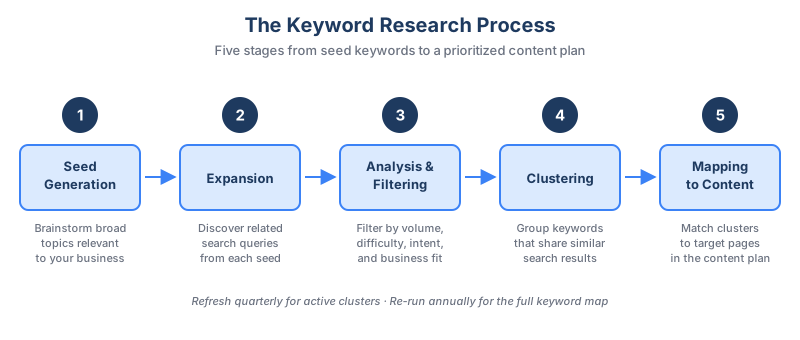
- The process has five repeatable stages: seed keyword generation, expansion, analysis and filtering, clustering, and mapping to content. Each stage answers a specific question.
- Tools matter less than the workflow. You can do solid keyword research with free tools. Paid tools save time and surface more opportunities, but neither is a substitute for thinking carefully about your audience and your business model.
What Keyword Research Is (and Why It Still Matters)
Keyword research is the systematic process of identifying the search queries your target audience uses, evaluating the opportunity behind each one, and selecting which to target with content. It's the bridge between what you want to write about and what your audience actually needs.
The discipline matters for four reasons that haven't changed in twenty years of SEO and won't change in the next twenty:
It tells you whether demand exists. You can write the most beautifully argued post on a topic, but if nobody searches for it, organic traffic will never arrive. The Ahrefs research team has studied over a billion pages and found that roughly 90% of pages get no organic traffic from Google. Targeting topics with verified search demand is the simplest way to avoid joining that 90%.
It informs site structure. A keyword map dictates which pages you need, how they relate to each other, and where to place internal links. Done well, it produces topical depth that both search engines and AI systems can recognize.
It surfaces competitive intelligence. When you study who currently ranks for your target keywords and what they're covering, you learn the competitive bar quickly. This connects directly to SEO competitive analysis work.
It creates a prioritization framework. Without keyword data, content planning becomes a popularity contest of whatever the loudest internal stakeholder wants this quarter. With it, you have a defensible answer to "why this topic over that one."
A common objection today sounds like this: "AI Overviews are eating my clicks, and people use ChatGPT instead of Google now, so why bother?"
The answer is that the underlying questions people ask haven't disappeared. According to Google, around 15% of daily queries are completely new and have never been searched before, a figure that has held steady through the rise of generative AI and was recently reaffirmed by Google's John Mueller. People are still searching, in larger volumes than ever. They're just doing it across more surfaces. Keyword research is how you map that demand.
The Core Metrics That Matter
Every keyword tool will throw a half-dozen metrics at you. Most decisions come down to four.
Search volume is the estimated number of times a keyword is searched per month, typically averaged over the past 12 months. Treat it as directional, not precise. Most tools build their volume estimates from clickstream data and Google Keyword Planner, both of which involve approximations. A keyword listed as "320 monthly searches" might realistically range from 200 to 500.
Keyword difficulty (KD) estimates how hard it is to rank in the top 10 results. Each tool calculates KD differently. Ahrefs bases it primarily on the number of backlinks to top-ranking pages. Semrush uses a broader signal mix. Treat KD as a relative measure within a single tool, not as an absolute truth. A KD of 25 in Ahrefs is a soft signal that ranking is plausible without an enormous link investment, and worth investigating further. Our deep dive on the topic explains the math and the limitations.
Search intent is what the searcher actually wants. There are four conventional types, covered in detail in our search intent guide:
| Intent | What the user wants | Example |
|---|---|---|
| Informational | Learn something | "what is keyword research" |
| Navigational | Find a specific site or page | "seoforge login" |
| Commercial | Compare or evaluate before buying | "best keyword research tools" |
| Transactional | Take an action or make a purchase | "seoforge pricing" |
If your content format doesn't match the dominant intent on the SERP, you usually won't rank, regardless of how strong the rest of your SEO is. Always check the live SERP before committing to a topic.
Traffic potential is how much traffic the current #1 page actually gets, which is often very different from the search volume of a single keyword. Pages don't rank for one keyword in isolation. The average top-ranking page also ranks in the top 10 for roughly 1,000 related queries. A keyword listed at 500 monthly searches might funnel into a page that pulls in 8,000 visits a month from the full keyword family.
CPC (cost per click) and trend data are useful but secondary. CPC indicates commercial value, since advertisers won't bid on terms that don't convert. Trend lines tell you whether interest in a topic is growing, stable, or declining.
Keyword Types You'll Encounter
Different keyword categories behave differently and deserve different treatment in your strategy.
Head terms vs. long-tail keywords
Plot every search query in a market by volume and you get a curve. The "head" is a small number of broad, high-volume terms. The "tail" stretches out into billions of specific, low-volume queries.
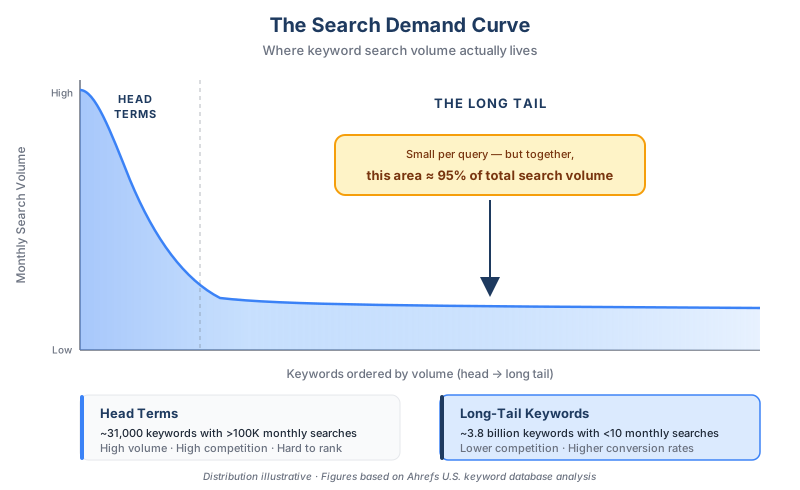
The numbers are striking. Ahrefs has reported that their U.S. database contains roughly 31,000 keywords with more than 100,000 monthly searches, while around 3.8 billion keywords get fewer than 10 searches per month, accounting for nearly 95% of their database. Long-tail terms aren't the leftovers of keyword research. They're where most search demand actually lives.
The strategic implication: most sites should weight their content investment heavily toward long-tail keywords. They convert better, face less competition, and accumulate into substantial traffic at scale.
Branded vs. non-branded
Branded keywords contain your brand name (or a competitor's). Non-branded keywords are everything else. Branded queries usually convert at much higher rates because the searcher already knows who you are. Non-branded queries are how you reach new audiences. Both belong in your tracking.
Commercial vs. informational
This split is essentially about funnel position. Informational queries ("how to clean a cast iron pan") sit at the top of the funnel. Commercial queries ("best cast iron pans") sit lower, where buying decisions happen. A balanced content strategy covers both, with commercial intent keywords producing the bulk of revenue and informational content building authority and capture for the funnel above.
Local keywords
For any business serving a geographic area, local modifiers matter. These often need a separate workflow tailored to local keyword research.
Easy-to-rank opportunities
Within any market there are pockets of low competition keywords that newer or less authoritative sites can realistically win in 3 to 6 months. Identifying these early is one of the highest-leverage moves in keyword research.
The Keyword Research Process: 5 Stages
A complete keyword research workflow moves through five stages. Each one answers a different question. Here's the strategic overview.
Stage 1: Generate seed keywords
Question: What broad topics describe your business, audience, and offer?
Seed keywords are the starting points everything else expands from. They aren't meant to be high-volume targets themselves. They're directional. A skincare brand might start with "skincare," "moisturizer," "acne," "anti-aging," and a few competitor brand names. A B2B accounting tool might start with "accounting software," "bookkeeping," "expense tracking," and the names of dominant competitors.
Good sources for seed keywords:
- A whiteboard session listing your products, services, and the problems your customers describe
- Sales call transcripts and support tickets, which contain the exact language your audience uses
- Subreddits, Quora threads, and industry forums where your audience hangs out
- The navigation and category pages of two or three direct competitors
Aim for 10 to 30 seed keywords. Don't overthink this stage. Volume comes from expansion.
Stage 2: Expand and discover
Question: For every seed, what related queries do real people search?
This is the stage where a keyword research tool earns its cost. A seed like "moisturizer" expanded through Ahrefs Keywords Explorer or a similar tool produces thousands of related queries: "moisturizer for oily skin," "best moisturizer for combination skin men," "ceramide moisturizer vs hyaluronic acid," and so on.
Free expansion sources work too, just with more manual effort:
- Google Keyword Planner (free with a Google Ads account) generates ideas from seed inputs and shows volume ranges. It's biased toward terms with paid demand.
- Google Search Console shows the queries your site already gets impressions for, including ones you didn't know you were ranking for.
- Google Autocomplete and "People Also Ask" surface related queries directly from the SERP.
- Google Trends shows relative interest over time and across regions, useful for spotting seasonal or rising topics.
- AnswerThePublic scrapes Autocomplete to surface question-format queries.
- Reddit and Quora reveal the exact phrasing of questions people ask within a niche.
Stage 3: Analyze and filter
Question: Which of these expanded keywords are actually worth pursuing?
You'll typically end up with thousands of candidates after expansion. Most aren't worth the time to write about. Filtering separates signal from noise.
Standard filters include:
- Minimum search volume. For most B2B sites, 50 monthly searches is a reasonable floor. For B2C, 100 is more typical.
- Maximum keyword difficulty. New sites should generally cap at KD 20-30. Established sites can target higher.
- Intent match. Cut keywords whose SERP intent doesn't align with what you can credibly create.
- Business relevance. A keyword with great metrics but no plausible connection to your offer is a vanity target. Skip it.
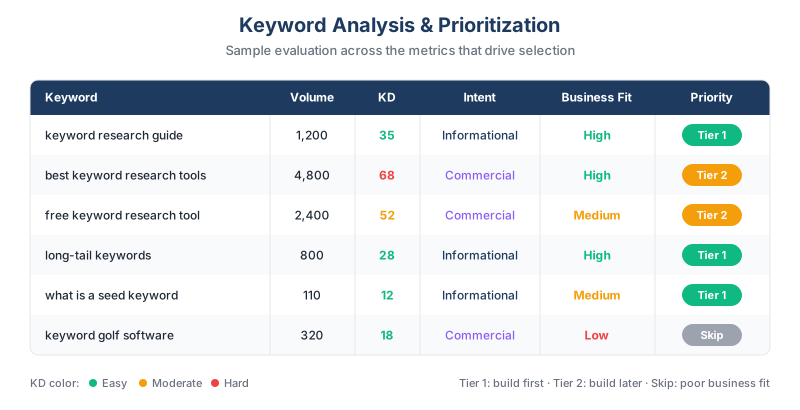
This is also the stage to study the SERP for each candidate keyword. What format is ranking? How long are the top results? What features are present (featured snippet, video carousel, AI Overview, local pack)? The answers tell you whether you can compete and what you'd need to build.
Stage 4: Cluster related keywords
Question: Which of these keywords should be targeted by the same page?
This is the stage most beginners skip, and it's where significant traffic gains come from. Many keywords are variations of the same underlying topic. "How to do keyword research," "keyword research process," "keyword research steps," and "how to find keywords" can almost certainly be served by one comprehensive guide rather than four thin ones.
Keyword clustering groups these variations together. The standard methodology is SERP-based: if the top 10 results for two keywords overlap substantially (typically 30% or more), Google sees them as the same topic. They belong on one page.
Manual clustering for a few hundred keywords is feasible in a spreadsheet. For larger sets, an AI-assisted tool makes the process tractable. Our keyword clustering tool handles this process automatically and creates topic clusters based on the most relevant keywords specifically for your business.
The Ahrefs research team has noted that pages frequently rank for the original target keyword and dozens of clustered variants together. Their Parent Topic metric reflects this reality: target the broadest term whose SERP matches your content, and you usually pick up the long tail automatically.
Stage 5: Map keywords to content
Question: For each cluster, what page (existing or new) will target it?
Keyword mapping is the connective tissue between research and execution. The output is a spreadsheet (or tool) with rows for each cluster and columns for: primary keyword, supporting keywords, intent, target URL, content type, priority, and status.
Mapping forces three useful decisions:
- Existing content vs. new content. A new keyword cluster often overlaps with a page you already have. Optimizing the existing page is almost always faster than creating a new one.
- Page type and template. Commercial keywords need product or comparison pages. Informational keywords need guides, tutorials, or definitions. Match the format to the intent.
- Internal linking structure. A clear keyword map exposes hub-and-spoke relationships. The pillar covers the broad topic; supporting articles cover the subtopics; everything links back to the pillar.
The output of stage 5 should be a content plan you can hand to a writer, an editor, or yourself in three months when you've forgotten why you flagged the topic.
Tools Overview
You don't need a $200/month subscription to do effective keyword research. You do need to know which tools fit which jobs.
Free tools
These cover the basics for a small site or a starting team:
- Google Search Console is non-negotiable. It shows the queries your site already shows up for and where the lowest-hanging fruit is.
- Google Keyword Planner offers volume estimates (in ranges, unless you're spending on ads) and idea generation.
- Google Trends is the only tool with a true timeseries view of search interest.
- Google Autocomplete and People Also Ask are free, fast, and reveal real query phrasing.
- AnswerThePublic (free with daily limits) is useful for question-format keywords.
Paid tools
Paid tools save time and surface keywords free options miss. The major players today are Ahrefs, Semrush, Moz, Mangools, and a growing category of AI-first platforms. They differ on data freshness, database size, KD methodology, and UX, but the core capabilities are similar.
AI-assisted keyword research
A newer category of tools uses LLMs to handle the expansion, clustering, and mapping stages automatically. Instead of manually filtering thousands of candidates, you input seed keywords or a competitor URL and get a clustered, prioritized content plan in minutes. These tools don't replace strategic thinking, but they collapse the time cost of stages 2 through 5 substantially.
At SEOForge, we go beyond keyword research: we map the entire user journey based on your ICP and business goals, then suggest internal linking for each cluster and article so everything aligns with your conversion funnel. We offer a free trial if you want to see what we can do for you.
Google's own tools
It's worth restating: Google publishes its own tools for understanding search demand. The official Google Keyword Planner inside Google Ads is free, and Search Console gives every site owner direct visibility into how Google sees their content. Both are first-party data, which makes them more reliable than third-party estimates for your own site's performance.
From Research to Action
A keyword list is a research artifact. It only matters if it shapes what you ship.
Connecting to content planning
Each cluster in your keyword map should produce one piece of content. The primary keyword goes in the title and H1. Supporting keywords appear naturally in H2s and body copy. The intent dictates the format. The keyword map becomes the input to your editorial calendar.
Site structure implications
Keyword research surfaces topical clusters, which in turn suggest your site's category structure. If a market has five distinct subtopics with significant search demand, you probably want five hub pages and a constellation of supporting articles around each. This is the same logic behind topic clusters and pillar content.
Competitive context
Layering competitor data over your keyword research adds a critical lens. If three direct competitors all rank in the top 5 for a cluster you'd planned to target, the bar is high. If none of them rank, you might be looking at either an opportunity or a reason nobody's bothered. The competitor keyword analysis and keyword gap analysis workflows extend the research into competitive territory.
Ongoing process
Keyword research is not a one-time project. New queries appear constantly (recall the 15% of daily queries Google has never seen before), product lines evolve, and competitor positions shift. Most teams should refresh their keyword research quarterly for active clusters and annually for the overall map. Search Console queries should be reviewed monthly for emerging opportunities.
This connects to broader SEO strategy work. Keyword research without strategic prioritization produces 200-row spreadsheets that nobody acts on. Strategy without keyword research produces content that nobody finds.
Common Keyword Research Mistakes
A few patterns repeatedly trip up otherwise competent SEO programs:
Chasing volume over intent. A 50,000-volume keyword that converts at 0.1% is worse than a 500-volume keyword that converts at 5%. Treat volume as one signal among several.
Ignoring the SERP. Tool metrics describe the keyword. The SERP describes what Google has decided about the keyword. If your planned content type isn't ranking, you're either misreading intent or about to fight gravity.
Treating each keyword as a separate page. Single pages routinely rank for hundreds of related queries. Cluster first, then write.
Skipping branded and competitor terms. Tracking your own brand and your competitors' brand searches gives you early warning of shifts in market awareness.
Anchoring on tool data without sanity-checking. Tool volumes are estimates. If a keyword feels like it should be searched but shows zero, search it yourself, look at the SERP, and trust your judgment when the data conflicts with reality.
What Comes Next
Once you have a working keyword map, the next moves are content production and measurement:
- Build content ensuring each piece matches its target intent.
- Track rankings for your priority keywords so you can detect movement early.
- Measure outcomes by tying keyword performance back to organic traffic, conversions, and revenue.
- Refresh regularly. Re-run the workflow for new content clusters, and audit existing maps for relevance every 3 to 6 months.
Keyword research is upstream of almost everything else in SEO. Done well, it stops being a quarterly chore and becomes the engine that drives content decisions, prioritization, and measurement. The tools will keep evolving. The discipline of asking what your audience searches for, and matching content to that demand, doesn't go out of date.
Frequently Asked Questions
Is keyword research still relevant in the age of AI search?
Yes, and arguably more so. AI Overviews, ChatGPT, and Perplexity all answer questions, but those questions still need to be discovered, mapped to content, and optimized for. The data confirming that 15% of daily queries are still completely new shows that search demand keeps expanding rather than collapsing. The skill isn't obsolete, but the surfaces you optimize for have broadened.
How long does keyword research take?
For a single content cluster, an experienced researcher can move from seed to mapped plan in 2 to 4 hours. For an entire site or a new niche, plan for 1 to 2 weeks of focused work. AI-assisted tools can compress this significantly, especially the expansion and clustering stages. The strategy and prioritization steps still benefit from human judgment.
What's the difference between a keyword and a topic?
A keyword is a specific search query. A topic is the underlying theme that may be served by many related keywords. Modern SEO operates at the topic level: you target a primary keyword as the anchor, but optimize the page to satisfy the broader topic so it ranks for the full keyword cluster. This is why keyword clustering is now central to the workflow.
How many keywords should one page target?
One primary keyword per page, plus all the related variants in its cluster. Research shows the average top-ranking page also ranks for around 1,000 other relevant queries. You don't pick those by stuffing a list of keywords. You pick them by writing comprehensive content that genuinely covers the topic, then letting Google match the related queries automatically.
Do I need a paid tool to do keyword research properly?
Not initially. Google Search Console, Keyword Planner, Trends, Autocomplete, AnswerThePublic, and a careful read of competitor sites can carry a small site through its first 50 to 100 pieces of content. Paid tools (or AI-assisted platforms) become worth the cost when you're managing many clusters, working with multiple sites, or need data freshness and depth that free tools can't match.