For over two decades, search engine optimization meant one thing: getting your pages to rank in Google's list of ten blue links. That era is not over, but a parallel one has arrived alongside it.
AI-powered search tools, including ChatGPT, Google AI Overviews, Perplexity, Claude, and Microsoft Copilot, are changing how people discover information, evaluate options, and make decisions. Instead of scanning a list of links, users now ask conversational questions and receive synthesized answers that cite (or don't cite) specific brands and sources.
AI search optimization is the practice of structuring your online presence so that large language models and AI-powered search features consistently mention, cite, and accurately represent your brand in their responses. It encompasses what the industry calls Generative Engine Optimization (GEO), Answer Engine Optimization (AEO), and AI visibility management.
This is an emerging discipline. There is no guaranteed playbook, and measurement is still imprecise. But the shift is real, the usage numbers are growing fast, and brands that start adapting now will have a meaningful advantage over those that wait. This guide covers what AI search optimization is, how it differs from traditional SEO, what factors influence AI recommendations, and the core tactics you can act on today.
Key Takeaways
- AI search optimization is a distinct discipline: It focuses on earning citations and mentions in AI-generated answers, not just ranking in traditional search results.
- AI search platforms are growing rapidly: As of early 2026, Google AI Overviews reach roughly 2 billion monthly users, ChatGPT has over 800 million weekly active users, and Perplexity processes hundreds of millions of queries per month.
- Traditional SEO still matters, but it is no longer enough: Strong SEO often helps AI visibility, but the two require different strategic thinking. Neither replaces the other.
- Key AI ranking factors differ from traditional search: Entity clarity, content comprehensiveness, authoritative sourcing, and brand presence matter more than keyword density or backlink volume alone.
- Measurement is evolving: There is no "Google Search Console for AI," but structured monitoring approaches exist and are improving.
- Start with fundamentals: Brands that produce authoritative, well-structured, clearly sourced content are best positioned for both traditional and AI search.
What Is AI Search Optimization?
AI search optimization is the process of making your content, brand, and online presence visible and citable across AI-powered search experiences. In practice, this means optimizing so that when someone asks ChatGPT, Perplexity, or Google AI Mode a question relevant to your business, your brand appears in the response, ideally with a citation back to your content.
The discipline sits at the intersection of three overlapping concepts:
Generative Engine Optimization (GEO) focuses on earning citations within AI-synthesized answers. When a large language model assembles a response from multiple sources, GEO aims to make your content one of those sources. Early academic research on GEO frameworks, widely cited in industry publications, suggests that optimized content can achieve up to 40% higher visibility in generative engine responses. You can explore this topic further in our complete guide to GEO.
Answer Engine Optimization (AEO) targets direct-answer formats, including featured snippets, Google AI Overviews, and zero-click results. AEO prioritizes structuring content so AI systems can extract clear, concise answers from your pages. We compare the two approaches in detail in AEO vs SEO.
AI visibility management is the broader practice of monitoring how your brand appears across all AI-powered discovery channels, tracking mention frequency, sentiment, and competitive positioning over time.
These three areas overlap significantly, and in practice most teams treat them as facets of a single strategy.
The Scale of the Shift
To understand why AI search optimization matters, consider the adoption numbers as of early 2026:
Google AI Overviews now reach approximately 2 billion monthly users across more than 200 countries and 40 languages, according to Google. Roughly half of all search queries in the United States trigger an AI Overview response. Google's separate AI Mode feature, a fully conversational search interface, passed 100 million users in its first months of availability.
ChatGPT has over 800 million weekly active users and processes more than 2 billion queries per day, according to OpenAI. It now accounts for the vast majority of AI-driven referral traffic to websites.
Perplexity processed approximately 780 million queries in May 2025, according to CEO Aravind Srinivas, with 20% month-over-month growth continuing into 2026. It functions as a real-time AI search engine that cites specific sources, making it particularly relevant for content-driven brands.
Microsoft Copilot, Claude, and other AI assistants add millions more users who bypass traditional search entirely for certain types of queries.
The key insight here is not that Google is being replaced. Google still processes roughly 14 billion search queries per day, dwarfing any single AI platform. But a growing share of information discovery now happens in environments where the answer is generated rather than linked to.
How AI Search Differs from Traditional Search
Understanding the differences between AI search and traditional search is essential for developing an effective strategy. Here is how the two compare across key dimensions:
| Dimension | Traditional Search | AI Search |
|---|---|---|
| User behavior | Short keyword queries | Conversational, multi-turn prompts |
| Results format | Ranked list of links | Synthesized answer with optional citations |
| Discovery goal | Find a page to visit | Get an answer directly |
| Primary ranking signals | Keywords, backlinks, technical SEO | Entity clarity, comprehensiveness, authority, citations |
| Measurement | Rankings, clicks, impressions | Mention frequency, citation tracking, sentiment |
| Maturity | Well-established (25+ years) | Emerging (2-3 years) |
User Behavior Is Fundamentally Different
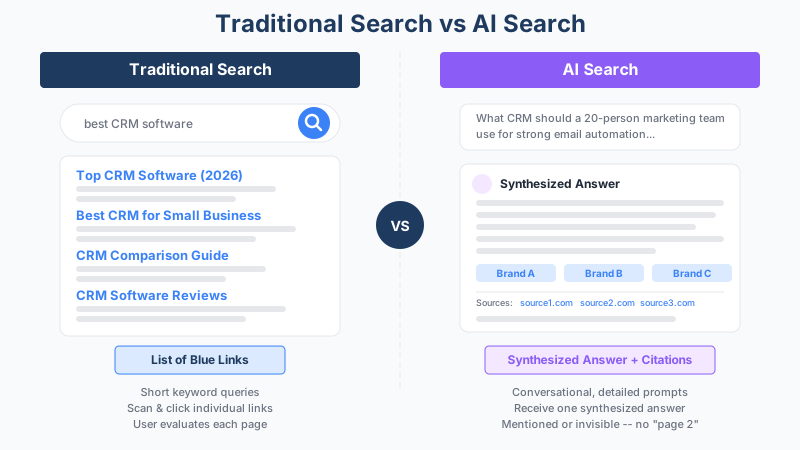
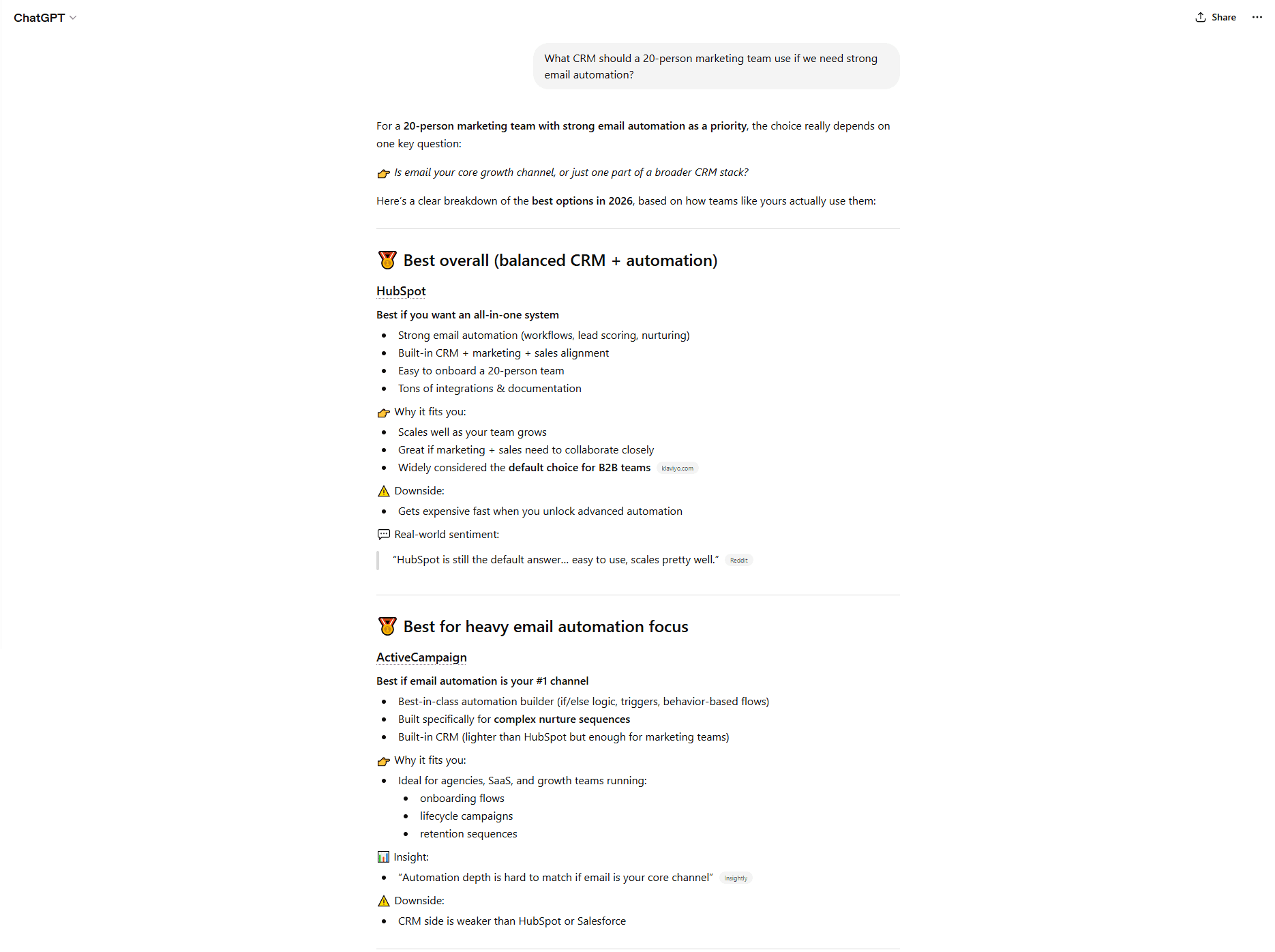
In traditional search, people type short queries like "best CRM software" and scan a results page. In AI search, they ask conversational questions: "What CRM should a 20-person marketing team use if we need strong email automation and a HubSpot integration?" The specificity and context of these prompts mean that AI responses tend to be more personalized and situational than a static ranking list.
Results Are Synthesized, Not Ranked
When Google returns ten blue links, each result is a discrete page the user can evaluate. When ChatGPT or Perplexity answers a question, the response synthesizes information from multiple sources into a single narrative. Your brand is either part of that narrative or it is invisible. There is no "page two" of results to scroll to.
This changes the competitive dynamic fundamentally. In traditional search, ranking fifth still gives you some visibility. In an AI-generated answer, a model might cite three sources and ignore everything else. The difference between "mentioned" and "not mentioned" is binary.
Each AI Platform Works Differently
Not all AI search platforms retrieve and cite information the same way. ChatGPT and Claude primarily draw from their training data, meaning they synthesize patterns learned during training about which brands appear in authoritative contexts. Perplexity performs real-time web searches and cites specific URLs, making it function more like a next-generation search engine. Google AI Overviews pull from Google's own index, favoring sources that already rank well in organic search.
The practical implication is that your AI search optimization strategy cannot be one-size-fits-all. You need authority signals for training-data-based models, current indexed content for real-time retrieval systems, and strong organic rankings for Google's AI features. The brands succeeding in AI search are those building presence across all three vectors.
The Citation Model Changes Everything
In AI search, being cited is the new equivalent of ranking on page one. Research from Ahrefs found that 76.1% of URLs cited in AI Overviews also ranked in Google's top 10 organic positions as of mid-2025, though more recent data suggests this overlap has decreased as Google's AI systems evolve. The finding still reinforces that traditional authority matters, but the trend is shifting. Ahrefs also found that ChatGPT primarily cites lower-ranking pages, meaning traditional rankings alone do not determine AI visibility.
The overlap between Google AI Overviews citations and AI Mode citations is low, with only about 13.7% of cited sources appearing in both, according to Ahrefs. This suggests that different AI features may weigh different factors, making a diversified content strategy important.
Key Factors That Influence AI Recommendations
AI systems do not use the same ranking algorithms as traditional search engines. While the exact mechanisms vary by platform, consistent patterns have emerged from industry research and observation. Here is what appears to influence whether an AI system cites, mentions, or recommends your brand.
Entity Clarity and Structured Data
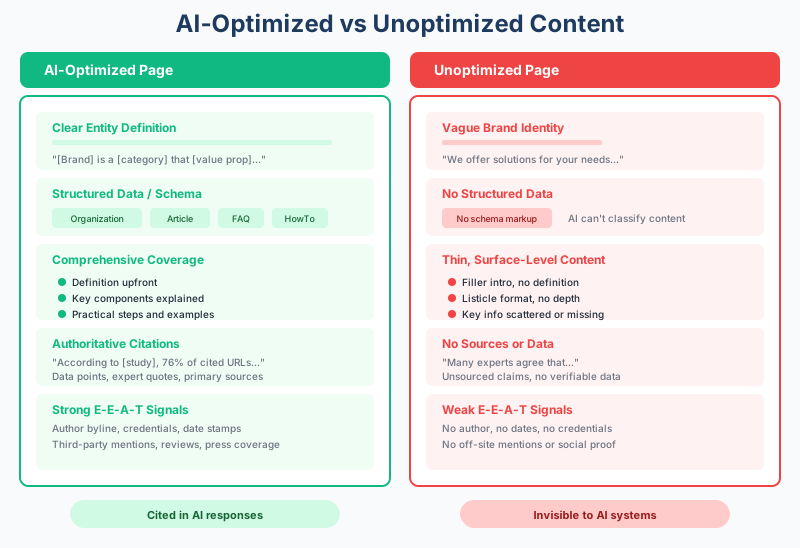
AI models rely on clear entity recognition to understand what your brand is, what it does, and how it relates to other entities in your space. When your site uses structured data markup (such as Organization, Article, FAQ, and HowTo schema), AI systems can extract and classify your content more accurately.
In practice, this means your homepage, about page, and key product pages should clearly define your brand using consistent terminology. Tools like a schema markup checker can help verify your implementation.
Content Comprehensiveness and Depth
AI models favor content that covers a topic thoroughly. Shallow listicles and thin pages are less likely to be cited than comprehensive guides that address multiple facets of a topic. This aligns with what works in traditional SEO, but the bar for comprehensiveness may be higher in AI contexts, since models draw from multiple sources and prefer the most complete coverage.
Industry analysis suggests that AI models disproportionately cite content from the opening sections of articles, reinforcing the importance of leading with substance rather than filler introductions. Front-loading your most important information, definitions, and data is critical for AI citation.
Here is what this looks like in practice: if you are writing about a topic, your content should cover the definition, the key components, the practical applications, common mistakes, and related concepts in a single, well-organized page. Think in terms of being the single best resource someone could read on a subject, the kind of content described in our guide to SEO content writing.
Authoritative Sourcing and Citations
Content that cites credible sources and includes verifiable data tends to earn more AI citations. This makes sense intuitively: AI models are trained to recognize patterns of authoritativeness, and content that references primary sources signals higher reliability.
This connects directly to E-E-A-T principles. Experience, expertise, authoritativeness, and trustworthiness are not just Google ranking factors. They are signals that AI systems of all kinds use to evaluate which sources deserve citation.
Brand Recognition and Online Presence
AI models build associations between brands and topics based on how frequently and in what context a brand appears across the web. Brands that are consistently mentioned in authoritative publications, industry forums, customer reviews, and expert roundups are more likely to surface in AI responses.
This is why AI search optimization cannot be treated as a purely on-page exercise. Your off-site presence, including press coverage, third-party reviews, industry mentions, and social proof, all feed into how AI systems perceive your brand.
Freshness for Time-Sensitive Topics
For topics where recency matters (product comparisons, pricing, industry trends), AI systems that perform real-time retrieval, such as Perplexity and Google AI Overviews, prioritize recently updated content. Keeping your key pages current with date-stamped updates signals to both traditional and AI search that your information is reliable.
Google Search Central's official guidance on AI features states that there are "no additional requirements to appear in AI Overviews or AI Mode, nor other special optimizations necessary." The same fundamentals that drive traditional search success, including being indexed, having useful content, and following Google's Search Essentials, apply to AI features. But in practice, the brands excelling in AI visibility are those that go beyond minimum requirements.
Core Tactics for AI Search Optimization
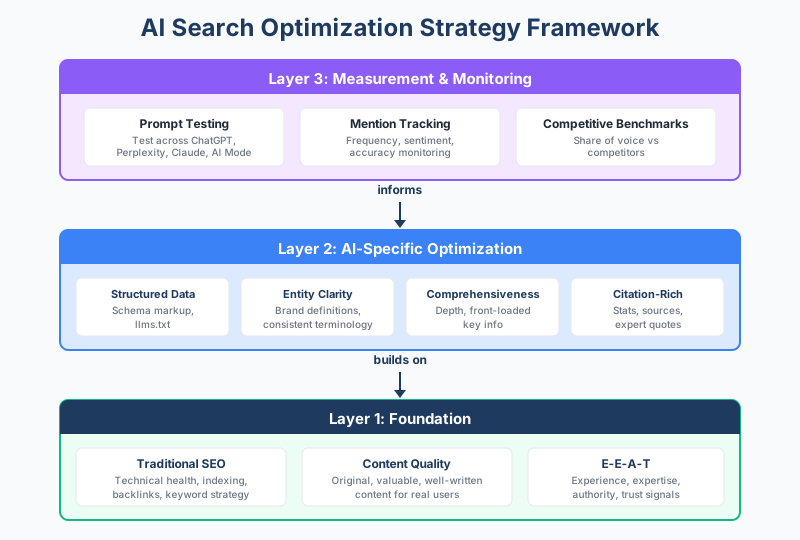
AI search optimization is not a single technique. It is a combination of content strategy, technical implementation, brand building, and measurement. Here is an overview of the core tactical areas, with links to deeper guides on each.
Understand and Apply AEO Fundamentals
Answer Engine Optimization starts with structuring your content so AI systems can easily extract answers. This means using clear headings, providing direct definitions early in your content, formatting information in extractable patterns (tables, step-by-step lists, Q&A structures), and ensuring your content directly addresses the questions your audience asks.
A practical starting point is auditing your most important pages for "extractability." Can an AI system pull a clear, standalone answer from your content without needing surrounding context? If your definitions are buried in the fourth paragraph or your key data points are scattered across multiple pages, you are making it harder for AI systems to cite you.
Our AEO vs SEO guide breaks down how these two disciplines complement each other and where they diverge.
Implement GEO Strategies
Generative Engine Optimization focuses on increasing the likelihood that AI models cite your content when generating responses. Key GEO tactics include adding statistics with cited sources, using authoritative quotations, structuring content with clear subtopic headings, and building topical authority through comprehensive content clusters.
Learn more about specific GEO frameworks and techniques in our dedicated GEO guide.
Optimize for Google AI Overviews
Google AI Overviews represent the largest AI search surface by user reach. Optimizing for AI Overviews involves many of the same principles as featured snippet optimization: providing clear, concise answers to specific questions, using structured formatting, and maintaining strong overall domain authority.
According to recent industry research, AI Overview coverage grew by 58% between February 2025 and February 2026. The growth was especially sharp in certain verticals: education queries rose from 18% AI Overview coverage in May 2025 to 83% by December 2025, B2B technology grew from 36% to 82%, and restaurant queries increased from 10% to 78%. This matters most for informational and research-driven content, where users often want a direct explanation, comparison, or recommendation rather than a list of links. For brands publishing educational content, guides, and explainers, AI Overviews make answer visibility a real extension of SEO.
One important nuance: being cited in an AI Overview is different from having an AI Overview appear for your keyword. You can track whether AI Overviews appear for your target keywords using an AI Overview tracker, but monitoring whether your domain is cited within those responses requires separate analysis.
Our Google AI Overviews guide covers optimization strategies specific to this feature.
Consider llms.txt Implementation
The llms.txt file is an emerging standard that lets website owners provide AI systems with structured information about their site, content, and brand. It is similar in concept to robots.txt but designed for large language models rather than search crawlers.
Adoption is still early and impact is not yet proven, but implementing an llms.txt file is low-effort and positions you ahead of most competitors. You can create one using our free llms.txt generator. For a deeper look at the standard, see our llms.txt guide.
Build Systematic Measurement
Perhaps the biggest challenge in AI search optimization is measurement. There is no equivalent of Google Search Console for LLMs. AI responses are dynamic, sometimes personalized, and vary between platforms.
Effective measurement requires defining a set of key prompts relevant to your brand, testing those prompts regularly across multiple AI platforms, and tracking mention frequency, citation quality, and competitive positioning over time. SEOForge's AI Monitoring tool can help automate this process by tracking how your brand appears across ChatGPT, Perplexity, Claude, and other AI responses.
For a complete framework on setting up AI search measurement, see our AI search analytics guide.
Realistic Expectations
It is worth being direct about what AI search optimization can and cannot deliver right now.
This is an emerging field. Best practices are evolving quickly. What works today may change as AI platforms update their models, retrieval methods, and citation behaviors. The tactics outlined above are based on the best available research and observation as of early 2026, but they are not permanent rules.
Measurement is imprecise. Unlike traditional SEO, where you can track exact rankings and click-through rates, AI visibility is harder to quantify. AI responses are non-deterministic, meaning the same prompt can generate different answers at different times. Industry research has shown that AI responses are highly non-deterministic, with less than a 1-in-100 chance that an AI tool will return the exact same brand list when asked the same question repeatedly.
Traditional SEO still matters. The majority of web traffic still comes through traditional search. Google processes roughly 14 billion daily queries compared to ChatGPT's 2 billion. Strong traditional SEO often helps AI visibility because the authority signals that drive Google rankings also influence what AI models consider credible. The best strategy is one that works for both environments.
There is no shortcut to authority. The brands that consistently appear in AI responses are those with genuine expertise, comprehensive content, strong third-party mentions, and real customer reviews. AI search optimization amplifies existing authority. It does not create it from nothing.
Frequently Asked Questions
What is the difference between AI search optimization and traditional SEO?
Traditional SEO focuses on ranking your pages in search engine results pages through keyword optimization, backlinks, and technical performance. AI search optimization focuses on getting your brand cited and mentioned in AI-generated answers from platforms like ChatGPT, Perplexity, and Google AI Overviews. The two overlap significantly, since strong SEO signals often help AI visibility, but they require different strategic approaches and different measurement methods.
Do I still need SEO if I optimize for AI search?
Yes. Traditional search engines still handle the vast majority of web queries. Google alone processes roughly 14 billion searches per day. AI search optimization should be treated as an addition to your SEO strategy, not a replacement. In most cases, the same content quality and authority signals that drive SEO success also improve AI visibility.
How do I know if my brand appears in AI search results?
The most straightforward approach is manual testing: ask relevant questions about your industry and product category across ChatGPT, Perplexity, Google AI Mode, and other platforms, then note whether your brand appears. For systematic monitoring at scale, AI visibility tracking tools can automate this process across multiple platforms and prompts.
Which AI search platform should I prioritize?
Google AI Overviews has the largest reach, with roughly 2 billion monthly users as of early 2026. ChatGPT has the largest dedicated AI user base. Perplexity is particularly important for content-driven brands because it cites specific URLs. The honest answer is that a diversified approach works best, since each platform uses different methods for selecting and citing sources.
How long does it take to see results from AI search optimization?
There is no reliable timeline. AI models update their training data and retrieval methods on different schedules, and visibility can fluctuate based on factors outside your control. However, foundational improvements like better structured data, more comprehensive content, and stronger entity clarity tend to compound over time across both traditional and AI search. Brands that invest consistently are more likely to see steady improvement than those looking for a quick fix.