
Search intent is the reason behind every query typed into a search engine. It answers a simple question: what does this person actually want to find?
Understanding search intent is one of the most important skills in SEO. You can target the right keywords, build great backlinks, and nail your technical setup, but if your content doesn't match what the searcher is looking for, it won't rank. Google has said this directly. Its documentation on how ranking works states that its systems must first establish what a user is looking for before returning relevant results (Google Search Central, "How Search Works"). Google's consumer-facing explanation of search goes further, noting that its systems try to understand the type of information you're looking for, not just the words you entered (Google, "Ranking Results").
In practice, this means content strategy starts with intent, not keywords. The keyword tells you what people are searching for. The intent tells you why, and that distinction shapes everything from the format of your page to the depth of your content.
Key Takeaways
- Search intent is the purpose behind a query: It goes beyond keywords to explain what a user actually wants to accomplish, whether that's learning, navigating, comparing, or buying.
- Google's ranking systems prioritize intent alignment: Content that matches the underlying reason for a search is more likely to rank than content that simply contains the right keywords.
- There are four core intent types: Informational, navigational, commercial investigation, and transactional, each requiring a different content approach.
- SERP analysis is the most reliable way to identify intent: Examining what Google already ranks for a keyword reveals what intent it has assigned to that query.
- Intent mismatch is a common reason pages fail to rank: High bounce rates, low engagement, and poor rankings often trace back to a disconnect between what the page offers and what the searcher needs.
What Search Intent Is
Search intent, also called user intent or keyword intent, is the goal a person has when they type a query into Google or any other search engine. It represents the deeper motivation behind the words themselves.
Consider the difference between someone searching "what is email marketing" and someone searching "best email marketing software." The words are similar, but the intent is completely different. The first person wants to learn. The second person wants to compare options before making a purchase decision.
Google's Search Quality Evaluator Guidelines, the document used to train its team of approximately 16,000 human quality raters, includes an entire framework for evaluating whether search results satisfy user intent. This framework, called the "Needs Met" rating scale, ranges from "Fully Meets" to "Fails to Meet" (Google Search Quality Evaluator Guidelines, September 2025). Google regularly updates these guidelines to refine how raters evaluate intent, including simplifying the Needs Met scale definitions and adding guidance for modern content formats (Google Search Central Blog, "Search Quality Rater Guidelines Update"). Pages that fully satisfy the intent behind a query earn the highest evaluation. Pages that miss the intent entirely, regardless of how well-written they are, receive the lowest scores. Intent alignment works alongside other quality signals like E-E-A-T to determine which pages deserve top rankings.
This isn't theoretical. Google's algorithm has evolved significantly to interpret intent rather than just match keywords. Understanding how search engines work at a fundamental level helps explain why intent alignment is so critical. Updates like Hummingbird (2013), RankBrain (2015), and BERT (2019) each pushed the algorithm further toward understanding the meaning and context behind queries, not just the literal words. These are part of a broader pattern of Google algorithm updates that have steadily shifted ranking systems toward intent interpretation. Google's own ranking systems guide confirms that BERT specifically helps the algorithm understand how word combinations express different meanings and intent (Google Search Central, "Guide to Google Search Ranking Systems").
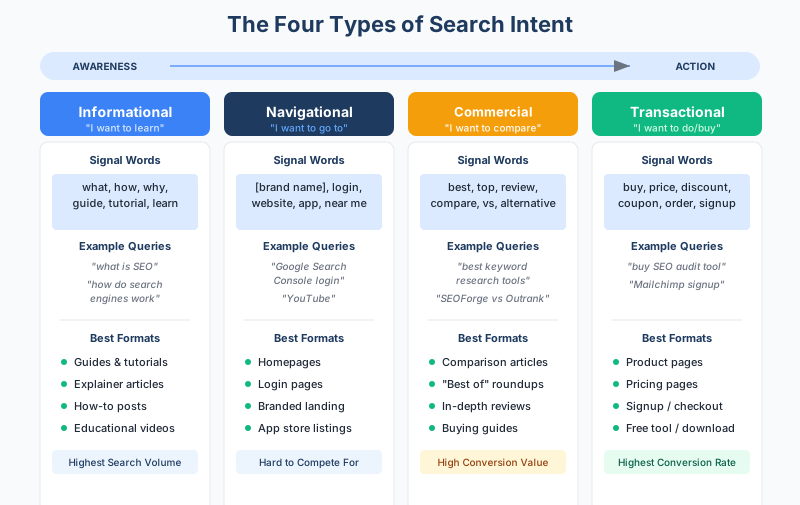
The Four Main Intent Types
Nearly all search queries fall into four broad categories. Understanding these categories helps you create the right type of content for each keyword you target.
Informational Intent
The searcher wants to learn something. These are "what is," "how to," and "why" queries. They represent the largest share of all Google searches.
Examples: "what is SEO," "how do search engines work," "why is my website slow"
Best content formats: Guides, tutorials, explainer articles, how-to posts, educational videos
Informational queries are the top of the funnel. The searcher isn't ready to buy anything. They're gathering knowledge. Your job is to teach clearly and thoroughly.
Navigational Intent
The searcher wants to reach a specific website or page. They already know where they want to go and are using Google as a shortcut.
Examples: "Google Search Console login," "Ahrefs pricing page," "YouTube"
Best content formats: Homepages, login pages, branded landing pages
Navigational queries are difficult to compete for unless you own the brand being searched. If someone searches "Semrush," they want Semrush's website, not a blog post about Semrush.
Commercial Investigation Intent
The searcher is researching options before making a decision. They're past the learning phase but haven't committed to a purchase yet.
Examples: "best keyword research tools," "Ahrefs vs Semrush," "SEO agency reviews"
Best content formats: Comparison articles, "best of" roundups, in-depth reviews, buying guides
This intent represents a critical stage in the buyer journey. The searcher has defined their problem and is evaluating solutions. Understanding commercial intent keywords in depth helps you create content that builds trust and positions your brand as a credible resource.
Transactional Intent
The searcher is ready to take action, usually a purchase, signup, or download.
Examples: "buy SEO audit tool," "Mailchimp signup," "download free SEO checklist"
Best content formats: Product pages, pricing pages, signup forms, checkout pages
Transactional queries have the highest conversion potential but often the most competition. Your page needs to minimize friction and make the desired action as straightforward as possible. Every element of the SERP listing matters here: a meta description that mirrors transactional language ("free trial," "get started," "buy now") can meaningfully improve click-through rates. If you're not sure how yours reads, run it through a meta description generator to test different variations.
How to Identify Search Intent
Knowing the four intent types is useful, but the real skill is accurately identifying which intent a specific keyword carries. Here's how to do it in practice.
Analyze the Keyword Itself
The words in a query often reveal intent directly. Modifier words are strong signals:
| Modifier Words | Likely Intent |
|---|---|
| what, how, why, guide, learn | Informational |
| best, top, review, compare, vs | Commercial investigation |
| buy, price, discount, coupon, order | Transactional |
| [brand name], login, near me | Navigational |
However, many keywords don't contain obvious modifiers. A query like "email marketing" is ambiguous on its own. That's where SERP analysis becomes essential.
Study the Current SERP
The most reliable method for identifying intent is to search the keyword yourself and analyze what Google ranks on page one. A SERP checker tool can help you do this systematically across multiple keywords. Google has already done the hard work of interpreting intent based on billions of user interactions. The results page is its answer.
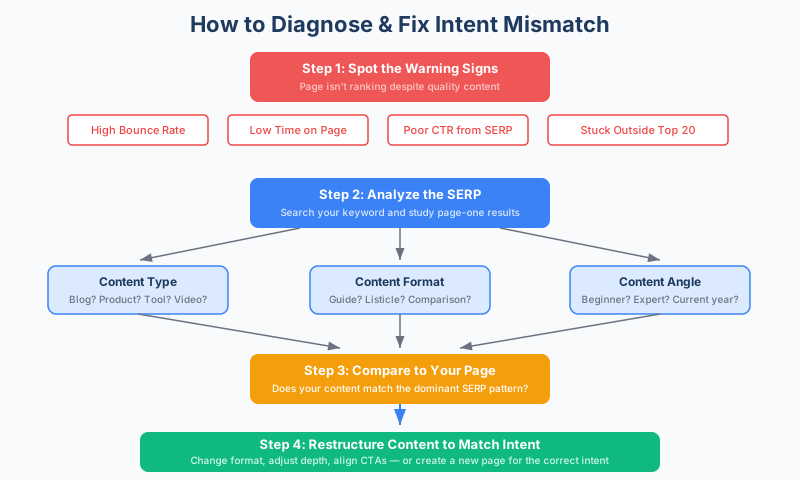
When evaluating the SERP, pay attention to three dimensions of the top-ranking content:
Content type: What kinds of pages are ranking? Blog posts, product pages, category pages, videos, or tools? If the top 10 results are all blog posts, Google has determined the intent is informational. Creating a product page for that keyword would be fighting against the algorithm.
Content format: Are the ranking pages how-to guides, listicles, comparisons, or opinion pieces? The dominant format tells you what structure users expect.
Content angle: Is there a common framing or perspective? For example, results for "keyword research" might all be beginner-focused guides. That angle signals what level of depth the audience expects.
You can use tools like the SERP Simulator to preview how your own content would appear alongside these results, helping you gauge whether your approach aligns with the existing SERP landscape.
Check SERP Features
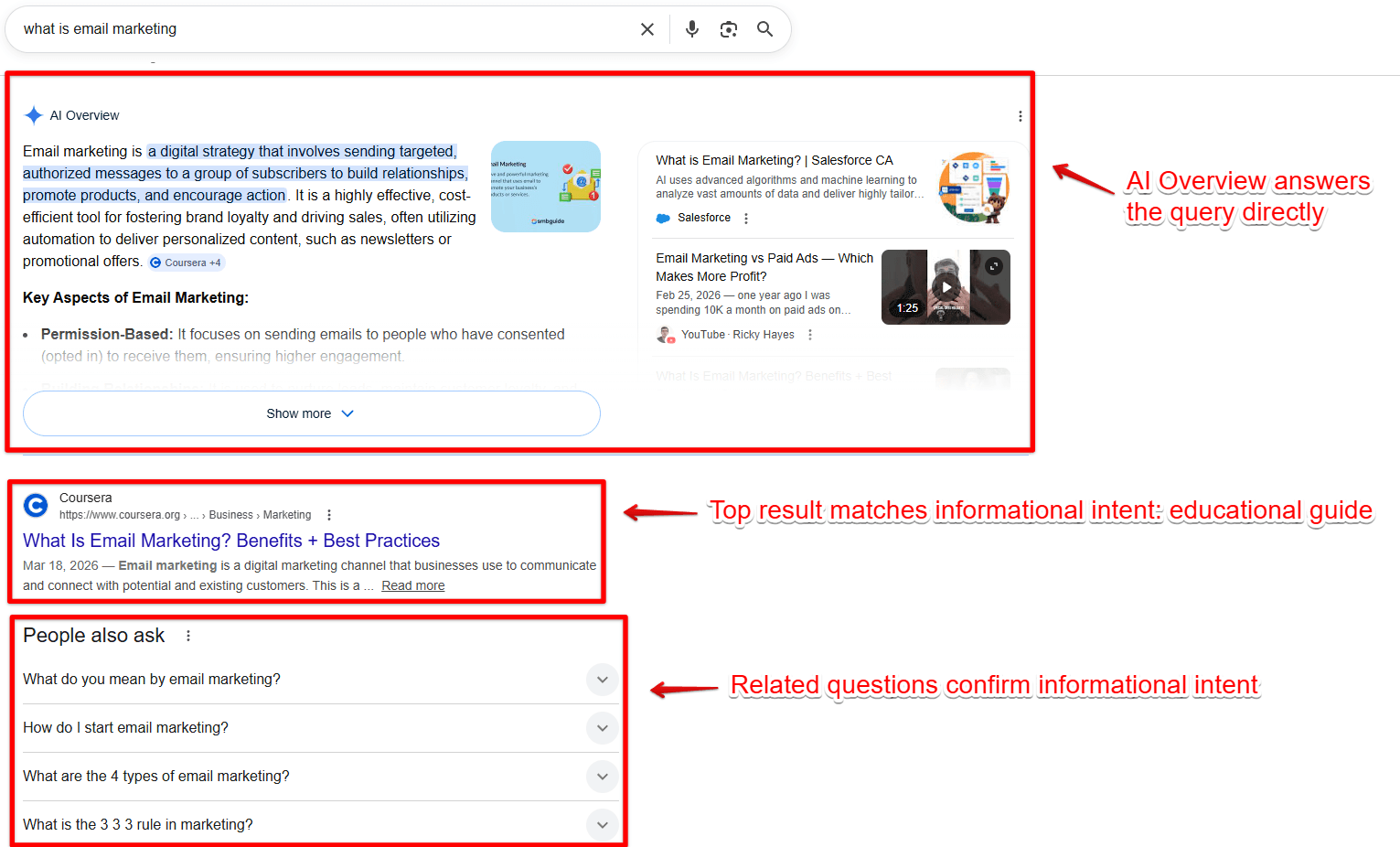
The special features Google displays on a results page also indicate intent. AI Overviews, featured snippets, People Also Ask boxes, knowledge panels, shopping carousels, and local map packs each correspond to different intent types.
For instance, if a keyword triggers a shopping carousel, Google interprets it as having strong transactional or commercial intent. If People Also Ask boxes dominate, the intent is primarily informational. These signals provide another layer of validation for your intent classification.
Understanding how to analyze SERPs effectively ties directly into competitive analysis and SERP research, which involves systematically examining search results to inform content strategy.
Matching Content to Intent
Once you've identified the intent behind a keyword, the next step is creating content that matches it precisely.
Format Selection
Each intent type has content formats that perform best. Trying to rank an informational blog post for a transactional keyword, or a product page for an informational query, creates a mismatch that Google will penalize with lower rankings.
Here's what this looks like in practice. If you're targeting "how to do keyword research," the SERP will show step-by-step guides. Your content should be a detailed tutorial. If you're targeting "best keyword research tools," the SERP will show listicles and comparisons. Your content should follow that format. This principle is foundational to effective SEO content writing: always let the SERP guide your format decisions.
This is why keyword research and intent analysis go hand in hand. Choosing the right keywords without understanding their intent leads to content that fails to rank, no matter how well-optimized it is. Automated keyword tools such us our Keyword Tool can help identify intent classification at scale, making this process more efficient when working across large keyword sets.
Depth and Length
Intent also shapes how detailed your content needs to be. Informational queries about complex topics often require comprehensive, long-form content. Transactional queries need concise, action-oriented pages. A 3,000-word article isn't inherently better than a 500-word product page if the shorter page matches the intent more precisely.
Call-to-Action Alignment
Your CTAs should reflect the searcher's stage in their journey. Informational content should guide readers toward related resources, not push a hard sell. Commercial investigation content can offer comparisons and feature product recommendations. Transactional pages should streamline the conversion path with clear, direct CTAs.
Mixed Intent and Ambiguity
What most guides miss is that search intent isn't always clean. Not every keyword fits neatly into a single intent category. Many queries carry what's known as mixed or blended intent, where users searching the same term may have different goals.
For example, "SEO tools" could be informational (someone learning what SEO tools are), commercial (someone comparing options), or navigational (someone looking for a specific tool). Google handles this by showing a mix of result types on the SERP, with blog posts, product pages, and listicles appearing together.
When you encounter mixed intent, look at the dominant pattern. If seven out of ten results are comparison articles, the primary intent is commercial investigation, even if a few informational results also appear. Align your content with the dominant intent first, and consider whether secondary intent can be addressed within the same page or whether a separate piece of content would serve better.
The key is to avoid trying to serve every possible intent on a single page. Focused content that clearly addresses one primary intent consistently outperforms pages that try to do everything.
Intent Mismatch: Diagnosing the Problem
If a page isn't performing despite solid on-page SEO and quality content, intent mismatch is one of the first things to investigate.
Common signs of a mismatch include high bounce rates, low time on page, poor click-through rates from search results, and ranking stagnation outside the top 20. These signals suggest that users are arriving at your page and quickly realizing it doesn't give them what they need.
The fix involves revisiting the SERP for your target keyword, identifying what intent Google is rewarding, and restructuring your content accordingly. Sometimes this means a complete format change, like converting a blog post into a tool page, or turning a product page into an educational guide. In one well-documented case, Ahrefs saw a dramatic traffic increase on their backlink checker page after realizing the SERP for that query favored free tools over informational landing pages. By adding a free tool to satisfy the actual search intent, they aligned with what users actually wanted rather than what they assumed users wanted.
Search Intent and AI Search
As AI-powered search tools like Google's AI Overviews, ChatGPT, and Perplexity become more prevalent, understanding intent becomes even more important. These systems aim to provide direct answers, which means content that clearly and authoritatively addresses user intent has the best chance of being cited or surfaced. Research from Ahrefs found that AI Overviews now reduce organic click-through rates for top-ranking content by 58%, making it even more critical that your content matches intent precisely when it does earn a click (Ahrefs, "AI Overviews Reduce Clicks by 58%").
The core principle remains the same: understand what the searcher wants and deliver exactly that. Whether the result appears as a traditional blue link, a featured snippet, or an AI-generated overview, intent alignment is the foundation of visibility across all search formats.
Frequently Asked Questions
What is search intent in SEO?
Search intent is the underlying goal or purpose behind a search query. It describes why a person is searching, not just what words they typed. In SEO, understanding search intent helps you create content that matches what users actually need, which improves your chances of ranking well and satisfying visitors.
What are the four types of search intent?
The four main types are informational (wanting to learn something), navigational (wanting to reach a specific website), commercial investigation (researching options before a purchase), and transactional (ready to take action like buying or signing up). Google's Search Quality Evaluator Guidelines categorize these slightly differently as "know," "do," "website," and "visit-in-person."
How do you determine search intent for a keyword?
The most effective method is SERP analysis. Search the keyword in Google and examine what types of pages rank on page one. Look at the content type (blog posts vs. product pages), format (guides vs. listicles), and angle (beginner vs. advanced). The dominant pattern reveals what intent Google has assigned to that keyword.
Why does search intent matter more than keywords?
Keywords tell you what people are searching for, but intent tells you why. Two keywords with similar words can have completely different intents, requiring different content approaches. Google's algorithm prioritizes pages that satisfy the intent behind a query, so even perfect keyword optimization won't help if the content doesn't match what the searcher needs.
Can search intent change over time?
Yes. Search intent can shift as user behavior evolves, new content types emerge, or market conditions change. A query that once had informational intent might develop commercial intent as a product category matures. This is why regularly re-checking the SERP for your target keywords is important for maintaining rankings.
Sources
- Google Search Central - In-depth guide to how Google Search works. https://developers.google.com/search/docs/fundamentals/how-search-works
- Google Search Quality Evaluator Guidelines (September 2025) - Official guidelines for quality raters, including the Needs Met rating scale and intent evaluation. https://guidelines.raterhub.com/searchqualityevaluatorguidelines.pdf
- Google - How Google Search ranking works: understanding meaning, relevance, and quality. https://www.google.com/intl/en_us/search/howsearchworks/how-search-works/ranking-results/
- Google Search Central - A guide to Google Search ranking systems, including BERT and neural matching. https://developers.google.com/search/docs/appearance/ranking-systems-guide
- Google Search Central Blog - Search Quality Rater Guidelines update, simplifying the Needs Met scale and adding modern content format guidance. https://developers.google.com/search/blog/2023/11/search-quality-rater-guidelines-update
- Ahrefs - Update: AI Overviews Reduce Clicks by 58%, with implications for intent-matched content visibility. https://ahrefs.com/blog/ai-overviews-reduce-clicks-update/