
Listen to this article
Stop Treating SEO Like a Checklist
Most SEO efforts fail not because the tactics are wrong, but because there's no strategy behind them. Teams publish content without a clear goal, chase keywords without understanding their audience, and fix technical issues without knowing which ones actually matter.
A good SEO strategy is the opposite of that. It connects every action to a business outcome, prioritizes based on real competitive data, and gives you a roadmap you can execute against week after week. Whether you're building a plan from scratch or rethinking an existing one, the framework matters more than any individual tactic.
In this guide, you'll learn a step-by-step process for building an SEO strategy that's grounded in your business goals, realistic about your resources, and designed to compound results over time.
Key Takeaways
- Start with business goals, not keywords. Every SEO strategy should connect directly to measurable outcomes like revenue, leads, or market share, not just traffic or rankings.
- Audit before you build. Understanding your current technical health, content gaps, and backlink profile prevents you from investing in the wrong areas.
- Competitor analysis reveals the fastest path. Studying what's working for competitors helps you find realistic opportunities instead of guessing.
- Prioritize by impact and effort. Not every SEO task is equal. Use a prioritization framework to focus on high-impact, achievable wins first.
- SEO is a system, not a project. Strategies that treat SEO as an ongoing operating system with milestones and KPIs outperform one-time campaigns.
What Makes a Good SEO Strategy
Before diving into the steps, it's worth understanding what separates effective SEO strategies from plans that stall out after month two.
A strong SEO strategy has four qualities. First, it's aligned with business goals. If your company needs leads for a sales team, your strategy should focus on commercial and transactional keywords, not just informational content. Second, it's realistic about resources. A three-person marketing team can't execute the same plan as a 20-person content operation. Third, it accounts for the competitive landscape. Targeting keywords where entrenched competitors have thousands of backlinks and years of topical authority isn't strategic, it's wishful thinking. Fourth, it's measurable. You should be able to look at your strategy six months in and know whether it's working.
Here's what this looks like in practice: two companies in the same industry can have completely different SEO strategies, and both can be right. A startup with a small budget might focus on long-tail keywords and building topical authority in a narrow niche. An enterprise brand might prioritize technical SEO fixes and content refreshes across thousands of existing pages.
The point is, there's no one-size-fits-all SEO strategy. The framework below helps you build one that fits your specific situation.
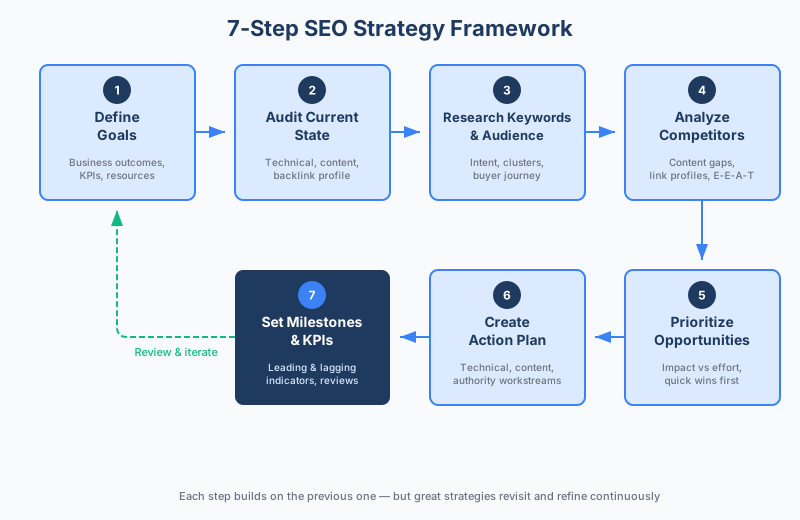
Step 1: Define Your Goals
Every strategy begins with the question: what does success look like?
It sounds obvious, but most SEO plans skip this step or define success too vaguely. "Get more traffic" isn't a goal. "Increase organic-sourced demo requests by 30% over six months" is.
Tie your SEO goals directly to business outcomes. Here are common goal types and what they mean for your strategy:
Revenue and pipeline goals focus your strategy on commercial and transactional keywords. You'll prioritize product pages, comparison content, and bottom-of-funnel terms that attract buyers, not just browsers.
Brand visibility goals shift your focus toward informational content, featured snippets, and AI search presence. Organic search continues to drive significantly more traffic than paid placements for most businesses, making organic visibility one of the most efficient awareness channels available.
Market share goals require competitive analysis to find keyword gaps and content opportunities where you can realistically outrank established players.
Set both short-term and long-term goals. Short-term goals (3-6 months) might include fixing critical technical issues or ranking for low-competition keywords. Long-term goals (12+ months) could involve building topical authority across an entire content cluster or growing organic revenue by a specific percentage. Google's own guidance on creating helpful, people-first content makes it clear that the "why" behind your content matters: if you're creating content primarily to help people rather than to game rankings, you're aligned with what their systems seek to reward.
Assess Your Resources
Before moving to the audit phase, take an honest look at what you have to work with. Your strategy needs to match your capacity, not your ambitions.
Consider your budget (tools, content production, link building), your team (in-house SEO expertise vs. generalists), and your content resources (writers, subject matter experts, design support). A small business with a single marketer wearing many hats needs a fundamentally different strategy than a mid-market company with a dedicated SEO team. If you lack technical SEO expertise in-house, you might prioritize content-first strategies and outsource technical audits. If you have strong developers but weak content, flip the emphasis.
Step 2: Audit Your Current State
You can't plan a route without knowing where you're starting from. A thorough SEO audit covers three areas: technical health, content performance, and backlink profile.
Technical Health
Run a crawl of your site to identify issues that prevent search engines from properly indexing your content. Common problems include slow page speed, broken internal links, missing meta descriptions, crawl errors, and poor mobile experience. Use tools like Google Search Console and a site crawler to surface these issues. You can also run a quick check with a free website grader to get a baseline.
Focus on issues that directly impact indexing and user experience first. A page that Google can't crawl is invisible, no matter how good the content is. Google's own SEO Starter Guide emphasizes that making your site accessible to search engines is the foundation everything else builds on.
Content Performance
Evaluate your existing content. Which pages drive organic traffic? Which ones rank but don't convert? Which topics have you covered, and where are the gaps? This analysis often reveals quick wins: pages that rank on page two and could move to page one with targeted improvements.
Backlink Profile
Review the quantity and quality of your backlink profile. How does your domain authority compare to competitors? Are your backlinks coming from relevant, trustworthy sources? Understanding your link strength helps you set realistic expectations for how quickly you can compete for higher-difficulty keywords.
Step 3: Research Your Audience and Keywords
With your goals defined and baseline established, it's time to understand what your audience is actually searching for and how they phrase their questions.
Effective keyword research goes beyond finding high-volume terms. You need to understand search intent, the reason behind the search. Someone searching "what is SEO" wants education. Someone searching "SEO agency pricing" is closer to a purchase decision. Your strategy should map content to each stage of the buyer journey.
Start by identifying seed topics from your business's core offerings. Then expand using keyword research tools to find related terms, question-based queries, and long-tail variations. AI-powered keyword tools can speed up the discovery and clustering process significantly.
Group your keywords into topic clusters rather than treating each keyword as a standalone target. A topic cluster is a set of related pages organized around a central pillar topic, with supporting articles that cover subtopics in depth. This structure sends strong relevance signals to search engines because it demonstrates comprehensive coverage of a subject.
According to an Ahrefs study analyzing 14 billion pages, 96.55% of content gets no traffic from Google. One reason: pages targeting isolated keywords without supporting content struggle to build the topical authority that search engines reward. Building clusters, and connecting them with strong internal linking, is one of the most effective ways to avoid that trap.
Step 4: Analyze Competitors
Competitor analysis isn't about copying what others do. It's about understanding the competitive landscape so you can make smarter decisions about where to invest. A structured SEO competitive analysis gives you the data to back those decisions.
Start by identifying your real SEO competitors, the sites that rank for your target keywords. These aren't always your business competitors. A B2B software company might compete against industry blogs, media sites, and review platforms in search results.
For each competitor, analyze their content strategy (what topics they cover and how deeply), their backlink profile (where their links come from), and their technical setup (site speed, structure, schema markup). Use tools like Ahrefs, Semrush, or a competitor tracking tool to automate parts of this analysis.
The most actionable output from competitor research is a content gap analysis. This reveals keywords your competitors rank for that you don't. These gaps often represent the fastest path to new organic traffic because the search demand is already proven.
Also look at your competitors' weaknesses. Thin content, outdated information, poor user experience, and missing E-E-A-T signals are all opportunities for you to create something meaningfully better. If a top-ranking page lacks first-hand experience, expert sourcing, or transparent authorship, you can differentiate by demonstrating genuine expertise in your content.
Step 5: Prioritize Opportunities
By this point, you likely have a long list of potential actions: technical fixes, content to create, keywords to target, links to build. The difference between a strategy that produces results and one that fizzles out is how you prioritize.
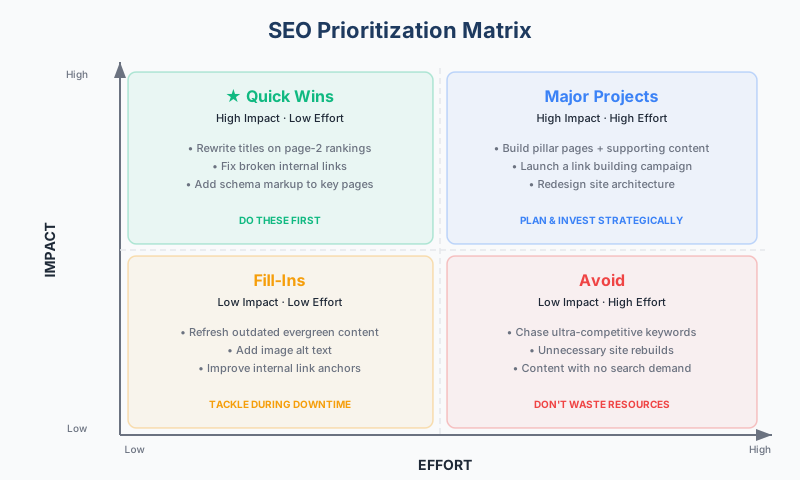
Use an impact vs. effort framework to categorize every opportunity:
Quick wins are high-impact, low-effort tasks. Examples include optimizing title tags and meta descriptions on pages already ranking on page two, fixing broken internal links, and adding schema markup to key pages.
Major projects are high-impact but require significant resources. Creating pillar content for a new topic cluster, building a link acquisition program, or redesigning site architecture fall into this category.
Fill-ins are low-impact, low-effort tasks you can tackle during downtime. Updating publish dates on evergreen content, adding alt text to images, or improving internal linking between related pages.
Avoid items that are low-impact and high-effort. Chasing vanity keywords with astronomical keyword difficulty, rebuilding a site that doesn't need it, or creating content for topics with no search demand.
In practice, the best strategies front-load quick wins to build momentum and demonstrate value while simultaneously investing in major projects that compound over time.
Step 6: Create Your Action Plan
Now translate your priorities into a concrete plan with owners, deadlines, and deliverables.
Structure your plan around three workstreams that run in parallel:
Technical SEO covers site health improvements. Sequence these by severity: start with issues that block crawling and indexing, then address page speed and Core Web Vitals, then optimize for structured data and on-page elements.
Content creation follows your keyword research and content gap analysis. Build a content calendar that balances quick-win optimizations of existing pages with new content production. Each piece should target a specific keyword cluster and link to related content on your site. Use your SERP simulator to preview how titles and descriptions will appear before publishing.
Authority building encompasses link acquisition, digital PR, and brand mentions. This is typically the slowest workstream to produce results, but it's essential for competing on higher-difficulty keywords. Focus your early link-building efforts on the pages that matter most to your business goals, not just whatever content happens to be easiest to promote.
It's also worth noting that authority building in 2026 extends beyond traditional backlinks. As AI search platforms grow in influence, brand mentions across the web, even unlinked ones, contribute to how AI systems perceive your authority and decide whether to cite you in generated responses.
A common mistake is treating these workstreams as sequential. You don't need to "finish" technical SEO before starting content creation. Run them simultaneously, allocating resources based on where the biggest gaps are.
Step 7: Set Milestones and KPIs
A strategy without measurement is just a wish list. Define clear KPIs at both the leading and lagging indicator level.
Leading indicators tell you whether your execution is on track. These include pages published per month, technical issues resolved, backlinks acquired, keywords entering the top 20, and crawl error reduction. You should see movement in leading indicators within the first 1-3 months.
Lagging indicators measure actual business impact. Organic traffic growth, keyword rankings in the top 3, organic conversions, and revenue attributed to organic search. These typically take 3-6 months to reflect your work. For newer sites or competitive niches, expect SEO timelines to stretch to 6-12 months before significant results appear.
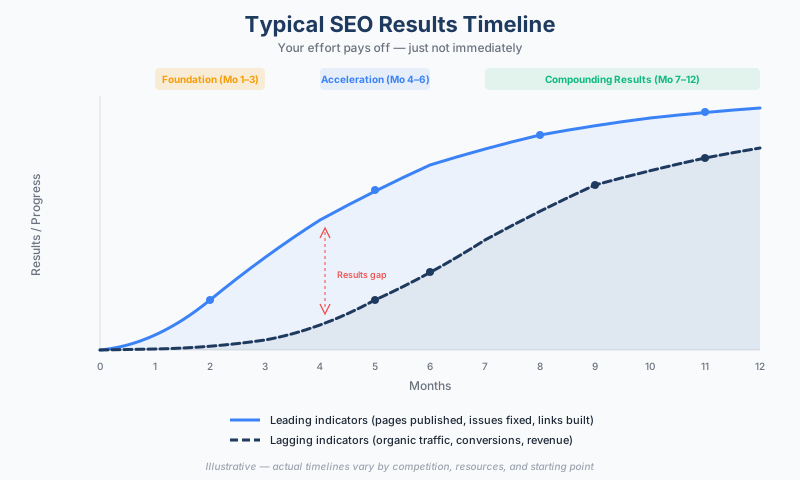
Set monthly check-in points to review progress. At each check-in, ask three questions: Are leading indicators trending in the right direction? Do we need to adjust priorities based on what we've learned? Are there new opportunities or threats we didn't anticipate?
The best strategies evolve. A quarterly review of your full SEO strategy, informed by data from Google Search Console and your analytics platform, lets you double down on what's working and cut what isn't.
When to Adjust Your Strategy
No SEO strategy survives contact with reality unchanged. Here are the most common signals that it's time to revisit your plan:
A major Google algorithm update significantly shifts your rankings. Google released three core updates in 2025 alone (March, June, and December), each taking two to three weeks to fully roll out. Rather than reacting to every small fluctuation, watch for sustained changes over 2-4 weeks before adjusting. Google's ranking systems guide documents the major systems that influence how content is evaluated, which can help you diagnose what changed.
Your competitive landscape shifts. A new competitor enters the market, an existing one launches a content hub targeting your keywords, or a merger changes the playing field.
Your business goals change. If your company pivots from lead generation to e-commerce, your SEO strategy needs to follow.
Your data tells a different story than expected. If six months of content creation hasn't moved the needle on organic traffic, it's time to reassess whether you're targeting the right keywords, creating the right content format, or if technical issues are holding you back.
The most successful SEO teams treat strategy as a living document. They plan thoroughly, execute consistently, measure rigorously, and adapt based on evidence, not gut feelings.
Frequently Asked Questions
How long does it take for an SEO strategy to show results?
Most SEO strategies take 3-6 months to show meaningful movement in organic traffic and rankings, with full results often taking 6-12 months. The timeline depends on your starting point, competition level, and the resources you invest. Technical quick wins can show impact in weeks, while content-driven strategies take longer to compound.
How much should I budget for SEO?
SEO budgets vary dramatically based on business size and goals. Small businesses might allocate $1,000-$5,000 per month for a combination of tools, content, and consulting. Mid-market companies typically spend $5,000-$20,000 monthly. The right budget depends on your competitive landscape and how aggressively you need to grow. Start with what you can sustain consistently rather than spending heavily for three months and then stopping.
Should I do SEO in-house or hire an agency?
Both approaches can work. In-house teams offer deeper business context and faster execution on content. Agencies bring specialized expertise and broader experience across industries. Many companies find a hybrid model works best: an in-house lead who manages strategy and an agency or freelancers who handle execution in areas like technical audits and link building.
Is SEO still worth it with AI search growing?
Yes. While AI search platforms like ChatGPT and Google's AI Overviews are changing how users find information, organic search remains a massive channel. According to Search Engine Land's analysis of Graphite data, U.S. organic search traffic declined only 2.5% year-over-year as of January 2026. An Ahrefs study analyzing 590 million keywords found that AI Overviews appear in roughly 12.8% of Google searches, meaning the vast majority of queries still display traditional results. The smartest strategies now optimize for both traditional search and AI visibility.
How often should I update my SEO strategy?
Do a light review monthly, checking KPIs and adjusting tactical priorities. Conduct a full strategic review quarterly, reassessing goals, competitive positioning, and resource allocation. If a major algorithm update or business change happens, review your strategy immediately rather than waiting for the next scheduled check-in.