
Google's algorithm is not a single formula. It's a collection of ranking systems that work together to answer one question: which page best satisfies the searcher's intent? These systems are constantly being refined, and when Google makes a significant change, that's what the SEO industry calls an algorithm update.
If you're building an SEO strategy for the long term, understanding how these updates work, and how to respond to them, is one of the most important skills you can develop. The good news: the fundamentals of responding well haven't changed much over the years, even as the updates themselves have grown more sophisticated.
In practice, most algorithm updates are small and go unnoticed. Google makes thousands of changes to Search each year. In 2022 alone, the company reported making 4,725 individual changes, roughly 13 per day. But several times a year, Google rolls out broader updates that can cause noticeable shifts in rankings and traffic. These are the ones that tend to make headlines.
This guide explains what those major updates are, how they differ from each other, and what you should actually do when one hits.
Key Takeaways
- Google updates its algorithm thousands of times per year, but only a handful of confirmed updates cause significant ranking changes.
- Core updates are not penalties. They re-evaluate how content quality is assessed across the web, meaning your rankings can change even if you haven't done anything wrong.
- There are distinct update types: core updates, spam updates, and historically separate updates for helpful content and product reviews, each targeting different quality signals.
- The best response to any update is patience and honest self-assessment, not panic-driven changes to your site.
- An update-proof strategy focuses on genuine value: strong E-E-A-T signals, helpful content, and avoiding manipulative tactics.
What Are Google Algorithm Updates?
Google's ranking systems use hundreds of signals to decide which pages appear at the top of search results. An algorithm update is a change to how those signals are weighted, interpreted, or combined.
According to Google Search Central, core updates are "significant, broad changes to our search algorithms and systems" that happen several times a year. They're designed to ensure Google delivers helpful and reliable results. These updates don't target specific sites or pages. Instead, they recalibrate how content quality is evaluated across the web as a whole.
Here's what this looks like in practice: think of it like a restaurant recommendation list. A friend asks for your top 20 restaurants, but your list was written two years ago. New restaurants have opened, some old favorites have declined, and your tastes have evolved. Updating the list isn't a punishment to any restaurant. It's simply a better reflection of what's worth recommending now.
That's essentially what a core update does. Google is re-ranking content to better reflect its current understanding of quality and relevance.
Google's approach to updates has evolved significantly over the years. Earlier updates like Panda (2011, targeting thin content), Penguin (2012, targeting link spam), and the introduction of machine learning systems like RankBrain (2015) and BERT (2019) each addressed specific quality dimensions. Today, these systems have been folded into Google's core ranking infrastructure, and modern updates tend to recalibrate quality assessment holistically rather than targeting a single issue.
Updates vs. Penalties
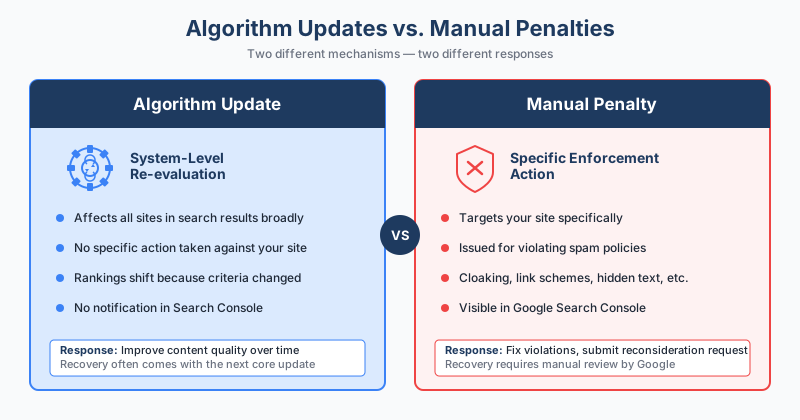
One of the biggest misconceptions in SEO is confusing algorithm updates with penalties. They are fundamentally different:
An algorithm update is a system-level change that reassesses pages using updated criteria. No action is taken against your site specifically. Your page might drop simply because other pages are now considered more relevant.
A manual penalty, on the other hand, occurs when a site clearly violates Google's spam policies, things like cloaking, hidden text, or link manipulation. Manual actions appear directly in Google Search Console and require a reconsideration request to resolve.
Google itself has stated that most ranking drops after updates are reassessments, not penalties. This distinction matters because the response to each is completely different.
Major Types of Algorithm Updates
Not all updates are the same. Understanding which type has rolled out helps you diagnose what changed and why.
Core Updates
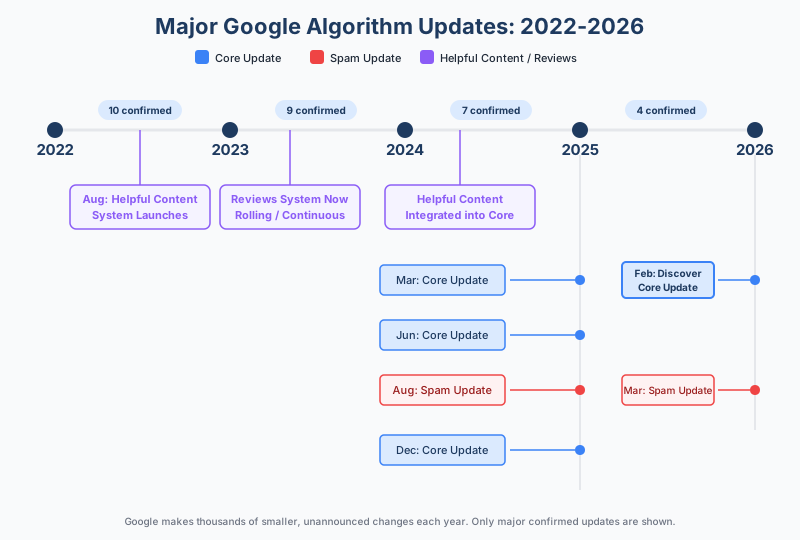
Core updates are the broadest type. They adjust how Google evaluates content quality across all topics, languages, and regions. Google typically releases several per year. As of March 2026, the most recent confirmed algorithm updates include:
- March 2025 Core Update (March 13-27, 2025)
- June 2025 Core Update (June 30 - July 17, 2025)
- December 2025 Core Update (December 11-29, 2025)
- February 2026 Discover Core Update (February 5-27, 2026), which was notable as the first core update Google labeled as Discover-specific
- March 2026 Spam Update (March 24, 2026), which completed in under 20 hours, making it one of the fastest confirmed updates on record
In 2025, Google confirmed only four total updates: three core updates and one spam update (the August 2025 spam update, which ran from August 26 to September 22, 2025). That's fewer than the seven confirmed in 2024, nine in 2023, and ten in both 2022 and 2021. However, Google has clarified that it doesn't announce all core updates, only the larger, broader ones. Dozens of unconfirmed ranking fluctuations were observed throughout the year.
Core updates typically take one to three weeks to fully roll out. Google announces them on the Search Status Dashboard and recommends waiting at least one full week after completion before analyzing your data.
Spam Updates
Spam updates target content that violates Google's spam policies. Unlike core updates, which re-evaluate quality broadly, spam updates specifically go after manipulative tactics. These include keyword stuffing, cloaking, link spam, scaled content abuse, and expired domain abuse.
Google uses SpamBrain, its AI-based spam detection system, to identify and neutralize spammy content. The most recent spam update, the March 2026 spam update, began and completed on March 24, 2026, wrapping up in just under 20 hours.
The key difference is: if a core update drops your rankings, it usually means your content isn't meeting quality expectations. If a spam update drops your rankings, it likely means Google has identified policy violations on your site.
Helpful Content System
Originally launched as a separate update in 2022, the helpful content system is now integrated into Google's core ranking systems. It evaluates whether content was created primarily for people or primarily to attract search engine traffic.
This system operates at the site-wide level, meaning that having a significant amount of unhelpful content on your site can affect the performance of your other pages too. Google's guidance is clear: content should demonstrate first-hand expertise, provide substantial value, and satisfy the reader's intent.
Product Reviews System
Google's product reviews system, which began with specific update announcements in 2021, evaluates the quality and credibility of review content. It rewards reviews that show first-hand experience, original research, and clear pros and cons.
Google announced in 2023 that the reviews system would be improved on a rolling basis, so standalone product review update announcements are no longer made.
How to Monitor for Algorithm Updates
Staying informed about updates helps you distinguish between site-specific issues and broader algorithmic shifts. Here's how the SEO community tracks changes:
Official sources come first. The Google Search Status Dashboard is the single most reliable place to confirm whether an update is rolling out. Google also announces updates through the Search Central Blog and their social media accounts.
Industry news fills in the gaps. Publications like Search Engine Land, Search Engine Roundtable, and Search Engine Journal track both confirmed and unconfirmed ranking volatility. Search Engine Roundtable, in particular, documents unconfirmed updates that Google doesn't officially announce.
Your own data tells the real story. SEO analytics tools like Google Search Console are essential for understanding how updates affect your specific site. Compare performance windows before and after an update completes. Filter by search type (web, images, video, news) to isolate where changes occurred.
Rank tracking tools add context. Tools that measure SERP volatility, like those from Semrush or Ahrefs, can help you see whether fluctuations in your rankings are happening industry-wide or are isolated to your site. Use a rank checker or SERP checker to monitor key positions over time.
The key difference between effective monitoring and anxiety-driven checking is having a structured approach. Check official sources first, then validate against your own data.
How to Respond When an Update Hits
The honest answer is: the first thing you should do is nothing. At least, not immediately.
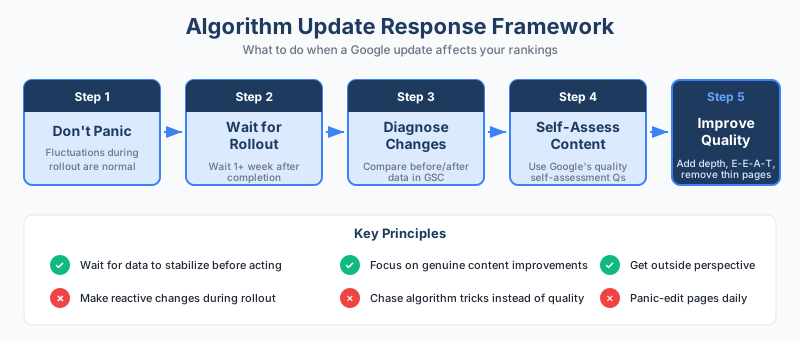
Step 1: Don't Panic
Ranking fluctuations during an update rollout are normal. Positions often shift multiple times before settling. Making reactive changes while an update is still rolling out can make things worse.
Step 2: Wait for the Rollout to Complete
Google recommends waiting until an update finishes, then giving it at least a full week before drawing conclusions. This prevents you from making decisions based on temporary volatility.
Step 3: Diagnose What Changed
Once the update has settled, compare your data:
- Which pages dropped? Which gained?
- Was the drop small (position 2 to 4) or large (position 4 to 29)?
- Which search types were affected?
- Are competitors covering topics you're missing?
A small position drop usually doesn't warrant action. A large, sustained drop across your site signals something worth investigating. Running a quick SEO audit can help identify technical issues that may be compounding content quality problems.
Step 4: Self-Assess Your Content
Google publishes a detailed set of self-assessment questions in their "Creating Helpful, Reliable, People-First Content" documentation. The core questions ask whether your content provides original information, demonstrates expertise, comprehensively covers the topic, and was created primarily for people rather than search engines.
Be honest with your assessment, and consider asking someone unaffiliated with your site to evaluate it as well.
Step 5: Make Improvements Based on Quality, Not Tricks
If you determine that improvements are needed, focus on changes that genuinely make your content more helpful:
- Add depth where content is thin
- Demonstrate experience and expertise through original examples, data, or analysis
- Remove or consolidate low-quality pages that add no unique value
- Ensure your content actually answers what searchers are looking for
What most guides miss: recovery doesn't always require the next major core update. Google has confirmed that it continually makes smaller, unannounced updates, and improvements can take effect through these incremental changes. That said, full recovery from a significant core update drop often does require a subsequent core update to see the biggest gains.
Building an Update-Proof Strategy
The most resilient approach to algorithm updates is building a site that aligns with what Google is fundamentally trying to reward, regardless of the specific mechanics of any individual update.
Focus on genuine user value. Every update Google has released in recent years, from helpful content to core updates to spam updates, points in the same direction: content that genuinely helps people performs well over time. This isn't a platitude. It's the consistent pattern across years of data.
Build real E-E-A-T. Experience, Expertise, Authoritativeness, and Trustworthiness are the signals Google uses as proxies for content quality. Demonstrate them through author credentials, original research, first-hand experience, and transparent sourcing.
Avoid manipulative tactics. Link schemes, scaled low-quality content, keyword stuffing, and cloaking have always been risky, and Google's ability to detect them improves with every update. SpamBrain and other AI-powered systems are increasingly sophisticated at identifying manipulation.
Keep content fresh and accurate. Content that was accurate two years ago may no longer be. Regular audits help you identify pages that need updating, consolidating, or removing. In practice, content freshness is especially important for topics that change frequently, like SEO tactics themselves.
Diversify traffic sources. Relying entirely on Google organic traffic leaves your business vulnerable to any single update. Email lists, direct traffic, social channels, and emerging sources like AI search all contribute to a more resilient traffic profile.
Monitor, but don't obsess. Stay informed through official channels and reliable industry sources, and understanding how search engines work helps you interpret what changes mean. Don't check rankings daily in a panic. A structured monthly or quarterly review is far more productive than reactive daily monitoring.
Frequently Asked Questions
How often does Google update its algorithm?
Google makes thousands of small changes to Search every year. In terms of major confirmed updates, the number varies. In 2025, Google confirmed four significant updates (three core updates and one spam update). However, many smaller changes go unannounced and can still cause noticeable ranking shifts.
What's the difference between a core update and a spam update?
Core updates broadly reassess how content quality is evaluated across the web. They don't target specific sites or violations. Spam updates specifically target content that violates Google's spam policies, such as link manipulation, cloaking, or scaled content abuse. A core update might lower your rankings because better content exists; a spam update lowers your rankings because your site broke the rules.
How long does it take to recover from a Google algorithm update?
Recovery timelines vary widely. Some improvements can take effect within days or weeks through Google's smaller, ongoing updates. However, full recovery from a major core update drop often requires the next broad core update, which typically comes three to four months later. Sites in sensitive categories like health or finance may take six to twelve months of consistent improvement.
Can AI-generated content survive algorithm updates?
Google has stated that it doesn't automatically penalize AI-generated content. What matters is whether the content is helpful, original, and demonstrates expertise. Mass-produced AI content without human oversight or unique value has been negatively affected by recent updates, while AI-assisted content that's reviewed, fact-checked, and enhanced with human expertise can perform well.
Should I make changes to my site during a core update rollout?
Google recommends waiting until the rollout completes and data stabilizes before making changes. Reactive edits during the rollout period can confuse your analysis and may not address the actual issue. Focus on understanding what changed first, then make deliberate, quality-focused improvements.
Sources
- Google Search Central - Google Search's Core Updates. Documentation explaining how core updates work and how to respond. https://developers.google.com/search/docs/appearance/core-updates
- Google Search Central - A Guide to Google Search Ranking Systems. Overview of active ranking systems including spam detection and content quality evaluation. https://developers.google.com/search/docs/appearance/ranking-systems-guide
- Google Search Central - Creating Helpful, Reliable, People-First Content. Self-assessment questions for evaluating content quality. https://developers.google.com/search/docs/fundamentals/creating-helpful-content
- Google Search Status Dashboard - Official source for confirmed algorithm update rollout dates. https://status.search.google.com/products/rGHU1u87FJnkP6W2GwMi/history
- Google Search Central Blog - February 2026 Discover Core Update announcement. https://developers.google.com/search/blog/2026/02/discover-core-update
- Search Engine Land - Google algorithm updates 2025 in review: 3 core updates and 1 spam update. Barry Schwartz's year-end analysis of confirmed updates. https://searchengineland.com/google-algorithm-updates-2025-in-review-3-core-updates-and-1-spam-update-466450
- Search Engine Roundtable - Google 2025 Algorithm Updates Infographics. Timeline and data on confirmed update counts by year. https://www.seroundtable.com/google-2025-algorithm-updates-infographics-40668.html