
E-E-A-T stands for Experience, Expertise, Authoritativeness, and Trustworthiness. It is a framework from Google's Search Quality Rater Guidelines that defines what high-quality content looks like, and it shapes how Google evaluates whether a page deserves to rank.
If you are working on SEO for your website, understanding E-E-A-T is essential. It is not a ranking factor you can toggle on or off. It is a set of quality signals that, when demonstrated consistently, align your content with what Google's systems are designed to reward. Building E-E-A-T takes time, and there are no shortcuts, but the effort compounds into lasting search visibility.
This guide breaks down what each element means, where the framework comes from, why it matters more for certain topics, and how to strengthen E-E-A-T signals across your site.
Key Takeaways
- E-E-A-T is not a direct ranking factor. It is an evaluation framework used by Google's human quality raters to assess whether search results are returning helpful, reliable content.
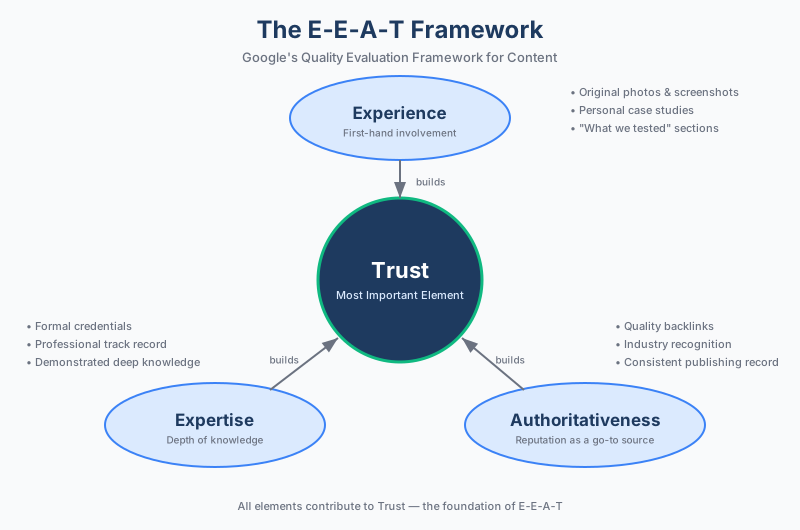
- Trust sits at the center. Google's guidelines state that trustworthiness is the most important element, because without it, experience, expertise, and authority lose their value.
- YMYL topics face the highest standards. Content about health, finance, legal matters, and safety requires stronger E-E-A-T signals because poor information in these areas can cause real harm.
- Experience was added in December 2022. Google expanded E-A-T to E-E-A-T to recognize the value of first-hand, lived experience with a topic.
- Building E-E-A-T is a long-term investment. It requires consistent effort across content quality, author credibility, site reputation, and technical trust signals.
Where E-E-A-T Comes From
E-E-A-T originates from Google's Search Quality Rater Guidelines, a document that runs over 180 pages and provides instructions to more than 10,000 human evaluators, called Search Quality Raters. These raters review search results and score them based on page quality and how well they meet the user's needs.
According to Google Search Central, the guidelines "are what are used by our search raters to help evaluate the performance of our various search ranking systems, and they don't directly influence ranking" (Google Search Central). Google compares rater feedback to feedback cards from restaurant diners: it helps them know if their systems are working, but individual ratings do not move specific pages up or down.
The framework was originally introduced as E-A-T (Expertise, Authoritativeness, Trustworthiness) in 2014. In December 2022, Google updated the guidelines to add the first "E" for Experience. As Google explained in their announcement, this update was designed to better recognize that helpful information can come from people with first-hand experience, not just formal credentials (Google Search Central Blog).
This distinction matters. Someone who has personally navigated a complex tax situation may produce content that is just as valuable as a CPA's guide, depending on the context. Google wanted its evaluation framework to account for that.
What Each Element Means
Experience
Experience refers to whether the content creator has first-hand involvement with the topic. Google's guidelines evaluate the extent to which someone has actually done what they are writing about, whether that is using a product, visiting a location, or working in a particular field.
A product review from someone who tested the item for a month carries more weight than one that simply restates the manufacturer's description. A guide to hiking a specific trail is more credible when the author has walked it themselves.
Signals that demonstrate experience include original photos and screenshots, specific details that only come from direct involvement, personal case studies, and sections that describe what was tested or observed.
Expertise
Expertise is about the depth of knowledge the content creator brings to the topic. This can come from formal education and credentials, professional experience, or a demonstrated track record in the subject area.
For certain topics, particularly YMYL content like medical advice or financial planning, formal expertise carries significant weight. A health article written or reviewed by a licensed physician will be held to a different standard than a hobbyist blog post.
However, Google's guidelines also recognize everyday expertise. Someone who has been baking for 20 years has genuine expertise in baking, even without a culinary degree. The key is that the content demonstrates real knowledge, not surface-level information anyone could compile from a quick search.
Authoritativeness
Authoritativeness refers to the reputation of the content creator and the website as a go-to source for the topic. It is not just about what you say about yourself, but what others say about you.
Authority is built through quality backlinks from respected sources, mentions and citations across the web, industry recognition, and a consistent publishing track record in your subject area. A website that is regularly referenced by other credible sources on a topic demonstrates authoritativeness in ways that self-promotion cannot replicate.
Trustworthiness
Trust is the foundation of E-E-A-T. Google's Search Quality Rater Guidelines are explicit on this point: trust is the most important element because pages that lack it cannot be considered high quality, regardless of how experienced, expert, or authoritative they appear (Search Engine Land).
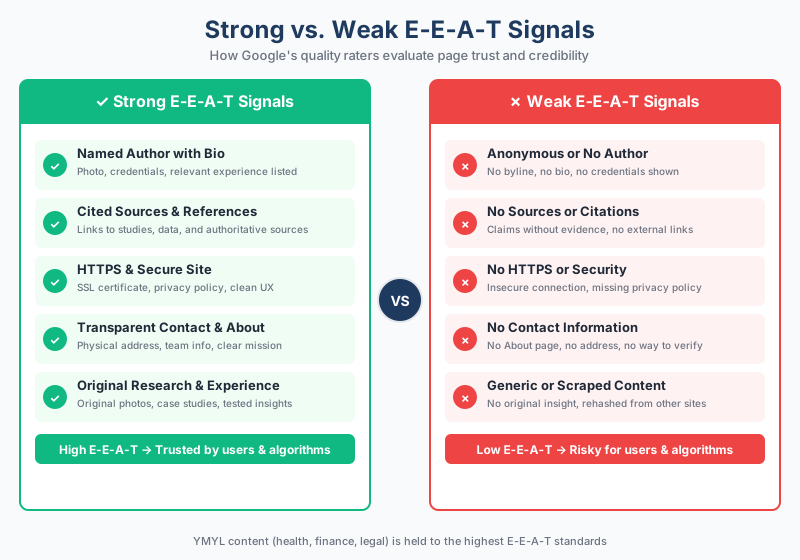
Trustworthiness is evaluated through accuracy of information, transparency about who created the content, clear sourcing and citations, site security (HTTPS), visible contact information, and an honest About page. The level of trust required depends on the page's purpose. An online store needs secure payment systems and reliable customer service. A medical information page needs verifiable authorship and proper sourcing.
YMYL: When E-E-A-T Matters Most
YMYL stands for Your Money or Your Life. It refers to topics where inaccurate or misleading information could negatively affect someone's health, financial stability, safety, or well-being. Google holds YMYL content to significantly higher E-E-A-T standards because the stakes are real.
Examples of YMYL topics include medical and health information, financial advice and planning, legal guidance, news about civic and government processes, and safety-related content. The September 2025 update to the guidelines also expanded YMYL definitions to include content related to elections and public trust institutions (Google Search Quality Rater Guidelines).
If you publish content in industries like healthcare, finance, or law, your E-E-A-T signals need to be especially strong. This means displaying author credentials prominently, citing authoritative medical or financial sources, having expert review processes in place, and maintaining strict accuracy standards.
That said, E-E-A-T is not exclusive to YMYL topics. Every type of content benefits from demonstrating quality signals. A recipe blog builds trust through tested recipes and original photography. A tech review site builds authority through consistent, honest evaluations. The bar is simply higher when content can directly impact someone's life.
How to Strengthen E-E-A-T Signals
E-E-A-T is not a checklist you complete once. It reflects the overall quality and credibility of your content, your authors, and your website over time. That said, there are concrete actions that help demonstrate E-E-A-T to both users and Google's systems.
Build Strong Author Profiles
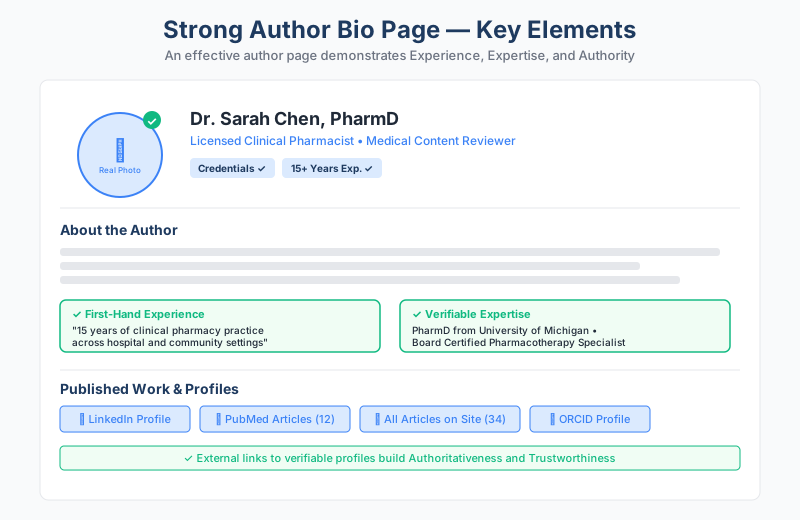
Create detailed author pages that include the person's name and photo, relevant qualifications and experience, links to other published work or professional profiles, and a clear explanation of why this person is qualified to write about the topic. Author attribution matters. Content that clearly shows who wrote it and why they are credible performs better from an E-E-A-T perspective than anonymous articles.
Improve Your About Page
Your About page should communicate who runs the site, what the organization's mission is, and how to contact real people. For businesses, include a physical address and verifiable business information. This signals legitimacy and helps raters (and users) evaluate trustworthiness at the site level.
Prioritize Content Accuracy and Sourcing
Every factual claim should be verifiable. Cite reputable sources, link to original research when possible, and keep content up to date. Outdated statistics or recommendations erode trust. Build a regular content review process to ensure accuracy is maintained over time, not just at the point of publication.
Strong SEO content writing practices naturally overlap with E-E-A-T principles: thorough research, clear structure, proper attribution, and a focus on genuinely helping the reader. Pairing these practices with a solid on-page SEO checklist ensures that your quality signals are supported by strong technical fundamentals.
Show First-Hand Experience
When you have direct experience with a topic, make it visible. Include original images and screenshots. Add sections like "What We Tested" or "Our Experience." Share specific results, data, or observations that could only come from someone who has actually done the work. This is especially important in an era of AI-generated content, where generic information is abundant but first-hand insight is scarce.
Earn Authority Over Time
Authority is not manufactured overnight. It grows through consistently publishing high-quality, accurate content in your subject area, earning backlinks and mentions from respected sources, contributing to industry conversations, and building a reputation that others reference and trust. You can check the structural quality of your content using tools like a readability checker or heading checker to make sure your pages are well-organized and accessible.
Secure Your Site
HTTPS is a baseline expectation. You can check your site's technical trust signals with a website grader. Beyond that, ensure your site has clear privacy policies, accessible contact information, and a clean user experience free of deceptive practices. Technical trust signals reinforce content trust signals, and gaps in either area can undermine the other.
Common Misconceptions About E-E-A-T
One of the most persistent myths is that E-E-A-T is a direct ranking factor, something Google measures with a specific score. It is not. As Google's John Mueller has stated, you cannot simply "add" E-E-A-T to a page. It is an abstraction that reflects the overall quality of a page and its source, not a technical signal you can manipulate.
Another misconception is treating E-E-A-T as a one-time optimization. Adding an author bio and calling it done misses the point entirely. Google's Danny Sullivan has described the relationship this way: Google's systems are not directly looking for E-E-A-T, but raters use the framework to verify whether those systems are surfacing good information. E-E-A-T is the result of sustained quality across content, authorship, site reputation, and user experience. It is something you build over months and years, not something you switch on.
Finally, strong E-E-A-T does not override other fundamentals. A page with excellent author credentials but poor search intent alignment, slow load times, or thin content will still struggle to rank. E-E-A-T is one dimension of quality within a broader system that includes relevance, technical health, and user experience. When Google rolls out algorithm updates, sites with strong E-E-A-T signals tend to weather the changes more effectively than those relying on shortcuts.
E-E-A-T and AI Search
E-E-A-T signals are becoming increasingly relevant beyond traditional search. AI-powered search experiences, including Google's AI Overviews and tools like ChatGPT and Perplexity, tend to cite content from sources that demonstrate clear authority and trustworthiness. Content that is well-sourced, clearly attributed, and structured for easy comprehension is more likely to be referenced in AI-generated answers.
This connection makes sense when you consider how these systems work. AI models need to select sources they can trust and extract information from accurately. Pages with clear authorship, verifiable facts, and structured formatting give AI systems the confidence to cite them. Pages without those signals are riskier to reference and tend to be passed over.
This means that investing in E-E-A-T is not just about ranking in traditional search results. It is about building the kind of credibility that makes your content citation-worthy across all discovery channels, whether a human is scanning search results or an AI system is selecting sources to reference. The fundamentals of quality, accuracy, and trust apply regardless of whether the audience is a person or an algorithm.
Frequently Asked Questions
Is E-E-A-T a Google ranking factor?
No. E-E-A-T is an evaluation framework from Google's Search Quality Rater Guidelines. It is used by human raters to assess whether Google's algorithms are returning quality results. However, the signals that demonstrate strong E-E-A-T, such as quality content, authoritative backlinks, and clear authorship, are closely aligned with what Google's algorithms reward.
What is the most important part of E-E-A-T?
According to Google's guidelines, trustworthiness is the most important element. Pages that lack trust have low E-E-A-T regardless of how experienced, expert, or authoritative they appear. The other three elements all contribute to and build upon trust.
How long does it take to build E-E-A-T?
There is no fixed timeline. Building E-E-A-T is a long-term process that involves consistently publishing high-quality content, earning recognition from other credible sources, and maintaining accuracy and transparency over time. Expect months to years of sustained effort rather than quick wins.
Does E-E-A-T apply to all types of content?
Yes, but the required level varies. YMYL topics like health, finance, and legal advice require the strongest E-E-A-T signals. Everyday topics still benefit from quality signals, but the standard is more proportional to the topic's potential impact on the reader.
Can AI-generated content demonstrate E-E-A-T?
Google has stated that AI-generated content is not automatically considered low quality. The issue is whether the content is helpful, accurate, and demonstrates real value. AI content that lacks first-hand experience, expert review, or proper sourcing will struggle with E-E-A-T, while AI-assisted content with strong human oversight and expertise can perform well.
Sources
- Google Search Central - Creating helpful, reliable, people-first content. Explains E-E-A-T concepts and how Google uses them. https://developers.google.com/search/docs/fundamentals/creating-helpful-content
- Google Search Central Blog - Our latest update to the quality rater guidelines: E-A-T gets an extra E for Experience. Official announcement of the December 2022 E-E-A-T update. https://developers.google.com/search/blog/2022/12/google-raters-guidelines-e-e-a-t
- Google Search Quality Rater Guidelines: An Overview - Google's public overview of the quality rater guidelines and how they relate to search. https://services.google.com/fh/files/misc/hsw-sqrg.pdf
- Search Engine Land - E-E-A-T and major updates to Google's quality rater guidelines. Detailed analysis of the December 2022 guideline changes. https://searchengineland.com/google-search-quality-rater-guidelines-changes-december-2022-390350
- Google Search Central Blog - Search Quality Raters Guidelines update (November 2023). Covers subsequent updates to the guidelines. https://developers.google.com/search/blog/2023/11/search-quality-rater-guidelines-update
- Google Search Quality Rater Guidelines (September 2025) - Most recent version of the guidelines with updated YMYL definitions and AI Overview evaluation guidance. https://guidelines.raterhub.com/searchqualityevaluatorguidelines.pdf