SEO stands for search engine optimization. It is the practice of improving your website so it appears higher in search engine results when people search for topics related to your business, products, or services.
In practical terms, SEO is how you get found online without paying for ads. When someone searches "best project management software" or "how to fix a leaky faucet," the websites that appear at the top of Google earned those positions through SEO. They created content that matched what the searcher needed, built a website that search engines could understand, and established enough credibility to be trusted with those top spots.
Why does this matter? Google alone processes more than 5 trillion searches per year, and research from BrightEdge found that organic search drives 53% of all trackable website traffic across industries. For B2B companies, that share is even higher. If your website does not show up when people search, you are invisible to the majority of potential customers.
SEO is not a trick or a shortcut. It is a long-term strategy that, when done well, turns your website into a consistent source of qualified traffic, leads, and revenue.
Key Takeaways
- SEO is about visibility: Search engine optimization helps your website rank higher in search results, driving organic (unpaid) traffic from people actively looking for what you offer.
- Three pillars drive results: Effective SEO combines technical health (site structure and speed), on-page optimization (content and keywords), and off-page authority (backlinks and brand signals).
- Search engines work in three stages: Google discovers your pages (crawling), stores and analyzes them (indexing), then matches them to relevant queries (ranking).
- Quality and trust matter more than ever: Google's E-E-A-T framework (Experience, Expertise, Authoritativeness, Trustworthiness) shapes how content is evaluated, rewarding genuine expertise over keyword stuffing.
- SEO takes time but compounds: Most businesses see meaningful results in 3 to 6 months, with returns growing over time as authority builds.
What SEO Means in Practice
Search engine optimization is the process of aligning your website with how search engines discover, understand, and rank content. The goal is straightforward: when someone searches for something your business can help with, your website shows up.
This involves three broad categories of work. You need a website that search engines can easily access and understand (technical SEO). You need content that matches what searchers are looking for (on-page SEO). And you need signals from across the web that tell search engines your site is credible and trustworthy (off-page SEO).
What SEO is not: it is not about gaming the system, stuffing keywords into every paragraph, or buying your way to the top. Google's algorithms have become sophisticated enough to recognize and penalize those tactics. As Google Search Advocate John Mueller has emphasized repeatedly, what matters is creating content that is helpful, accurate, and built to serve users. The websites that rank well in 2026 are the ones that genuinely serve their audience. For a deeper look at common misconceptions, see our guide to SEO myths that hold businesses back.
How Search Engines Work
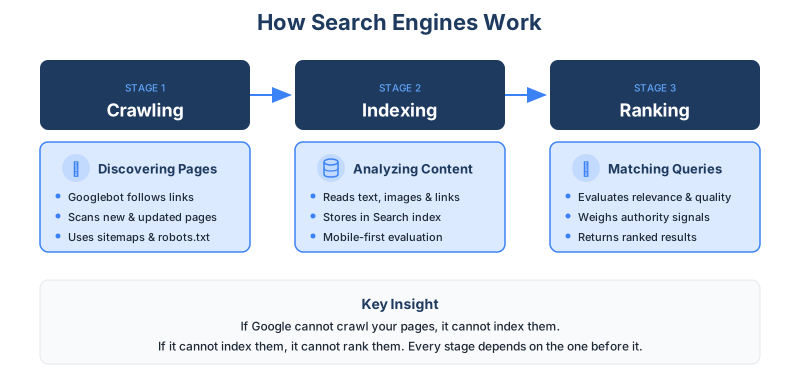
To understand SEO, you need to understand how search engines find and rank content. According to Google Search Central, the process works in three stages.
Crawling: Discovering Your Pages
Google uses automated programs called crawlers (sometimes called "spiders" or "Googlebot") to continuously scan the web for new and updated pages. These crawlers follow links from page to page, downloading text, images, and videos as they go.
If Google cannot find your pages, it cannot rank them. This is why having a clear site architecture, a properly configured robots.txt file, and an XML sitemap all matter. You can verify that your site is crawlable using tools like our free robots.txt tester or sitemap checker.
Indexing: Understanding Your Content
Once a page is crawled, Google analyzes its content to understand what it is about. This includes reading the text, examining images, cataloging headings and links, and evaluating the overall structure of the page.
Google stores this information in its Search index, a massive database hosted across thousands of computers. Not every crawled page gets indexed. Pages with thin content, duplicate material, or technical barriers may be excluded entirely. It is also worth noting that Google uses mobile-first indexing, meaning it primarily evaluates the mobile version of your page when deciding what to index and how to rank it.
Ranking: Matching Queries to Results
When someone types a query into Google, the search engine scans its index for matching pages and returns results it considers most relevant and useful. Google's ranking systems evaluate hundreds of factors to determine which pages best satisfy a given query. Systems like RankBrain use machine learning to understand the relationship between words and concepts, helping Google interpret queries it has never seen before.
As Google explains on its How Search Works page, ranking is done entirely programmatically. No one can pay Google to rank higher in organic results.
These factors include how well the content matches the searcher's intent, the quality and depth of the information, the authority of the source, and technical elements like page speed and mobile-friendliness.
Here's what this looks like in practice: for a detailed explanation of each stage, read our supporting article on how search engines work.
The Three Pillars of SEO
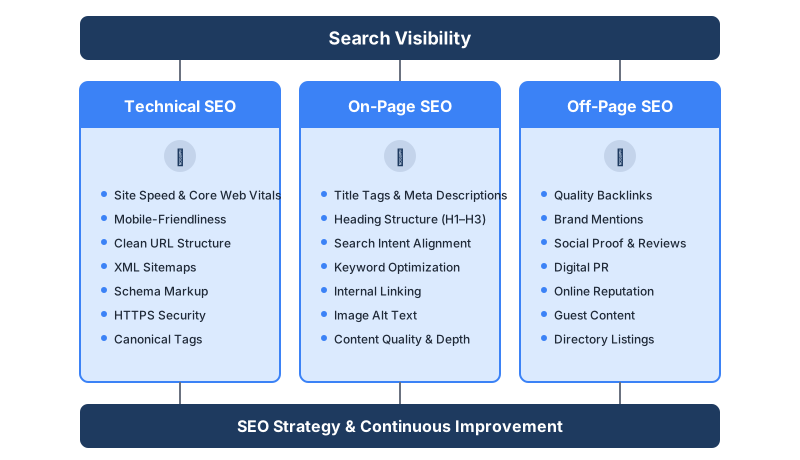
SEO professionals typically organize their work into three pillars. Each one addresses a different aspect of what makes a website rank well.
Technical SEO
Technical SEO is the foundation. It ensures search engines can find, access, and understand your website without obstacles. If the technical foundation is broken, even the best content may never appear in search results.
Key elements of technical SEO include site speed and Core Web Vitals, mobile-friendliness (Google uses mobile-first indexing, meaning it primarily uses the mobile version of your site for ranking), clean URL structure and logical site hierarchy, proper use of canonical tags to manage duplicate content (you can verify yours with our canonical tag checker), schema markup that helps search engines understand your content, and secure connections (HTTPS).
Think of technical SEO as building a house with a solid foundation. You can fill it with beautiful furniture (content), but if the foundation is cracked, nothing else holds up. In practice, technical SEO is often where the biggest gains hide for established websites. A site that has been live for years may have accumulated crawl errors, broken redirects, or slow-loading pages that silently suppress its rankings. Fixing these issues can produce noticeable improvements even before you create a single new page.
On-Page SEO
On-page SEO is about the content and HTML elements on your pages. This is where you align what you publish with what your audience is searching for.
The most important on-page elements include title tags and meta descriptions that accurately describe your content (you can preview how they look using our SERP simulator or meta description generator), heading structure (H1, H2, H3) that organizes information logically, content that comprehensively addresses search intent, strategic use of keywords without overstuffing, internal links that connect related content across your site, and optimized images with descriptive alt text.
The goal of on-page SEO is not to write for search engines. It is to write for people in a way that search engines can understand and categorize. Original research from Backlinko analyzing millions of Google search results found that the top-ranking position earns a click-through rate of roughly 27%, while positions further down the page receive dramatically fewer clicks. The quality of your on-page optimization directly affects where you land. Our full on-page SEO checklist walks through every element.
Off-Page SEO
Off-page SEO refers to actions taken outside your own website that signal authority and credibility to search engines. The most significant off-page factor is backlinks: links from other websites to yours.
When a reputable website links to your content, it acts as a vote of confidence. Google interprets these links as signals that your content is valuable and trustworthy. However, not all links are equal. A single link from a respected industry publication carries more weight than dozens of links from low-quality directories.
Beyond backlinks, off-page SEO also includes brand mentions across the web, social proof and reviews, and your overall online reputation. As Google's algorithms evolve, brand signals are becoming increasingly important. Websites that are recognized as authorities in their space tend to rank more consistently.
For small businesses, off-page SEO might start with getting listed in relevant directories, earning local press coverage, or building relationships with complementary businesses that link to your resources. Larger organizations often invest in content marketing, digital PR, and thought leadership to earn authoritative backlinks at scale. The approach should match your resources and goals. For businesses just getting started with SEO on a budget, our guide to small business SEO covers practical, cost-effective strategies.
Key Ranking Factors
Google uses hundreds of signals in its ranking systems, but not all carry equal weight. Here are the factors that matter most in practice.
Content relevance and quality. Does your content actually answer the searcher's question? Google has become remarkably good at understanding what users are looking for, meaning whether someone wants a quick definition, a step-by-step guide, or a product comparison. Pages that match intent accurately tend to outperform those that don't, regardless of other factors.
Backlinks and authority. The quantity and quality of websites linking to your pages remain one of the strongest ranking signals. According to Google's own ranking systems guide, their PageRank system (while evolved significantly since its original form) still uses links as a key way to determine which pages contain the most valuable information on a topic.
User experience signals. How people interact with your site matters. If visitors consistently click your result and then immediately return to Google (known as "pogo-sticking"), it signals that your content did not satisfy their query. Page speed, mobile usability, and clear navigation all contribute to a positive user experience.
Technical health. Sites with crawling errors, broken links, slow load times, or security issues face an uphill battle in rankings. A technically sound website removes barriers between your content and the search engines that need to access it.
Freshness. For time-sensitive topics, Google favors content that is current and regularly updated. This does not mean rewriting every page constantly, but it does mean keeping your most important content accurate and up to date. Staying aware of Google algorithm updates helps you understand what Google is prioritizing at any given time.
What most guides miss is that these factors do not operate in isolation. A page with excellent content but a slow load time may lose to a slightly less comprehensive page that loads instantly and provides a better user experience. SEO success comes from getting the fundamentals right across all of these areas simultaneously.
E-E-A-T: Experience, Expertise, Authoritativeness, Trustworthiness
E-E-A-T is a framework Google uses to evaluate the quality of content, particularly for topics that could impact a person's health, finances, or safety (known as "Your Money, Your Life" or YMYL topics).
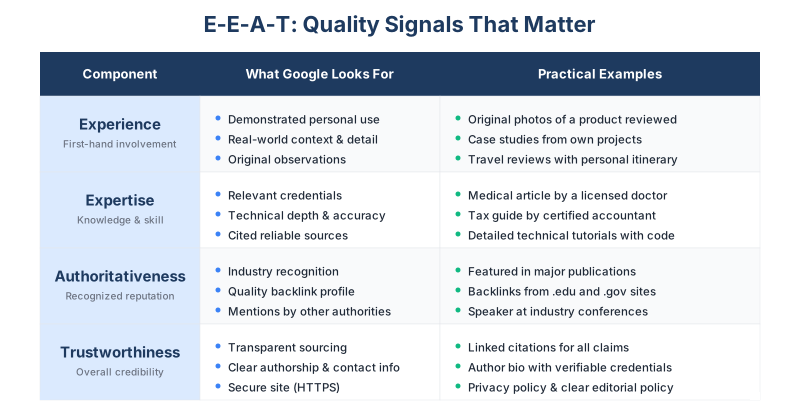
The four components break down as follows. Experience means the content creator has firsthand, practical experience with the topic. A product review written by someone who actually used the product demonstrates experience. Expertise means the creator has relevant knowledge or skill. A medical article written by a licensed physician signals expertise. Authoritativeness means the creator or website is a recognized source on the topic. Trustworthiness is the overall credibility of the page, including accuracy, transparency about who created it, and the security of the site.
In practice, E-E-A-T is not a single ranking factor you can flip on. It is a set of qualities that Google's algorithms evaluate through many different signals, from author bios and cited sources to the overall reputation of your domain. For a complete breakdown, see our guide on E-E-A-T and SEO.
Google's December 2025 core update reinforced E-E-A-T principles significantly. According to Google's own guidance on core updates, these broad changes are designed to surface helpful, reliable, people-first content. As Search Engine Land reported, Google described the December 2025 update as targeting "relevant, satisfying content for searchers from all types of sites." The takeaway: building genuine trust and expertise is not optional.
How Long Does SEO Take?
The honest answer: SEO is a long-term investment, not an overnight fix. Most businesses start seeing measurable improvements in organic traffic within 3 to 6 months of consistent effort, though competitive industries may require 6 to 12 months or longer.
Several factors influence the timeline. New websites with no existing authority take longer to build rankings than established domains. Competitive keywords with high search volume require more time and effort than niche, long-tail keywords. The depth and quality of your content, technical health of your site, and strength of your backlink profile all play a role.
What makes SEO uniquely valuable is that results compound. Unlike paid advertising, where traffic stops the moment you stop paying, a well-optimized page can drive traffic for months or years. Every piece of quality content you publish, every authoritative backlink you earn, and every technical improvement you make builds on what came before.
From experience, the businesses that succeed with SEO are the ones that commit to a consistent SEO strategy rather than chasing quick wins. For a realistic timeline with benchmarks, read how long does SEO take.
SEO vs. Other Marketing Channels
SEO is one of many ways to drive traffic to your website. How does it compare to the alternatives?
SEO vs. PPC (Pay-Per-Click). PPC delivers immediate visibility through paid ads at the top of search results, but you pay for every click. SEO takes longer to produce results but generates free, ongoing traffic once you rank. Google dominates global search, and organic results still capture the majority of clicks. Many businesses use both channels together: PPC for short-term results and SEO for long-term growth. For a full comparison, see SEO vs. PPC.
SEO vs. Social Media. Social media can build brand awareness and engagement, but its traffic share is relatively small compared to search. BrightEdge's research showed social media contributes roughly 5% of website traffic on average, compared to organic search's 53%. Social platforms also control your reach through algorithms, whereas search traffic depends on your own content and site quality.
SEO vs. Paid Social/Display Ads. Like PPC, paid social and display campaigns stop delivering the moment you pause your budget. SEO's advantage is sustainability: the work you do today continues generating returns over time.
The key difference is that SEO captures demand that already exists. People searching on Google have a specific intent. They are actively looking for answers, products, or services. That makes organic search traffic some of the highest-quality traffic any channel can deliver.
SEO and AI Search: What Is Changing
Search is evolving. AI-powered tools like ChatGPT, Google's AI Overviews, Perplexity, and others are changing how people find information. Research from Ahrefs found that AI Overviews reduce the organic click-through rate for the top-ranking position by 58% when they appear.
Does this mean SEO is dying? No. But it does mean SEO is expanding. The same principles that help you rank in traditional search, such as clear content structure, authoritative sourcing, and genuine expertise, also help AI systems understand and recommend your content.
The bottom line: strong SEO serves as the foundation for visibility across both traditional search engines and AI-powered discovery. The fundamentals have not changed. What has changed is the number of places your content can appear.
This is worth emphasizing. BrightEdge's 2025 research confirmed that while AI search referral traffic is growing rapidly, it still accounts for less than 1% of total referral traffic, while organic search continues to drive the majority of conversions. The smart approach is not to abandon traditional SEO for AI optimization. It is to build on a strong SEO foundation that benefits both channels.
Getting Started with SEO
If you are new to SEO, here is a practical path forward.
Start with the fundamentals. Ensure your website is technically sound, your content addresses real questions your audience has, and your pages are properly structured.
Build a keyword strategy. Understanding what your audience searches for is the foundation of effective content creation.
Create content that serves your audience. Write for people first, then optimize for search engines. Focus on depth, accuracy, and genuine helpfulness. Our AI-powered Article Writer can help you scale production once your strategy is in place.
Build authority over time. Earn backlinks through quality content, establish your expertise in your field, and maintain a consistent publishing cadence. SEO rewards patience and consistency.
Track your progress. Use Google Search Console and other analytics tools to monitor your rankings, traffic, and engagement over time.
For businesses with a local presence, local SEO adds another layer of optimization focused on geographic visibility, including Google Business Profile management and local citations.
SEO is not a one-time project. It is an ongoing practice of creating value for your audience and making sure search engines can find and understand that value. The businesses that treat it as a core part of their marketing strategy, rather than a box to check, are the ones that consistently win.
Frequently Asked Questions
What does SEO stand for?
SEO stands for search engine optimization. It refers to the process of improving your website's visibility in organic (unpaid) search engine results. The goal is to increase both the quantity and quality of traffic your website receives from search engines like Google.
Is SEO still worth it in 2026?
Yes. Despite changes in the search landscape, including AI Overviews and the rise of AI-powered search tools, organic search remains the largest single source of website traffic for most businesses. According to BrightEdge, organic search drives 53% of all trackable website traffic. The fundamentals of SEO, such as quality content, technical health, and authority signals, also support visibility in AI search.
How much does SEO cost?
SEO costs vary widely depending on your approach. Small businesses managing SEO in-house may spend primarily on tools (ranging from free to a few hundred dollars per month). Hiring an agency or consultant typically costs between $1,000 and $10,000+ per month depending on scope and competitiveness. The key consideration is return on investment: unlike paid advertising, SEO traffic does not stop when you stop spending.
What is the difference between SEO and SEM?
SEM (Search Engine Marketing) is a broader term that encompasses both SEO (organic search optimization) and PPC (paid search advertising). SEO focuses on earning traffic through unpaid results, while PPC involves paying for placement at the top of search results. Both fall under the SEM umbrella.
Can I do SEO myself, or do I need to hire someone?
Many small businesses successfully handle basic SEO themselves, especially with the wealth of free resources and tools available. Tasks like optimizing title tags, creating quality content, and setting up Google Search Console are achievable without specialized expertise. More complex technical SEO, competitive keyword strategies, and link building campaigns often benefit from professional guidance.
Sources
- Google Search Central - How Google Search Works. https://developers.google.com/search/docs/fundamentals/how-search-works
- Google Search Central - A Guide to Google Search Ranking Systems. https://developers.google.com/search/docs/appearance/ranking-systems-guide
- Search Engine Land - Google now sees more than 5 trillion searches per year. https://searchengineland.com/google-5-trillion-searches-per-year-452928
- Search Engine Land - Organic search responsible for 53% of all site traffic (BrightEdge study). https://searchengineland.com/organic-search-responsible-for-53-of-all-site-traffic-paid-15-study-322298
- Backlinko - Google Click-Through Rates by Ranking Position. https://backlinko.com/google-ctr-stats
- Ahrefs - AI Overviews Reduce Clicks by 58% (Updated Study). https://ahrefs.com/blog/ai-overviews-reduce-clicks-update/
- Google Search Central - Google Search Core Updates. https://developers.google.com/search/docs/appearance/core-updates
- Google - How Search Works: Ranking Results. https://www.google.com/intl/en_us/search/howsearchworks/how-search-works/ranking-results/
- Search Engine Land - Google December 2025 core update rollout is now complete. https://searchengineland.com/google-december-2025-core-update-rollout-is-now-complete-466362
- BrightEdge - AI Search Visits Surging in 2025, But Organic Search Remains the Cornerstone. https://www.brightedge.com/resources/research-reports/ai-search-visits-in-surging-2025