
Most businesses start seeing meaningful SEO results within three to six months, with significant impact typically taking six to twelve months or longer. But "it depends" isn't a dodge here. It's the reality of a process shaped by competition, resources, your site's current state, and what you actually mean by "results."
If you're investing in search engine optimization for the first time, this timeline can feel frustrating, especially compared to paid ads that deliver traffic the same day. But SEO builds compounding value over time, and understanding the realistic timeline helps you plan smarter and avoid pulling the plug too early.
This article breaks down what the data actually shows, which factors speed things up or slow them down, and how to tell whether your SEO efforts are working before the big wins arrive.
Key Takeaways
- Three to six months is the typical starting point: Most sites begin seeing early ranking and traffic improvements within this window, though competitive industries may take longer.
- Google itself says four to twelve months: A former Google Developer Programs Tech Lead stated that SEOs typically need four months to a year to implement improvements and see potential benefits (Google Search Central).
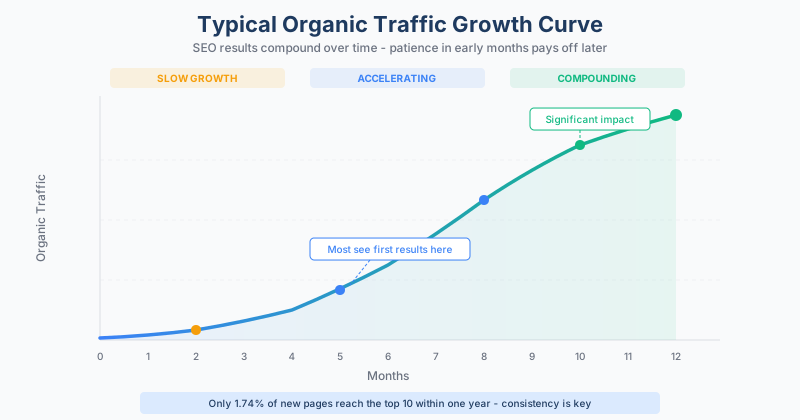
- New pages rarely rank quickly: According to Ahrefs' 2025 study, only 1.74% of newly published pages reach Google's top 10 within one year (Ahrefs).
- Different activities have different timelines: Technical fixes can show impact in weeks, content takes months to gain traction, and link building often needs six to twelve months for full effect.
- "Results" means different things: Rankings, traffic, and conversions each move at different speeds. Impressions often improve before clicks, and clicks improve before revenue.
What the Research Shows
Rather than relying on opinions, several large-scale studies have examined actual ranking data.
The Ahrefs Studies
Ahrefs has conducted two major time-to-rank studies, and the 2025 update paints a clear picture. After analyzing millions of URLs, the study found that 72.9% of pages currently ranking in Google's top 10 are more than three years old, up from 59% in the original 2017 study. The average page sitting in the number-one position is roughly five years old.
Only 13.7% of top-10 results come from pages less than one year old, down from 22% in 2017. Among the small percentage of new pages that do reach the top 10, most achieve it within approximately 61 to 182 days (Ahrefs).
The takeaway isn't that new content can't rank. It can. But the data confirms that ranking success is typically measured in months and years, not days and weeks.
The Semrush Study
Semrush tracked 28,000 new domains over 13 months. Among those that maintained top-100 visibility throughout the study, about 41% were ranking in the top 10 positions after six months. However, holding those positions proved much harder: only 4.2% of domains maintained at least one top-10 ranking for the entire study period. Around 27% of sites that reached the top 10 stayed there through the end of the research.
This highlights something important: getting to page one and staying there are two different challenges. Consistent effort over time is what separates sites that build lasting visibility from those that see a brief spike and fade.
What Google Says
Maile Ohye, who spent 12 years as a Developer Programs Tech Lead at Google, addressed this question directly. In Google's "How to Hire an SEO" guide, she stated that SEOs typically need four months to a year to first implement improvements and then see potential benefits.
Google's John Mueller has added nuance to this, noting that simple changes like updating page titles can be picked up relatively quickly, while major site overhauls or strategic shifts take much longer for Google to fully process and re-evaluate.
Factors That Affect Your Timeline
No two SEO campaigns follow the same trajectory. Here's what moves the needle in either direction.
Competition Level
If you're a local bakery targeting "best cupcakes in Austin," you'll likely see results faster than an insurance company targeting "best life insurance." The more established competitors you're up against, the more time and effort it takes to earn comparable visibility.
This is where keyword research becomes essential. Use a free keyword difficulty checker to find lower-competition terms first, then build momentum while working toward more competitive keywords over time.
Current Site State and History
A well-established domain with clean technical foundations, existing content, and some backlink authority has a significant head start over a brand-new website. The Ahrefs data showed that pages on higher-authority domains rank faster than those on weaker ones.
Conversely, a site with unresolved technical problems, thin content, or a history of spammy link building may need months of cleanup before forward progress begins.
Domain Age and Authority
While Google's John Mueller has said domain age itself has little direct impact on rankings, older domains tend to benefit indirectly. They've had more time to accumulate backlinks, establish crawl patterns, and build the kind of topical authority that search engines reward.
New domains often experience what practitioners call a "sandbox" period, where rankings fluctuate more significantly in the early months. Mueller has acknowledged that Google's algorithms take time to figure out where a new website fits in search results.
Resource Investment
More resources, whether time, budget, or both, generally accelerate results. A team publishing four well-researched articles per month, actively building quality backlinks, and fixing technical issues simultaneously will outpace a business owner squeezing in one blog post every few weeks.
That said, quality matters more than volume. Publishing frequently but poorly won't help.
Content Quality
The Semrush study found that top-performing domains featured substantially longer, more comprehensive content than underperformers. This aligns with Google's emphasis on helpful content: pages that genuinely answer searchers' questions, demonstrate experience and expertise, and cover topics thoroughly tend to rank faster and hold their positions longer.
Timeline by Activity Type
Different SEO activities produce results on different schedules. Here's a practical breakdown.
Technical Fixes: Weeks to See Effect
Resolving crawl errors, improving page speed, fixing broken links, and ensuring mobile-friendliness can show measurable impact within weeks. These changes remove barriers that prevent Google from properly crawling, indexing, and ranking your content.
Content Creation: Three to Six Months to Gain Traction
New content typically needs several months to index, accumulate user engagement signals, and climb the rankings. According to the Ahrefs data, even among pages that do reach the top 10, most take two to six months to get there.
Building a content strategy around a cluster model, where you create comprehensive coverage of a topic through interlinked articles, helps search engines recognize your topical authority faster. This is the same approach behind a strong SEO strategy.
Link Building: Six to Twelve Months for Full Impact
Backlinks remain one of the strongest signals Google uses to evaluate a page's authority. But earning quality links takes time. The Semrush study confirmed that more than half of domains without at least one backlink never reached the first page.
Link building compounds over time. The links you earn in months one through three lay groundwork that amplifies the content you publish in months four through six.
New Domain vs. Established Domain
Publishing on an established domain can produce ranking improvements in days to weeks for lower-competition terms. A brand-new domain typically requires six to twelve months or longer to reach comparable positions for the same keywords, simply because it hasn't yet built the trust signals that search engines need to see.
What "Results" Actually Means
One reason the "how long" question is so hard to answer is that "results" can mean very different things.
Rankings are typically the first metric to move. You might see a page climb from position 50 to position 15 within a few months. That's real progress, even if it doesn't feel like it yet.
Traffic follows rankings, but not immediately. The jump from page three to page two doesn't drive much additional traffic. The real gains come when pages break into the top five positions, where the majority of clicks happen.
Conversions and revenue are the lagging indicators. Even after traffic increases, it takes time for that traffic to translate into leads, sales, or other business outcomes. Tracking SEO KPIs at each stage helps you measure progress accurately.
In practice, the progression looks like this: impressions increase before clicks, clicks increase before conversions, and conversions compound over months as more pages gain visibility.
Setting Realistic Expectations Month by Month
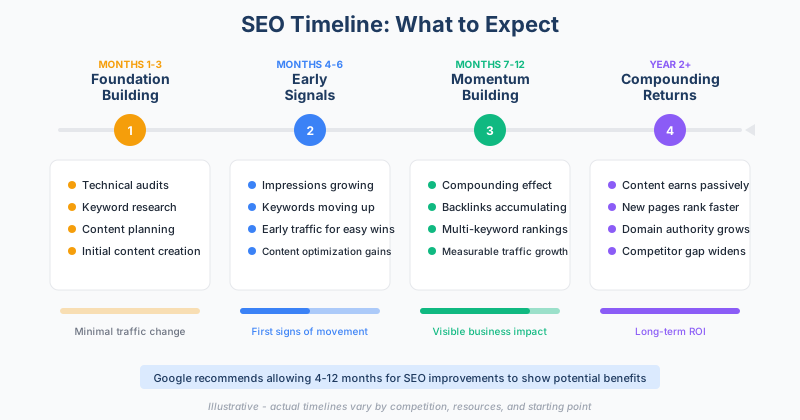
Months 1-3: Foundation Building
This is when the unsexy but critical work happens. Technical audits, keyword research, content planning, and initial content creation. You probably won't see meaningful traffic changes yet, but you're setting up the infrastructure that everything else depends on.
Visible progress during this phase: improved site health scores, pages getting indexed, and initial impressions appearing in Google Search Console.
Months 4-6: Early Signals
New content starts gaining traction. You should see impressions growing in Search Console, some keywords moving from beyond page five into positions 10-30, and possibly early traffic increases for lower-competition terms.
This is also when content optimization of existing pages can produce quicker wins, since Google already knows those pages exist.
Months 7-12: Momentum Building
The compounding effect becomes visible. Earlier content has had time to accumulate backlinks and engagement signals. Internal linking between articles strengthens the entire cluster. Rankings improve across multiple keywords simultaneously.
This is typically when businesses start seeing measurable traffic growth that connects to business outcomes.
Year 2 and Beyond: Compounding Returns
This is where SEO's long-term value really shines. Established content continues attracting traffic with minimal additional investment. New content ranks faster because your domain has built authority. The gap between your site and competitors who started later widens.
Signs Your SEO Is Working (Even If Traffic Hasn't Spiked Yet)
Don't wait for a traffic explosion to gauge whether your investment is paying off. These early indicators show that things are moving in the right direction:
- Impressions increasing in Google Search Console. Google is showing your pages to more people, even if they're not clicking yet.
- Keyword positions improving, even outside page one. Moving from position 80 to position 25 won't drive clicks, but it shows Google is recognizing your content.
- More pages getting indexed. Your content is being crawled and stored.
- Backlinks accumulating. Other sites are referencing your content.
- Engagement metrics improving. Time on page and pages per session are increasing.
When to Worry
Not all slow progress is normal. If you're seeing no measurable improvement after six months of consistent, quality work, it's time to reassess. Common causes include targeting keywords that are too competitive for your current authority, unresolved technical issues blocking crawlability, thin content that doesn't meet search intent, or a penalty from past SEO practices.
The key word is "consistent." Six months of sporadic effort is very different from six months of focused execution.
Frequently Asked Questions
Can SEO work in less than three months?
It's possible, especially for established sites targeting low-competition keywords or fixing obvious technical issues. Quick wins exist, but substantial, sustainable results almost always take longer. Be skeptical of anyone promising guaranteed rankings in weeks.
Why does SEO take longer than paid advertising?
Paid ads place you in front of searchers immediately because you're paying for that placement directly. SEO requires earning visibility by demonstrating relevance, authority, and trustworthiness to search engines, which is an inherently gradual process. The tradeoff is that SEO builds long-term value, while paid traffic stops the moment you stop paying.
Does SEO take longer for new websites?
Yes, typically. New domains haven't built the trust signals, backlink profile, or content depth that established sites have. Google's algorithms also fluctuate more for new sites as they determine where to place them. Expect to add three to six months to standard timelines for a brand-new domain.
How do I know if my SEO agency is actually doing anything?
Ask for monthly reports showing specific metrics: keyword position changes, pages indexed, backlinks earned, technical issues resolved, and content published. Legitimate progress shows up in data, even before traffic increases. If an agency can't show any measurable movement after four to six months, ask hard questions.
Is SEO a one-time project or an ongoing effort?
Ongoing. The Semrush study found that only 27% of sites that reached the top 10 stayed there through a 13-month period. Rankings shift due to new competitors, algorithm updates, and changing user behavior. Maintaining and improving your positions requires consistent content updates, technical maintenance, and continued link building.