
Google AI Overviews have changed the way search results look and how users interact with them. Instead of scanning ten blue links, millions of searchers now read an AI-generated summary at the top of the page, complete with cited sources and links to dig deeper.
For SEO professionals and content strategists, this creates both a challenge and an opportunity. The challenge: organic click-through rates drop significantly when an AI Overview appears. The opportunity: content that gets cited inside an AI Overview earns prominent visibility, even if it does not hold the number one organic position. Optimizing for AI search is no longer optional for teams that want to maintain organic visibility.
This guide walks you through what AI Overviews are, how Google selects sources for them, and the specific steps you can take to increase your chances of being cited. We will also cover what you can realistically measure today, where the gaps still exist, and how AI Overviews relate to featured snippets.
A quick note before we dive in: this is an evolving feature. Google continues to adjust how often AI Overviews appear, which queries trigger them, and how sources are selected. The tactics here reflect current best practices as of early 2026, but you should expect this landscape to keep shifting.
Key Takeaways
- AI Overviews are now a core search feature: Google has rolled AI Overviews out to over 120 countries and territories, and they appear on a significant and growing percentage of searches.
- Existing SEO fundamentals still matter most: According to Google Search Central, there are no additional technical requirements to appear in AI Overviews beyond standard SEO best practices.
- Content structure is the biggest optimization lever: AI systems favor content that is clearly organized, answers questions directly, and can be easily extracted and summarized.
- Measurement remains a challenge: Google Search Console includes AI Overview data within the standard "Web" search type but does not offer a separate filter to isolate it.
- Citation patterns are shifting: Early research showed ~76% of AI Overview citations came from top-10 pages, but updated Ahrefs data from 2026 shows this has dropped to ~38%, meaning content quality and topical authority matter more than ranking position alone.
What Are Google AI Overviews?
Google AI Overviews are AI-generated summaries that appear at the top of search results for certain queries. Rather than pulling a single snippet from one page (like traditional featured snippets), AI Overviews synthesize information from multiple sources into a cohesive response, with links to the pages they drew from.
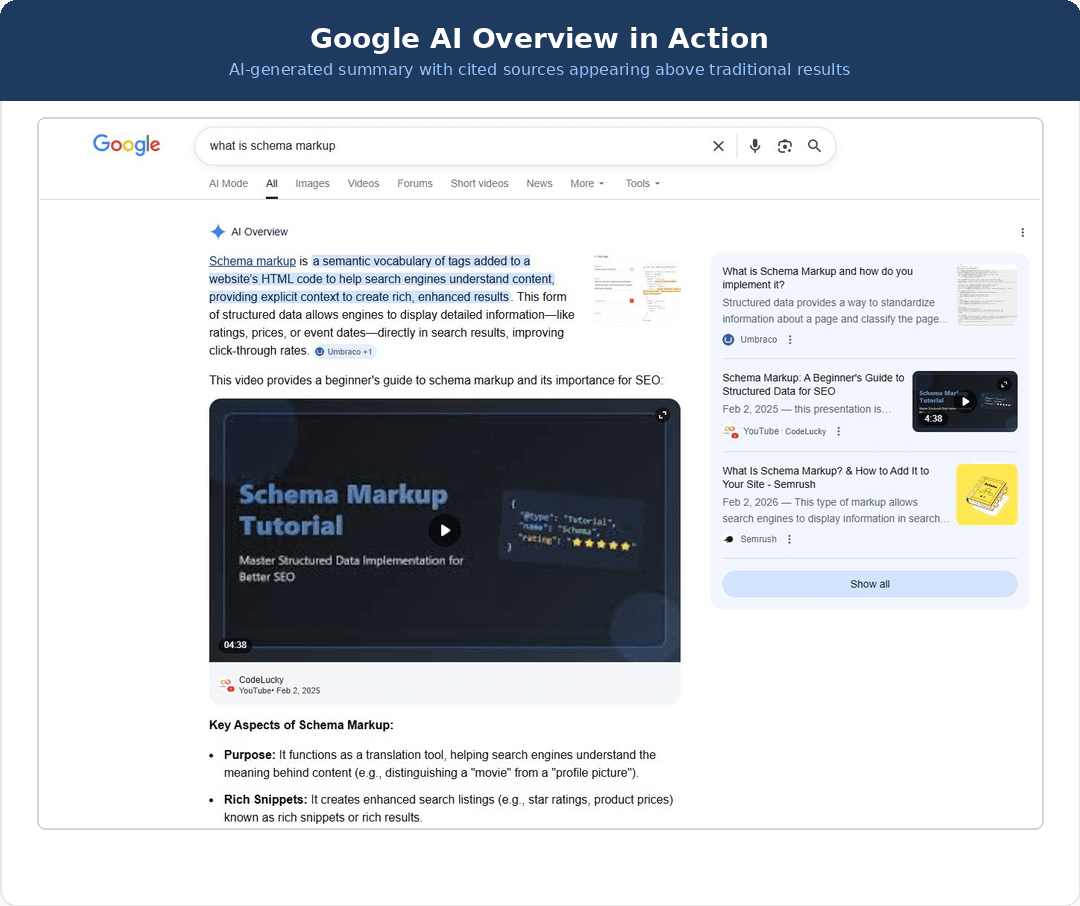
The feature evolved from Google's Search Generative Experience (SGE), which launched as a Search Labs experiment in 2023. Google rebranded it as AI Overviews and rolled it out broadly to U.S. users in May 2024 (Google, 2024), expanding to more than 120 countries by late 2024. According to Google, AI Overviews had over 1.5 billion monthly users by Q1 2025 (Google, 2025).
AI Overviews do not appear for every query. Google's systems trigger them selectively, primarily for queries where an AI-generated summary adds value beyond what standard results provide. Research from Ahrefs, analyzing 55.8 million AI Overviews across 590 million searches, found that roughly 12.8% of all Google searches showed AI Overviews as of mid-2025 (Ahrefs, 2025). A Semrush analysis of over 10 million keywords showed AI Overview visibility peaked at nearly 25% in mid-2025 before pulling back to approximately 16% by late 2025 (Search Engine Land, 2025).
The types of queries most likely to trigger AI Overviews include informational and question-based searches (especially "what," "how," and "why" queries), complex multi-part questions, comparison and planning queries, and research-oriented searches. Branded, navigational, and short-tail queries trigger AI Overviews far less frequently.
It is also worth understanding the difference between AI Overviews and Google's newer AI Mode. AI Overviews appear alongside traditional search results, while AI Mode is a separate, more conversational experience (similar to ChatGPT) that does not show the standard ten blue links. Both draw from web sources, but they use different models and may cite different pages for the same query.
How Google Selects Sources for AI Overviews
Google's official documentation on this topic is clear, if somewhat general. According to Google Search Central: "The best practices for SEO remain relevant for AI features in Google Search. There are no additional requirements to appear in AI Overviews or AI Mode, nor other special optimizations necessary."
In practice, though, third-party research gives us a more nuanced picture of what content tends to get cited:
Relevance and topical authority. AI Overviews draw from pages that comprehensively cover a topic, not just pages that match a keyword. Google's systems use a "query fan-out" technique, issuing multiple related sub-queries to assemble a complete response. Your content needs to address the topic broadly enough that it answers related questions, not just the primary query.
Organic ranking strength. An Ahrefs study from mid-2025 found that roughly 76% of URLs cited in AI Overviews also ranked in the top 10 of traditional organic results (Ahrefs, 2025). However, an updated study from early 2026 analyzing 4 million AI Overview URLs found this overlap has dropped to approximately 38%, likely due to Google's shift to Gemini 3 for AI Overviews in January 2026 (Ahrefs, 2026). Strong SEO performance remains important for AI visibility, but Google is increasingly pulling citations from outside the top 10, making content quality and topical authority even more critical.
Content structure and extractability. AI systems need to be able to identify and extract clear answers from your content. Pages with well-organized heading hierarchies, concise answer paragraphs, and logical section flow are easier for AI to parse and cite.
E-E-A-T signals. Experience, Expertise, Authoritativeness, and Trustworthiness remain critical quality signals. Content from recognized authorities on a topic, backed by credible sources, is more likely to be selected.
Freshness. For time-sensitive topics, Google favors current content. This is especially relevant for queries about evolving topics like technology, policy, or current events.
What we do not know is exactly how Google's algorithm weights these factors or the precise mechanics of source selection. It is important to treat optimization tactics as informed best practices rather than guaranteed formulas.
Step-by-Step: Optimizing Your Content for AI Overviews
Step 1: Identify Your AI Overview Opportunities
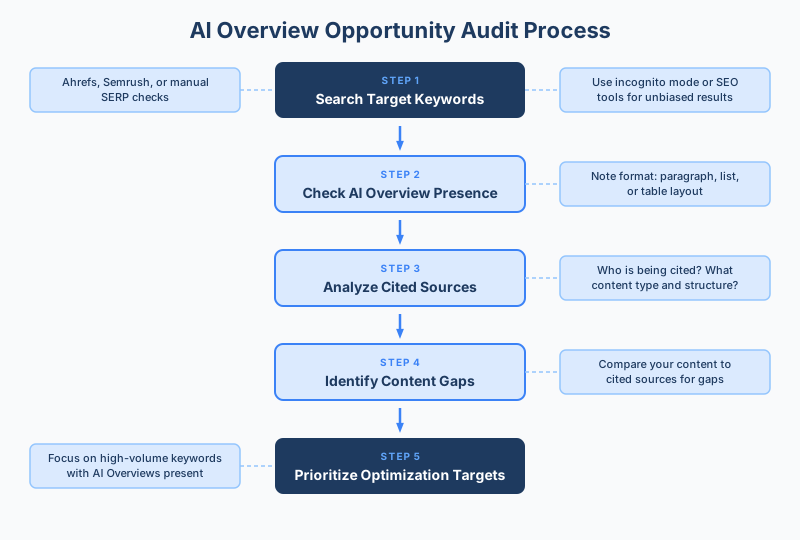
Start by finding which of your target keywords actually trigger AI Overviews. Not every query will, and optimizing for AI Overviews on a keyword that never triggers one is wasted effort.
Search your primary keywords in an incognito browser window and note which ones display an AI Overview. Pay attention to what sources are being cited, what format the overview takes (paragraph, list, table), and what question it is answering.
You can also use SEO platforms like Ahrefs or Semrush that now include AI Overview tracking in their SERP feature reports. This is more scalable than manual checks for large keyword sets.
Step 2: Structure Content for Extractability
This is the single most impactful optimization you can make. AI Overviews need content they can easily parse and summarize. Here is what that looks like in practice:
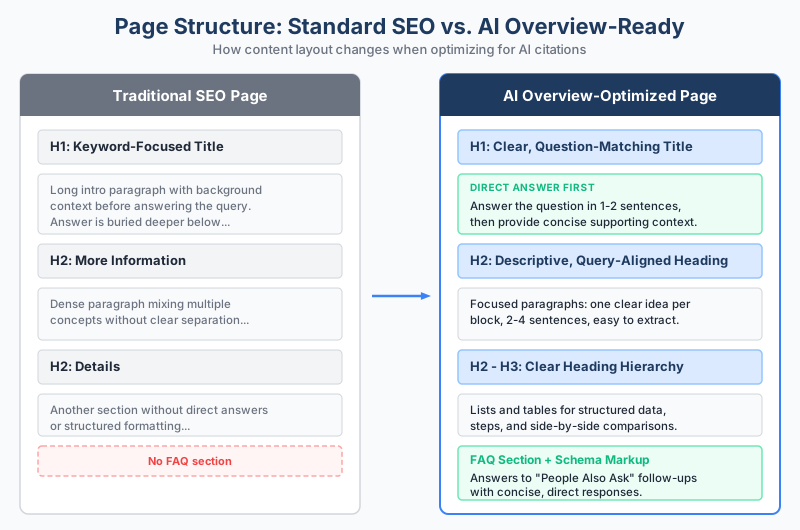
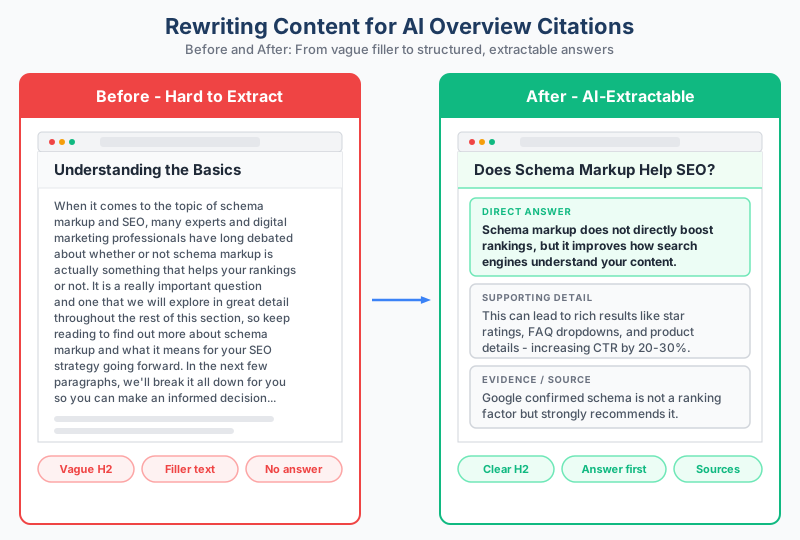
Lead with direct answers. When your content addresses a question, answer it clearly within the first few sentences of the relevant section. Do not bury the answer under three paragraphs of context. Put the answer first, then provide supporting detail.
Use a clear heading hierarchy. Organize your content with descriptive H2 and H3 headings that signal what each section covers. Avoid vague headings like "More Information" or "Details." Instead, use headings that match the questions your audience is asking.
Use lists and tables where appropriate. For process-oriented content, numbered lists make step-by-step information easy to extract. For comparisons, tables present information in a format that AI can readily summarize.
Keep paragraphs focused. Each paragraph should convey one clear idea in two to four sentences. Dense paragraphs that mix multiple concepts are harder for AI systems to parse.
Step 3: Build Comprehensive Topical Coverage
AI Overviews synthesize information across subtopics. If your content only covers one narrow angle, it may not provide enough depth for Google to cite it as a primary source.
Build content clusters around your key topics. A pillar page covering the broad topic, supported by detailed articles on each subtopic, creates the kind of topical authority that AI systems recognize and draw from. This approach also strengthens your traditional SEO through improved internal linking and topical depth. For AI-specific visibility, implementing an llms.txt file can also help AI systems better understand your site's structure and key content.
Step 4: Implement Schema Markup
While Google has not confirmed that schema markup directly influences AI Overview selection, structured data helps Google understand your content's context, entities, and relationships. This is particularly valuable for FAQ content, how-to guides, and review-style content.
At minimum, implement FAQ schema on pages with question-and-answer sections, Article or BlogPosting schema with proper author information, and HowTo schema for step-by-step content. You can validate your implementation with Google's Rich Results Test or a schema markup checker.
Step 5: Strengthen E-E-A-T Signals
Google's quality raters evaluate Experience, Expertise, Authoritativeness, and Trustworthiness when assessing content. For AI Overviews, these signals are especially important because Google is putting its own reputation on the line by synthesizing and presenting your content as a trusted answer.
Practical ways to strengthen E-E-A-T include adding clear author bios with relevant credentials, citing authoritative sources throughout your content, demonstrating first-hand experience where applicable, keeping content accurate and up to date, and ensuring your site has a strong backlink profile from relevant domains.
Step 6: Optimize for Related Query Formats
AI Overviews often appear for question-based and conversational queries. Expand your content to address the natural follow-up questions users might ask after reading an initial answer.
Check Google's "People Also Ask" section for your target keywords. These questions represent the kinds of follow-up queries that AI Overviews may address. Including clear answers to these questions within your content increases the chances of being cited across multiple related queries.
Measuring Your AI Overview Performance
This is one of the most challenging aspects of AI Overview optimization. As of early 2026, measurement options are limited but improving.
Google Search Console includes AI Overview and AI Mode data within the standard "Web" search type in the Performance report. However, there is no separate filter to isolate impressions or clicks that came specifically from AI Overviews versus traditional organic results (Google Search Central). This means you cannot directly attribute traffic to AI Overview citations in Search Console alone.
What you can do is look for patterns: if impressions are growing while click-through rates are declining for informational keywords, AI Overviews may be a contributing factor. Cross-reference this data with third-party tools that track AI Overview presence for your keywords. Google has also confirmed that AI Mode traffic data now appears in Search Console's Performance report (Search Engine Land, 2025).
Third-party SEO tools from Ahrefs, Semrush, and others now offer AI Overview tracking features that show which of your keywords trigger AI Overviews and whether your pages are cited. These tools provide the most actionable data currently available.
Manual monitoring is still valuable for high-priority keywords. Regularly search your target queries and document which pages are cited. Track changes over time. This gives you qualitative insight into how your optimization efforts are performing.
For tracking your brand's visibility across AI platforms beyond just Google, including ChatGPT, Perplexity, and Claude, SEOForge's AI Visibility Monitor can help centralize this data. For a deeper look at measuring AI visibility across platforms, see our guide to AI search analytics.
AI Overviews vs. Featured Snippets
If you have been optimizing for featured snippets, you already have a head start. Many of the same principles apply: clear answers, structured content, and authoritative sources. But there are important differences.
Featured snippets pull content from a single page and display it almost verbatim. AI Overviews synthesize information from multiple sources and generate an original summary. This means the optimization goal shifts from "have the single best answer" to "be one of the authoritative sources on this topic."
Featured snippets are a winner-takes-all format. AI Overviews can cite multiple pages in a single response, which means more sites can benefit from a single query. However, the total click-through to any individual site may be lower since users often get enough information from the AI-generated summary itself.
Research from Ahrefs found that AI Overviews now correlate with a 58% lower average click-through rate for position one content compared to queries without AI Overviews (Ahrefs, 2026). This is a significant change from their earlier finding of a 34.5% reduction, and it reinforces why being cited inside the overview, rather than just ranking below it, is becoming increasingly important.
Common Mistakes to Avoid
Treating AI Overview optimization as separate from SEO. Google has been explicit that the same SEO best practices apply. Do not abandon your SEO fundamentals in pursuit of AI-specific tricks.
Overpromising results. No one can guarantee inclusion in AI Overviews. Google's systems are complex and dynamic. Focus on the factors you can control: content quality, structure, authority, and relevance.
Ignoring the evolving nature of this feature. AI Overviews are still changing. Query coverage fluctuates, source selection evolves, and new features like AI Mode are expanding the landscape. Build adaptable processes, not rigid checklists.
Optimizing only for AI Overviews while ignoring other AI search platforms. Google is one part of the picture. Users also get AI-generated answers from ChatGPT, Perplexity, Claude, and Microsoft Copilot. A comprehensive strategy for optimizing across AI search platforms accounts for all of these platforms. Understanding the differences between AEO and traditional SEO and learning about generative engine optimization (GEO) are good starting points.
Focusing on gaming the system rather than creating genuinely useful content. The content that consistently gets cited is content that clearly, thoroughly, and accurately answers questions. That has always been the foundation of good SEO, and it remains the foundation of AI Overview optimization.
Frequently Asked Questions
Can my content appear in AI Overviews even if it does not rank in the top 10?
Yes, and this is becoming more common. An updated Ahrefs study from early 2026 found that only about 38% of AI Overview citations come from pages ranking in the top 10, down from 76% in mid-2025. Google's expanded use of "query fan-out" techniques means content can be cited based on its relevance to sub-queries, even if it does not rank highly for the primary keyword. Strong topical authority and clear content structure help pages outside the top positions earn citations.
Does Google Search Console show AI Overview data separately?
Not yet. AI Overview impressions and clicks are included in the "Web" search type within the Performance report, but there is no dedicated filter to isolate them. Third-party tools currently offer better visibility into AI Overview-specific performance.
How long does it take to see results from AI Overview optimization?
This varies considerably. Structural improvements to existing high-ranking content can show results within weeks as Google recrawls and reprocesses pages. Building the topical authority needed for new content to be cited typically takes several months of consistent work, though timelines depend heavily on your existing domain authority and competitive landscape.
Will optimizing for AI Overviews hurt my traditional SEO performance?
No. The tactics that improve AI Overview visibility, like clear structure, comprehensive coverage, and strong E-E-A-T signals, also strengthen traditional SEO. These strategies are complementary, not competing.
Are AI Overviews the same as Google's AI Mode?
No. AI Overviews appear alongside traditional search results as a summary panel. AI Mode is a separate, more conversational search experience that does not display the standard ten blue links. Both cite web sources, but they use different models and may show different results for the same query.