If you've been in marketing for any length of time, you know SEO. You've optimized title tags, built backlinks, and tracked rankings. But a newer term keeps showing up in industry conversations: AEO, or Answer Engine Optimization.
The question most marketers are asking isn't "what is AEO?" It's "do I need to do something different, or is this just SEO with a new label?" The honest answer is: it's a bit of both. AEO and SEO share DNA, but they respond to fundamentally different user behaviors and platform mechanics. Understanding where they overlap and where they diverge is essential for any team investing in AI search optimization.
This article breaks down the core differences, shows where the two strategies reinforce each other, and gives you a practical framework for deciding where to invest your time and budget.
Key Takeaways
- AEO optimizes for AI-generated answers; SEO optimizes for search engine rankings. Both aim for visibility, but through different mechanisms and for different user behaviors.
- They are not competing strategies. Research from Semrush's analysis of 260 billion rows of clickstream data found that ChatGPT adoption does not reduce Google Search usage, suggesting these channels expand rather than replace each other.
- Strong SEO still supports AEO, but the link is weakening. Ahrefs' July 2025 data showed 76% of AI Overview citations came from top-10 organic results, but their March 2026 update found this dropped to 38% after Google's Gemini 3 upgrade. Traditional authority still matters, but it's no longer a reliable proxy for AI visibility on its own.
- AEO is still an emerging discipline. Measurement is imprecise, playbooks are evolving, and no one can guarantee placement in AI-generated responses.
- Most teams should strengthen SEO first, then layer AEO tactics on top. The foundations are largely the same: authoritative, well-structured, comprehensive content.
Defining the Terms
SEO (Search Engine Optimization) is the practice of optimizing websites and content to rank higher in traditional search engine results pages. It focuses on keywords, backlinks, technical health, and user experience to drive organic traffic from platforms like Google and Bing. If you're new to the concept, our guide on what SEO is covers the fundamentals.
AEO (Answer Engine Optimization) is the practice of structuring content so AI-powered platforms can extract, understand, and cite it in their responses. These platforms include ChatGPT, Google AI Overviews, Perplexity, Microsoft Copilot, Claude, and voice assistants like Alexa. The goal isn't to rank in a list of links, but to become the source an AI system references when generating an answer.
A related term you'll encounter is GEO (Generative Engine Optimization), which focuses specifically on large language models like ChatGPT and Claude. Some practitioners use AEO and GEO interchangeably, while others draw distinctions. The terminology is still settling. For a deeper look at GEO specifically, see our article on what GEO means.
AEO vs SEO: The Core Differences
Here's a side-by-side comparison of the two approaches across the dimensions that matter most for marketers:
| Dimension | SEO | AEO |
|---|---|---|
| Primary goal | Rank in search engine results | Get cited or mentioned in AI-generated responses |
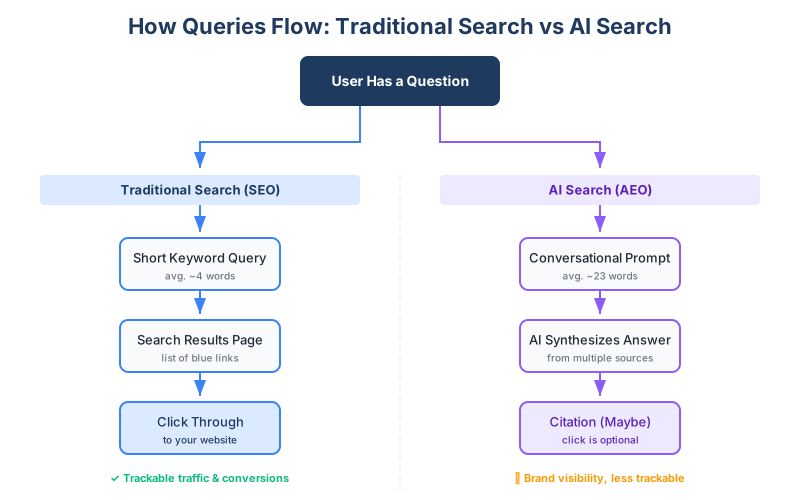
| User behavior | Short keyword queries (avg. ~4 words), scanning result lists | Conversational prompts (avg. ~23 words on ChatGPT), expecting direct answers |
| Key ranking factors | Keywords, backlinks, technical health, user engagement | Entity clarity, content comprehensiveness, authoritative citations, structured data |
| Measurement | Rankings, clicks, impressions, organic traffic | Mention tracking, citation monitoring, AI visibility share |
| Maturity | Well-established (25+ years of data and tools) | Emerging (limited playbooks, evolving rapidly) |
| Output format | List of clickable links | Synthesized answers, sometimes with source citations |
| Traffic model | Click-through to your website | May or may not generate a click; brand visibility even without clicks |
How User Behavior Differs
The most important distinction between SEO and AEO isn't technical. It's behavioral.
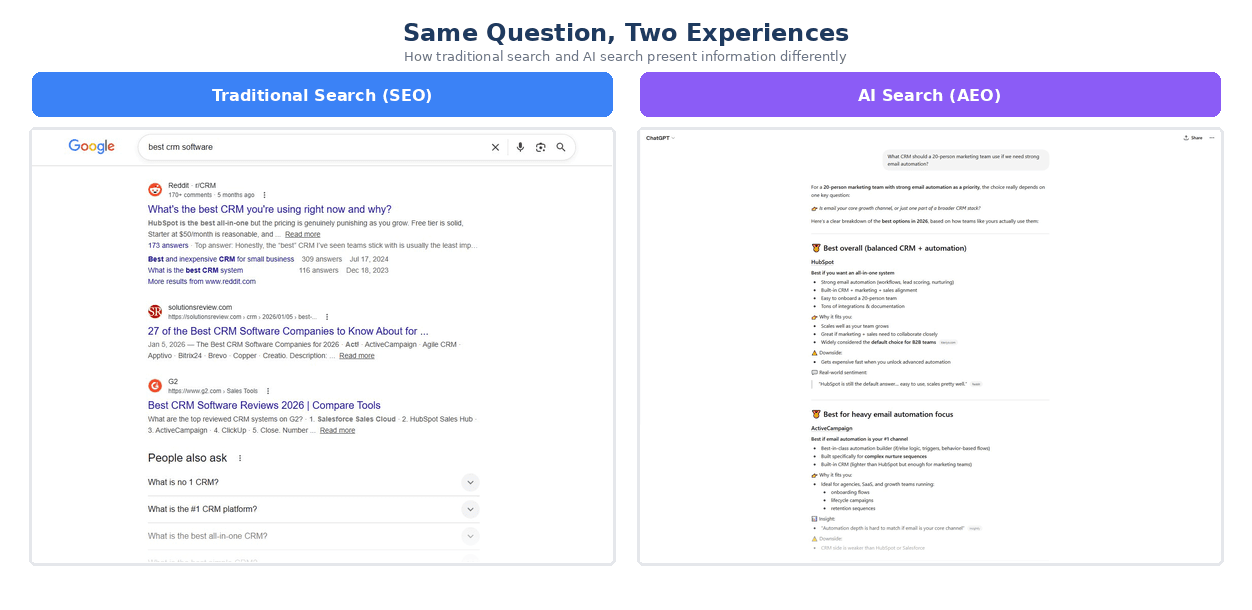
When someone uses Google Search in the traditional way, they type a short query like "best CRM software," scan a list of results, and click through to pages that look promising. The average Google search query typically runs just a few words. Users expect to do some of the synthesis work themselves, reading and comparing across multiple sources.
When someone uses ChatGPT or another AI platform, the interaction looks different. Semrush found that for most of its study period, 65% to 85% of ChatGPT prompts could not be matched to any traditional search keyword in its database. That suggests users often phrase AI queries in ways that do not resemble traditional Google searches. They ask more conversational, specific, and context-rich questions, especially when they expect the AI system to synthesize the answer for them. Follow-up questions are also part of the behavior. The user is having a conversation, not scanning a results page.
This shift in behavior is what makes AEO a distinct discipline. The content that performs well in AI responses needs to be comprehensive enough to be synthesized, clear enough to be extracted, and authoritative enough to be trusted as a source.
How Ranking Factors Compare
SEO success depends on a well-understood set of signals: on-page optimization, a strong backlink profile, technical health (site speed, mobile-friendliness, crawlability), and user engagement metrics. Google's own documentation and decades of practitioner experience provide a clear framework.
AEO is less well-defined. Based on early research and practitioner observation, the factors that correlate with AI citations include:
Entity clarity. AI systems need to understand what your content is about in unambiguous terms. Schema markup and structured data help (you can validate yours with a schema markup checker), as does consistent use of entities (people, organizations, products, concepts) throughout your content.
Comprehensiveness and depth. AI platforms tend to cite sources that cover a topic thoroughly. Thin, surface-level content rarely gets referenced.
Authoritative sourcing. Content that cites credible sources and demonstrates E-E-A-T signals (experience, expertise, authoritativeness, trustworthiness) is more likely to be selected by AI systems.
Content structure. Clear headings, well-organized sections, FAQ blocks, and direct answers to specific questions make it easier for AI systems to extract relevant information.
Where AEO and SEO Overlap
Despite the differences, AEO and SEO share more common ground than many marketers realize. In practice, the foundations are largely the same.
Authority signals still transfer, but less reliably than before. In mid-2025, Ahrefs found 76% of AI Overview citations came from top-10 organic pages. But their updated March 2026 study of 863,000 keywords and 4 million AI Overview URLs showed this dropped to 38%, likely driven by Google's Gemini 3 upgrade and increased use of "query fan-out" (where the AI splits a user's question into multiple sub-queries and pulls sources across all of them). Traditional SEO authority still matters for AI visibility, but the correlation is weakening as AI systems expand their source selection beyond page-one results.
Content quality matters everywhere. The same comprehensive, well-sourced, clearly structured content that ranks well in Google also tends to perform well in AI responses. There's no shortcut for either channel.
Technical foundations are shared. Structured data, fast page speeds, clean site architecture, and proper indexing support both traditional search visibility and AI discoverability.
Where they diverge most is in measurement and output format. SEO gives you clicks and traffic you can track in analytics. AEO gives you brand mentions and citations that may or may not result in a visit to your site, and tracking these mentions requires different tools entirely.
The Click Impact: What the Data Shows
The rise of AI-generated answers is changing click behavior, and the data is worth understanding even if some findings are still debated.
Ahrefs studied 300,000 keywords and found that, as of December 2025, the presence of an AI Overview correlates with a 58% lower click-through rate for the top-ranking organic result. This represents a significant acceleration from their earlier finding of a 34.5% CTR reduction based on March 2025 data.
Independent research corroborates the trend. A Pew Research Center study tracking the actual browsing behavior of 900 U.S. adults found that users clicked on a traditional search result just 8% of the time when an AI summary appeared, compared to 15% without one. Additionally, 26% of users ended their browsing session entirely after encountering an AI summary, versus 16% on pages without one.
However, the picture isn't entirely bleak. Semrush's analysis of over 10 million keywords found that when they tracked the same keywords before and after AI Overviews appeared, the zero-click rate actually decreased slightly, from 33.75% to 31.53%. Their interpretation: many queries that now trigger AI Overviews were already unlikely to generate clicks, and the relationship between AI features and click behavior is more complex than simple displacement.
What does this mean for your strategy? Traditional SEO still drives the vast majority of website traffic. But as AI-generated answers expand, optimizing for citation and mention visibility becomes an additional layer of your overall search strategy.
A Prioritization Framework
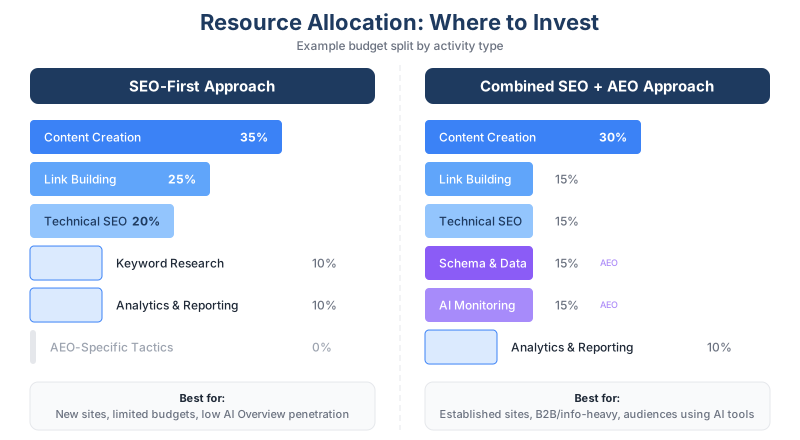
Not every team needs to invest equally in both AEO and SEO. Here's a practical framework for deciding where to focus:
Focus on SEO first when:
- You're building a site from scratch or have limited organic authority
- Your primary revenue comes from website traffic and on-site conversions
- Your industry has low AI Overview penetration (local services, e-commerce product pages)
- You need predictable, measurable results
Layer AEO on top when:
- You already have strong SEO foundations and domain authority
- Your audience actively uses AI tools for research and decision-making
- You operate in a space with high informational query volume (B2B software, healthcare information, professional services)
- You want to build brand visibility beyond click-through traffic
How to combine them effectively:
Start with the practices that serve both channels: create comprehensive, authoritative content with clear structure, proper schema markup, and credible sourcing. Then add AEO-specific tactics like optimizing for Google AI Overviews, implementing llms.txt files (you can create one with our free llms.txt generator), and monitoring your AI visibility with SEOForge's AI Visibility Monitor across platforms. As a starting point, run your site through an AEO readiness checker to identify quick wins.
Track both traditional SEO metrics (rankings, traffic, conversions) and emerging AEO signals (AI mentions, citation frequency, brand visibility in AI responses). Over time, the data will tell you where your audience is actually finding you, and where it's worth investing more.
What AEO Is Not
Given how new this discipline is, it's worth being clear about what AEO cannot promise:
AEO is not a replacement for SEO. Semrush's clickstream study found that ChatGPT adoption does not reduce Google Search usage. People use both. The channels are additive.
AEO cannot guarantee placement in AI responses. Unlike search rankings, where we understand the algorithm inputs reasonably well, AI response generation is less predictable and highly variable. Content that gets cited one day may not appear the next.
AEO is not a fully mature discipline. Best practices are still being defined, measurement tools are limited, and the platforms themselves change frequently. Anyone claiming a proven, reliable AEO playbook is overstating the current state of knowledge.
The smartest approach right now is to treat AEO as an important, evolving extension of your search strategy, not as a separate silo or a replacement for the fundamentals.
Frequently Asked Questions
Is AEO replacing SEO?
No. AEO complements SEO rather than replacing it. Research consistently shows that users who adopt AI tools like ChatGPT continue using Google at the same or slightly increased rates. The two channels serve different needs: SEO drives website traffic through ranked results, while AEO builds visibility in AI-generated answers. Most businesses will benefit from investing in both.
What does AEO stand for?
AEO stands for Answer Engine Optimization. It refers to the practice of optimizing your content so that AI-powered platforms, such as ChatGPT, Google AI Overviews, Perplexity, and voice assistants, can understand, extract, and cite it when generating answers to user queries.
Do I need different content for AEO and SEO?
In most cases, no. The same well-structured, comprehensive, authoritative content performs well for both. The difference is more about ensuring your content is formatted for AI extraction (clear headings, direct answers, structured data, FAQ sections) and that you're monitoring AI-specific visibility metrics alongside traditional SEO metrics.
How do I measure AEO performance?
AEO measurement is still evolving. Key metrics include: how often your brand or content appears in AI-generated responses, citation frequency across platforms like ChatGPT and Perplexity, referral traffic from AI sources, and share of voice in AI answers within your niche. Tools for AI search analytics are developing rapidly but aren't yet as mature as traditional SEO tools.
Which industries benefit most from AEO?
Industries where users commonly ask informational or research-heavy questions tend to see the most AI Overview activity. This includes technology, healthcare information, education, financial services, and B2B software. E-commerce and local services have seen less AI Overview penetration so far, though this is gradually expanding.