If your brand isn't showing up when someone asks ChatGPT for recommendations in your industry, you might never know. Unlike traditional search, where Google Search Console tells you exactly how many impressions and clicks you earned, there's no centralized dashboard for AI search optimization. AI responses are dynamic, personalized, and often differ from one query to the next.
That creates a measurement gap that most marketing teams are still figuring out how to close. The good news: while AI search analytics is still an emerging discipline, practical frameworks already exist for tracking your brand's visibility across AI platforms. This guide walks you through the metrics that matter, the measurement approaches available today, and how to build a monitoring process that connects AI visibility to real business outcomes.
The honest answer is that no one has this fully figured out yet. But waiting for perfect measurement means missing the window to establish your brand's presence in AI-generated answers.
Key Takeaways
- There's no Google Search Console for AI search. AI responses vary by session, user, and platform, making measurement inherently less precise than traditional SEO analytics.
- Focus on five core metrics: citation frequency, brand mentions, sentiment, recommendation context, and competitor share of voice.
- Start with manual prompt testing. Before investing in tools, run a structured audit of 20-30 key queries across ChatGPT, Perplexity, and Google AI Overviews to establish a baseline.
- Track trends, not snapshots. AI responses are volatile, so consistent monitoring over weeks and months reveals meaningful patterns that one-off checks cannot.
- Connect AI visibility to business signals. Look for correlations between AI mention increases and branded search traffic, self-reported attribution, and referral data.
The Measurement Challenge
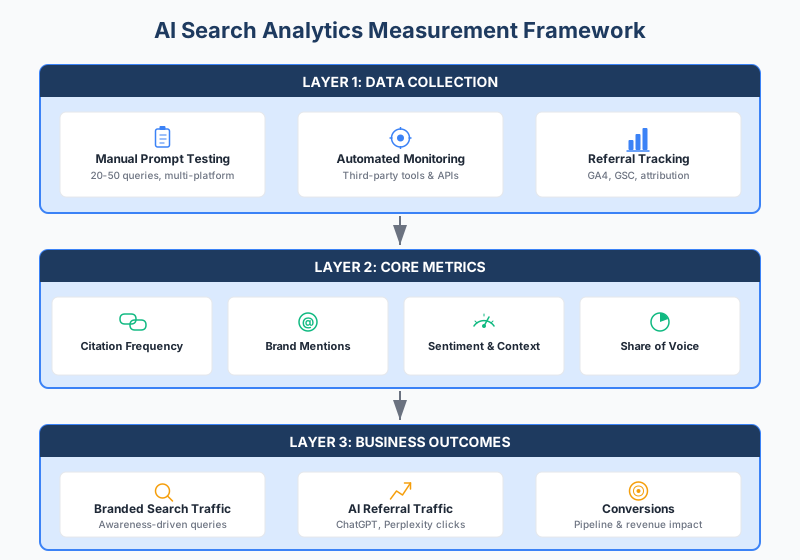
Traditional SEO analytics relies on a well-established data pipeline. Google Search Console shows impressions and clicks. Google Analytics tracks on-site behavior. Rank trackers monitor position changes daily. Every metric feeds into the next, creating a clear picture of performance.
AI search breaks this model in several important ways.
First, there is no universal reporting tool for AI platforms. Google has confirmed that AI Overviews and AI Mode data appear in Search Console's Performance report under the "Web" search type, but this data is not separated from traditional search results. You can see that clicks from AI features are counted, but you cannot isolate them. And for platforms like ChatGPT, Perplexity, and Claude, there is no equivalent reporting at all.
Second, AI responses are inherently inconsistent. The same question asked twice on the same platform can produce different brand recommendations, different source citations, and different framing. And AI Overviews themselves appear on a volatile and growing percentage of searches, making the landscape a moving target. This volatility makes single-check measurements unreliable.
Third, most AI interactions never result in a website visit. When a user asks ChatGPT "what are the best project management tools for small teams?" and gets a conversational answer, they may act on that recommendation without ever clicking a link. Your brand influenced a purchase decision, but your analytics dashboard shows nothing. Google AI Overviews present a slightly different dynamic, since they can include clickable source links, but research from Ahrefs found that AI Overviews reduce position-one click-through rates significantly, and zero-click behavior remains common across AI platforms.
These challenges don't mean measurement is impossible. They mean it requires a different approach than what most SEO analytics teams are used to. And they underscore why making your content as discoverable as possible, including implementing an llms.txt file to help AI systems understand your site (you can use our llms.txt generator to create one), matters alongside measurement.
Available Measurement Approaches
In practice, there are three tiers of measurement you can layer together, from simple and free to comprehensive and automated.
Manual Prompt Testing
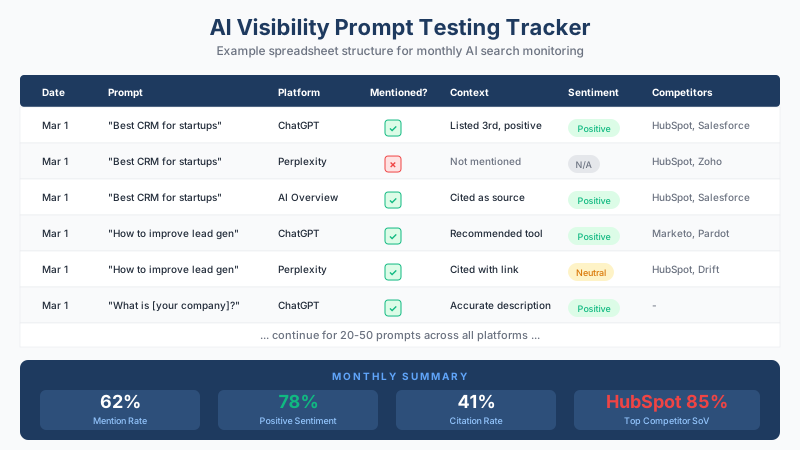
The simplest starting point is also the most instructive. Pick 20-30 queries that represent how your target audience searches for solutions in your space. Run each one across ChatGPT, Perplexity, Google AI Overviews, and Gemini. Document whether your brand appears, in what context, and which competitors show up instead.
Here's what this looks like in practice:
| Prompt | Platform | Your Brand Mentioned? | Context | Competitors Listed |
|---|---|---|---|---|
| "Best CRM for startups" | ChatGPT | Yes | Listed 3rd, positive | HubSpot, Salesforce, Pipedrive |
| "Best CRM for startups" | Perplexity | No | Not mentioned | HubSpot, Zoho, Monday |
| "Best CRM for startups" | Google AI Overview | Yes | Cited source | HubSpot, Salesforce |
This approach has clear limitations: it is time-consuming, results change between sessions, and it does not scale. But it gives you something no automated tool can fully replace, which is qualitative context about how AI systems frame your brand. Are you being recommended, or just listed? Is the sentiment positive or neutral? Are you positioned as a leader or an afterthought?
Run this exercise monthly to track directional trends.
Third-Party Monitoring Tools
A growing category of AI visibility platforms now automates what manual testing does by hand. These tools typically send structured prompts to multiple AI platforms on a recurring schedule, then track mentions, citations, sentiment, and competitive positioning over time.
As of early 2026, this tool category includes dedicated AI visibility trackers, traditional SEO platforms adding AI brand monitoring features, and brand monitoring tools expanding into LLM tracking. The landscape is evolving quickly, with new entrants launching regularly.
When evaluating these tools, focus on several key capabilities: how many AI platforms they cover, whether they track both brand mentions and source citations, how they handle the inconsistency problem (multiple runs per prompt), and whether they provide competitive benchmarking.
A word of caution: this category is still maturing. No tool has solved the fundamental problem that AI responses are nondeterministic. Use these tools for trend data, not absolute numbers.
API-Based Monitoring for Scale
For teams with engineering resources, AI platform APIs offer another monitoring path. OpenAI, Perplexity, and other providers offer APIs that let you programmatically send prompts and analyze responses. This enables higher-volume testing, such as running hundreds of prompts weekly and parsing responses automatically for brand mentions, competitor references, and sentiment.
The advantage is scale and consistency: an automated script runs the same prompts at the same intervals without human error. The trade-off is that API responses may differ from what end users see in the consumer-facing products, since parameters like temperature settings, model versions, and system prompts vary between the API and the chat interface. API-based monitoring works best as a complement to manual testing, not a replacement.
Referral Traffic and Analytics Signals
The third layer uses your existing analytics stack to detect AI-driven traffic. Google Search Console now includes AI Overview and AI Mode data in the standard Performance report, though it's blended with traditional search data. According to Google's documentation on AI features, users who click through from AI results tend to spend more time on site, suggesting stronger intent.
For traffic from ChatGPT and Perplexity, check your referral reports in Google Analytics. ChatGPT referral traffic has become identifiable in analytics as a distinct referral source. According to Semrush's research on AI search trends, AI referral traffic is a growing channel, though it still represents a small percentage of total traffic for most sites. Industry leaders expect this to change quickly: Search Engine Land reports that measurement frameworks for AI search visibility are solidifying in 2026 as the channel matures.
You can also look for indirect signals. Monitor branded search volume: if your AI mentions increase and branded searches rise in the same period, that correlation suggests AI visibility is driving awareness. Adding a "How did you hear about us?" field to forms with AI platform options provides direct attribution data.
Metrics That Matter
Not every data point is equally useful. Here are the five metrics worth tracking consistently, along with what each one actually tells you.
Citation frequency measures how often AI platforms reference your content as a source. This is the clearest signal that AI systems treat your brand as authoritative on a topic. Track this per platform, because citation behavior varies significantly between ChatGPT, Perplexity, and Google AI Overviews.
Brand mention rate captures references to your company even when no link is provided. A mention without a citation still shapes user perception. In practice, many AI recommendations influence decisions without ever generating a trackable click. Tracking mentions alongside citations gives you a fuller picture of your actual influence.
Sentiment and recommendation context goes beyond counting mentions to assess quality. Is your brand being recommended enthusiastically, listed neutrally among alternatives, or mentioned with caveats? A negative mention can be worse than no mention at all. This is where manual review adds value that automated tools often miss.
Competitor share of voice compares your visibility against competitors across the same set of queries. If a competitor appears in 80% of responses to your key prompts and you appear in 30%, you have a clear gap to close. This metric is most useful when tracked over time to see whether you're gaining or losing ground. Industry-specific benchmarks are starting to emerge: Search Engine Journal's 2026 AEO Benchmarks Report provides visibility data across 10 industries that can help you contextualize your numbers.
Citation quality distinguishes between linked citations (where the AI platform includes a URL to your content) and unlinked mentions (where your brand is named but not linked). Linked citations drive referral traffic. Unlinked mentions build awareness. Both matter, but they serve different purposes.
Setting Up a Monitoring Process
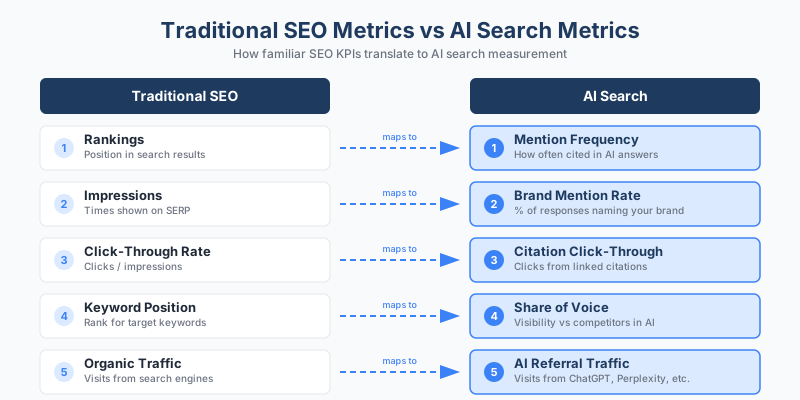
A repeatable monitoring process matters more than the specific tools you use. Here's a practical framework.
Step 1: Define Your Prompt Library
Start by identifying 20-50 prompts that reflect how your target audience uses AI search. These fall into three categories.
Brand queries test whether AI platforms know your brand: "What is [your company]?" and "Tell me about [your product]." Category queries test whether you appear in competitive contexts: "Best [your category] tools" and "What are the top [your category] solutions for [use case]?" Problem queries test whether you're recommended when users describe pain points: "How do I solve [problem your product addresses]?"
Step 2: Establish a Monitoring Cadence
Run your full prompt library across all tracked platforms at least monthly. For your top 10 most important queries, consider weekly checks. Document everything in a structured format, whether that's a spreadsheet, a dedicated tool, or a simple database.
Consistency matters more than frequency. A monthly check you actually do is worth more than a daily monitoring plan you abandon after two weeks.
Step 3: Build Competitor Baselines
You cannot assess your AI visibility in isolation. For each prompt in your library, document which competitors appear. Over time, this reveals patterns: which competitors dominate AI recommendations in your space, whether their dominance is consistent or platform-specific, and where gaps exist that you could fill.
Step 4: Connect to Business Metrics
The most important step is linking AI visibility data to outcomes your organization cares about. Set up dashboards that overlay AI mention trends with branded search volume from Google Search Console, referral traffic from AI platforms, form attribution data, and pipeline or revenue metrics if available.
This correlation analysis won't give you perfect attribution. But it will help you answer the question that matters most: is investing in AI visibility producing business results?
Interpreting Results
AI search analytics data requires careful interpretation. The field is still maturing, and the temptation to read too much into any single data point is real. Here are the principles that help you draw meaningful conclusions.
Trends over time matter more than any single data point. Because AI responses fluctuate from session to session, a single check is almost meaningless. Look for directional patterns across weeks and months instead. Is your mention rate trending up or down? Are you gaining or losing share of voice against specific competitors? A steady improvement from 20% to 35% mention rate over three months is a meaningful signal. A jump from 25% to 40% in a single week might just be noise.
Platform differences are significant and strategic. Your brand might appear consistently in Perplexity (which emphasizes source citations and links) but rarely in ChatGPT (which draws more heavily from its training data and web search results). Google AI Overviews behave differently again, pulling from indexed web content using what Google describes as a "query fan-out" technique that retrieves information across subtopics and data sources. These differences should inform platform-specific optimization strategies, not be averaged away into a single "AI visibility score."
Attribution will remain imperfect, and that's acceptable. No one can precisely measure how much revenue came from a ChatGPT mention. The same was true of brand advertising for decades before digital attribution models existed. Focus on directional evidence: if AI mentions go up and branded search follows in the same period, that's a meaningful signal even without pixel-perfect attribution. Self-reported attribution ("How did you hear about us?" with AI platform options) provides another useful data point.
Don't overreact to short-term swings. AI platforms update their models, adjust their retrieval systems, and change their response patterns regularly. A drop in mentions after a model update isn't necessarily a reflection of your content quality. Look for sustained patterns across multiple monitoring cycles before making major strategic changes. This is one area where AI search analytics differs sharply from traditional rank tracking, where a position change is usually directionally reliable.
For teams who want to scale their monitoring systematically, AI visibility tracking tools can automate prompt testing across platforms and track trends over time, replacing much of the manual work described above.
What to Do With What You Learn
Measurement only matters if it informs action. Here's how to close the loop.
If you're not appearing for key category queries, prioritize content that demonstrates clear expertise on those topics. AI systems favor content that is comprehensive and well-structured, supported by authoritative sources. Review the principles in our guide to generative engine optimization for specific tactics.
If competitors consistently outperform you, study what they're doing differently. Often, the brands that dominate AI recommendations have stronger entity recognition and E-E-A-T signals across the web: mentions in industry publications, consistent information across platforms, and content that directly answers the questions users are asking. Understanding the differences between AEO and traditional SEO can help you identify which optimization levers to pull first.
If your mentions are increasing but traffic isn't following, focus on improving citation quality. Content that earns linked citations (not just name drops) drives measurable referral traffic. Structured content with clear, quotable statements and original data tends to perform best.
The SEO KPIs you've always tracked still matter. AI search analytics adds a new layer on top of that foundation, not a replacement for it.
Frequently Asked Questions
Can Google Search Console show AI Overview performance separately?
Not as a standalone filter, as of early 2026. Google includes AI Overview and AI Mode clicks in the Performance report under the "Web" search type, but does not provide a way to isolate this data from traditional search clicks. You can use the Search Appearance filter to see some AI-related data, but comprehensive separation is not yet available.
How often should I check my AI visibility?
Monthly is a reasonable starting cadence for most teams. Run your full prompt library once per month and track your top 10 priority queries weekly. The key is consistency: pick a schedule you can sustain and stick to it. Sporadic checks produce unreliable data because AI responses fluctuate naturally between sessions.
Is AI referral traffic visible in Google Analytics?
Yes, for some platforms. ChatGPT referral traffic appears as a distinct referral source in GA4. Perplexity traffic is also identifiable. However, many AI-influenced visits arrive as direct traffic because the user searched your brand name after seeing an AI recommendation, which means your analytics will undercount the true impact.
What's the difference between citations and mentions in AI responses?
A citation is when an AI platform links to your content as a source, which is common in Perplexity and Google AI Overviews. A mention is when your brand is named in the response text without a link, which is more common in ChatGPT. Both are valuable, but citations drive direct referral traffic while mentions build brand awareness.
Do I need a paid tool to track AI visibility?
No. You can start with manual prompt testing using a simple spreadsheet, which costs nothing and provides rich qualitative data. Paid tools become valuable when you need to scale monitoring across hundreds of queries, track multiple competitors, or need automated reporting. Start manual, then invest in tools once you've validated that AI visibility matters for your business.