
If you've searched for something recently, there's a good chance you got an AI-generated answer instead of a list of links. Platforms like ChatGPT, Perplexity, Google AI Overviews, Claude, and Copilot are changing how people find information, and that shift has created a new challenge for anyone trying to be visible online.
Generative Engine Optimization, or GEO, is the emerging practice of optimizing your content so that AI systems can find, understand, and cite it when generating responses. It's a natural extension of AI search optimization, and it's gaining attention as more searches move toward conversational, AI-driven formats.
The honest answer is that GEO is still a young discipline. There's no guaranteed playbook. But the core principles are becoming clearer, and understanding them now gives you a meaningful advantage as this space matures.
Key Takeaways
- GEO stands for Generative Engine Optimization: It's the practice of making your content visible and citable within AI-generated responses from platforms like ChatGPT, Perplexity, and Google AI Overviews.
- The term has academic roots: Researchers from Princeton, Georgia Tech, the Allen Institute for AI, and IIT Delhi introduced the GEO framework in a November 2023 paper, demonstrating that specific optimization strategies can boost content visibility in generative engine responses by up to 40% (Aggarwal et al., 2024).
- GEO builds on SEO, it doesn't replace it: Strong traditional SEO foundations, like authority, content quality, and technical health, remain essential. GEO adds a layer focused on AI-specific visibility.
- Terminology is still evolving: GEO, AEO (Answer Engine Optimization), AIO (AI Optimization), and LLMO (Large Language Model Optimization) are often used interchangeably, though each has slightly different nuances.
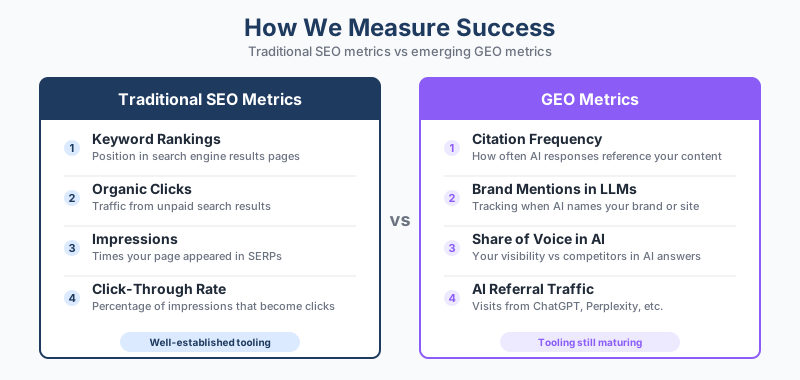
- Measurement is limited: Unlike traditional SEO, there's no equivalent of Google Search Console for tracking LLM citations. This is one of the biggest challenges in the space today.
What Generative Engine Optimization Means
GEO is the practice of structuring your content and online presence so that generative AI systems can retrieve, interpret, and reference your information when answering user queries. In practice, this means creating content that AI platforms treat as a trustworthy source worth citing.
Traditional search engines rank pages and present a list of links. Generative engines work differently. They synthesize information from multiple sources and present a unified response, sometimes with citations, sometimes without. When someone asks ChatGPT or Perplexity a question, the AI reads, evaluates, and summarizes content from across the web, then constructs an original answer.
The goal of GEO is to ensure your content is part of that process. Not just indexed, but actually selected and referenced when the AI assembles its response.
Here's what this looks like in context: a user asks Perplexity, "What's the best approach to keyword research for a new website?" The AI pulls from several sources, synthesizes an answer, and links to the ones it considers most useful. If your content is clear, comprehensive, and authoritative on that topic, you have a better chance of being cited.
Where the Term Came From
The concept of GEO was formalized in a November 2023 research paper titled "GEO: Generative Engine Optimization," authored by researchers from Princeton University, Georgia Tech, the Allen Institute for AI, and IIT Delhi. The paper was later presented at KDD 2024, the ACM's annual conference on knowledge discovery and data mining (Aggarwal et al., KDD 2024).
The researchers proposed GEO as a systematic framework for helping content creators improve visibility within AI-generated responses. To test it, they created GEO-bench, a benchmark of 10,000 diverse queries across multiple domains, and evaluated nine different optimization strategies.
Their key finding: tactics like including citations, adding relevant statistics, and using authoritative language could boost a source's visibility in generative engine responses by up to 40%. Importantly, these strategies worked differently across domains. Authoritative language helped most with historical content, citation optimization benefited factual queries, and statistics improved performance for topics in law and government.
The research also revealed something interesting for smaller publishers. According to the paper, websites that ranked lower in traditional search results benefited significantly more from GEO strategies than those already ranking at the top. This suggests that GEO could help level the playing field for content that's well-optimized but lacks traditional ranking authority.
GEO vs AEO vs Traditional SEO
If you've come across the terms GEO, AEO, and traditional SEO and found them confusing, you're not alone. The terminology is still being defined, and different sources use these terms in overlapping ways.
Here's how they generally break down:
| Dimension | Traditional SEO | AEO (Answer Engine Optimization) | GEO (Generative Engine Optimization) |
|---|---|---|---|
| Focus | Ranking in search engine results | Appearing in direct answer formats | Being cited in AI-generated responses |
| Target Systems | Google, Bing (organic results) | Featured snippets, voice assistants, People Also Ask | ChatGPT, Perplexity, Google AI Overviews, Claude |
| Core Signals | Keywords, backlinks, technical health | Question-answer formatting, structured data | Entity clarity, comprehensiveness, citation-worthiness |
| Measurement | Rankings, clicks, impressions | Featured snippet capture rate | Mention tracking, citation frequency |
| Maturity | Well-established (25+ years) | Established (5-10 years) | Emerging (2-3 years) |
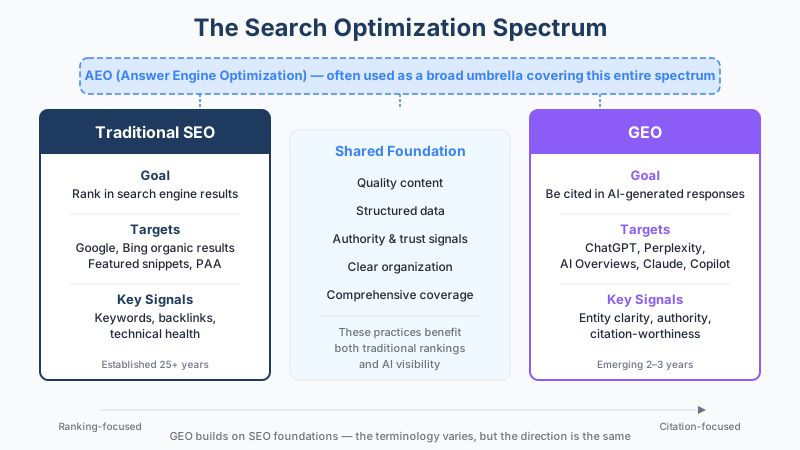
AEO is sometimes used as a broader umbrella that includes GEO. Other times, GEO is positioned as the more specific term for optimization targeting large language models. For a deeper comparison of these approaches, see our guide on AEO vs SEO.
What matters more than the label is the underlying principle: as AI systems become a primary channel for information discovery, your content needs to be optimized for how those systems source and present information.
Core GEO Principles
While GEO is still an emerging discipline, several principles are becoming consistent across early research and industry practice.
Entity Clarity and Structured Data
AI systems need to understand what your content is about, not just the keywords it contains. This means defining entities clearly: your brand, the products you discuss, the people and concepts you reference. Using structured data via Schema.org markup helps AI crawlers parse your content with greater precision.
In practice, this looks like: clear definitions early in your content, consistent terminology, and structured data that explicitly identifies your organization, authors, and topics.
Comprehensive, Authoritative Content
Generative engines tend to favor content that covers a topic thoroughly. Thin or surface-level content is less likely to be selected as a source. The Princeton GEO study specifically found that authoritative language and comprehensive coverage were among the most effective optimization strategies.
This aligns closely with E-E-A-T principles: demonstrating experience, expertise, authoritativeness, and trustworthiness through your content.
Citation-Worthy Information
Content that includes original data, specific statistics, expert quotes, and well-sourced claims is more likely to be cited by AI systems. The GEO research showed that adding relevant citations and statistics to content significantly improved visibility in generative engine responses.
From experience, this means treating every piece of content as if it needs to serve as a primary source. If an AI system is looking for a definitive answer on a topic, your content should be the one worth referencing.
Clear, Well-Organized Structure
AI models process content structurally. Clear headings, logical flow, direct answers to questions, and well-organized sections all help generative engines extract and use your information accurately. This is one area where there's strong overlap with traditional SEO best practices.
The Current State of GEO
It's important to be honest about where GEO stands as of early 2026. This is an emerging discipline with real promise but significant limitations.
According to a Semrush analysis of over 10 million keywords, Google AI Overviews appeared in a fluctuating percentage of queries throughout 2025, peaking in mid-year before pulling back. Meanwhile, Search Engine Land reported that GEO strategies are showing measurable impact in research settings, but real-world application is still in its early stages.
Several factors make this space challenging:
Measurement is limited. There's no Google Search Console equivalent for LLM citations. You can track referral traffic from AI platforms and manually test your visibility, but comprehensive tracking tools are still maturing. For a deeper look at the current state of measurement, see our guide on AI search analytics. SEOForge's AI Visibility Monitor can help fill this gap, tracking how often brands appear in AI-generated responses across platforms like ChatGPT and Perplexity.
AI systems change frequently. The models powering these platforms are updated regularly, and what works today may shift as models evolve. This is similar to how Google algorithm updates change traditional SEO, but the pace of change in AI search is faster.
No one has "cracked the code." Anyone claiming to have a guaranteed GEO strategy is overpromising. The field is too new and the systems are too opaque for certainty. What we have are strong hypotheses backed by early research and industry observation.
Traditional SEO still matters. Multiple studies show significant overlap between pages that rank well in traditional search and those cited by AI systems. Strong organic performance remains one of the best predictors of AI visibility. According to Ahrefs' research, a mid-2025 study found 76% of URLs cited in Google AI Overviews ranked in the top 10, but an updated February 2026 analysis of 863,000 keywords showed that figure dropped to approximately 38%. This suggests Google's AI is increasingly drawing from beyond page one, making comprehensive, authoritative content even more important regardless of current ranking position.
How to Get Started with GEO
If you're already investing in content quality and traditional SEO fundamentals, you have a strong starting point. Here's what to layer on:
- Audit your content for AI readability. Is your content clearly structured? Does it answer questions directly? Are key terms and concepts defined early?
- Implement structured data. Schema markup helps AI systems understand your content's context. Start with Organization, Article, and FAQ schema at minimum.
- Create an llms.txt file. This emerging standard helps AI crawlers understand your site structure. You can generate one quickly using our free llms.txt generator.
- Test your visibility manually. Ask ChatGPT, Perplexity, and Google AI Overviews questions related to your topics. Note whether your brand or content is cited, and track changes over time.
- Focus on being the best source. The most reliable GEO strategy is also the simplest: create content that's genuinely the most comprehensive, accurate, and well-sourced resource on your topic. AI systems are designed to find and reference the best available information.
Frequently Asked Questions
Is GEO replacing SEO?
No. GEO builds on SEO fundamentals and extends them to cover AI-powered search platforms. Traditional SEO remains critical because strong organic performance is one of the strongest predictors of AI visibility. Think of GEO as an additional optimization layer, not a replacement.
What tools can I use to track GEO performance?
Dedicated GEO tracking tools are still emerging. Currently, you can monitor referral traffic from AI platforms in Google Analytics, manually test queries across ChatGPT and Perplexity, and use specialized AI monitoring platforms that track citation frequency and brand mentions across LLM responses.
How is GEO different from optimizing for Google AI Overviews?
Google AI Overviews optimization is a subset of GEO. GEO encompasses all generative AI platforms, including ChatGPT, Perplexity, Claude, and Copilot, while AI Overviews optimization focuses specifically on Google's AI-generated summaries within search results.
Do I need to completely change my content strategy for GEO?
Not likely. If you're already creating comprehensive, well-structured, authoritative content, you're well-positioned. GEO refinements tend to be additive: better structure, clearer entity definitions, more thorough sourcing, and implementation of structured data and emerging standards like llms.txt.
When will GEO become mainstream?
It's happening now, but gradually. As AI search platforms continue growing and more users shift toward conversational information discovery, GEO will become an increasingly standard part of any digital marketing strategy. The earlier you start building these practices, the better positioned you'll be.