
Every keyword research tool greets you with the same number: a keyword difficulty score between 0 and 100. It looks authoritative. It feels like a verdict. And it is easily the most misread metric in SEO.
The problem is not the score itself. Keyword difficulty (KD) is a useful proxy for estimating how much backlink authority a page likely needs to reach the first page of Google. The problem is treating that proxy as the whole story. A keyword with a KD of 15 can still be unwinnable if the SERP is dominated by Reddit threads Google clearly prefers. A keyword with a KD of 65 can be surprisingly accessible if the top ten are thin, outdated product pages and your site has topical depth.
This guide explains what keyword difficulty actually measures, why scores differ so dramatically between tools, how to interpret a KD number relative to your own site, and what to look at beyond the score before committing content resources. If you are new to keyword research overall, start with our keyword research guide and come back here once you need to prioritize.
Key Takeaways
- Keyword difficulty is an estimate, not a ruling. KD scores reverse-engineer Google's backlink-driven ranking signals from the top 10 pages. They do not account for on-page quality, intent alignment, or your site's specific authority.
- Different tools produce different scores because they use different formulas. Ahrefs relies almost entirely on referring domain counts. Semrush weights multiple factors including authority scores and SERP features. Moz uses Page and Domain Authority. Cross-check across at least two tools.
- KD is relative to your site, not absolute. A KD of 50 can be easy for an established site with topical authority and very hard for a new domain. Semrush's Personal Keyword Difficulty concept formalizes what experienced SEOs have always done informally.
- Manual SERP analysis matters more than the score. Before writing, check content format, freshness, intent match, and SERP features. These routinely override what the KD number suggests.
- Treat KD as a filter, not a decision. Use it to narrow thousands of candidates into a manageable shortlist. Make the actual go/no-go call from direct SERP inspection.
What Is Keyword Difficulty?
Keyword difficulty is a score, typically on a 0 to 100 scale, that estimates how hard it would be to rank a new page in the top 10 organic results for a given keyword. Higher numbers mean more competitive SERPs. Lower numbers suggest the top results are more vulnerable to new, well-executed content.
The score is derived by analyzing the pages currently ranking for the keyword, specifically factors like how many unique websites link to them, how strong those linking sites are, and in some tools, the authority of the domains themselves. The exact formula varies by vendor, which is why the same keyword routinely returns different scores across Ahrefs, Semrush, and Moz.
One clarification worth making early: KD is not a metric Google publishes or uses internally. There is no "keyword difficulty" dial inside Google's ranking systems. KD scores are third-party estimates built by SEO tools that reverse-engineer what we know about Google's signals, primarily PageRank-style link analysis, into a comparable number across keywords.
That distinction matters because it explains both why KD is useful and why it is incomplete. It approximates one important dimension of ranking difficulty (link-based competition) but ignores others that can decide whether you rank, including search intent match, content quality, freshness, and SERP feature dominance.
How SEO Tools Calculate Keyword Difficulty
Each major tool uses its own formula, and understanding the differences is the first step to interpreting scores correctly.
Ahrefs. Ahrefs bases its KD entirely on one signal: how many unique websites link to each of the top 10 ranking pages. The more referring domains those pages have accumulated, the higher the score. Ahrefs deliberately excludes on-page SEO factors from this calculation, arguing that backlink data is the most measurable, reliable correlate of rankings. The tradeoff is that the score reflects only link-based competition, and Ahrefs itself recommends adding manual SERP review on top of it.
Semrush. Semrush uses a composite formula that blends several signals into a single score. These include the median count of referring domains across ranking URLs, the ratio of followed to nofollowed links pointing to those pages, the median authority of the ranking domains, and SERP-level characteristics of the keyword itself. The tradeoff is reduced transparency: the score captures more of the competitive picture, but you cannot easily tell which specific factor is pushing a given number up or down.
Moz. Moz's KD is commonly understood to be derived primarily from the Domain Authority and Page Authority of the top 10 results. If the ranking set is dominated by high-DA domains, the score rises.
All three return a 0-100 number, but they are measuring slightly different things. A KD of 40 in Ahrefs is an estimate of how many referring domains you would likely need. A KD of 40 in Semrush is a composite score. These are not interchangeable.
Why Scores Vary So Much Between Tools
It is common to see the same keyword return a KD of 83 in Ahrefs, 100 in Semrush, and 72 in Moz. This is not because one tool is wrong and another is right. It is because each tool weights different signals and normalizes them to its own 0-100 scale.
The practical implication: do not treat a single tool's KD as the authoritative number. Check at least two, and understand what each one is actually measuring.
How to Interpret a KD Score
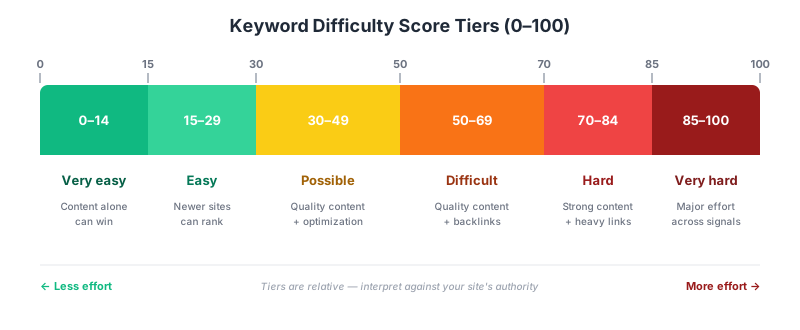
Most tools break the 0-100 scale into rough tiers. Semrush's public bands, documented in their keyword difficulty methodology overview, are a useful baseline to reason from, even if the exact cutoffs differ by tool:
| Score Range | Semrush Label | What It Typically Means |
|---|---|---|
| 0-14 | Very easy | Minimal link competition; strong content on a decent domain can rank |
| 15-29 | Easy | Some competition but achievable, even on newer domains |
| 30-49 | Possible | Requires quality, well-structured content with proper optimization |
| 50-69 | Difficult | Needs quality backlinks alongside strong content |
| 70-84 | Hard | Significant link building plus excellent content required |
| 85-100 | Very hard | Major effort across content, links, on-page, and promotion |
These tiers align with how Semrush publicly describes its own KD bands: the lowest range represents keywords that can be won with good content alone, the mid-range demands well-optimized content and often some backlink support, and the highest bands require sustained effort across content, links, on-page optimization, and active promotion.
These tiers are general guidelines, not rules. What "easy" means for your site depends entirely on your current authority, which is the most important concept to internalize.
Keyword Difficulty Is Relative, Not Absolute
This is the single most misunderstood aspect of KD, and the reason many SEOs dismiss the score entirely when used naively.
A KD of 50 is not an objectively fixed level of effort. It is an average estimate for an average site trying to enter the top 10. A site with strong existing authority in the topic area, plenty of relevant backlinks, and a track record of ranking for adjacent terms will find a KD 50 keyword notably easier than a brand new site targeting the same phrase.
Ahrefs frames this as "Personal Keyword Difficulty" using a highway-speed analogy: a posted limit of 70 MPH is the same number for every driver, but what feels fast or slow depends heavily on the car you are actually driving. A high-authority site with deep topical coverage sails through KD 70 keywords that would exhaust a new domain.
Semrush has formalized the concept directly in its tool, presenting a Personal Keyword Difficulty score alongside the general KD. Where general KD reflects the average difficulty of competing for a keyword, PKD adjusts that estimate for your specific site's authority, showing what the target actually looks like from your starting position.
In practice, this means you should interpret every KD score through a simple question: how does my site's authority compare to what is currently ranking? If top-ranking pages sit on domains with authority scores well above yours, expect the keyword to be harder than the KD suggests. If you see pages with authority below yours in the top 10, the keyword is probably easier than the score implies.
Beyond the Score: What KD Does Not Tell You
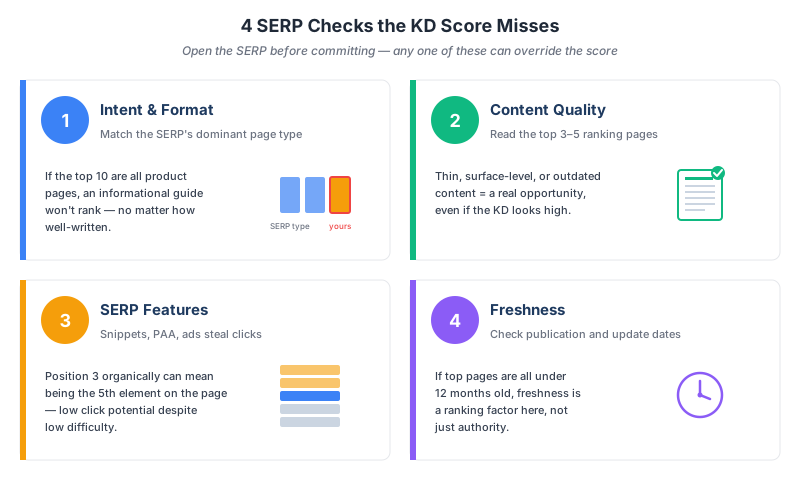
KD is a useful starting filter. It is not a sufficient signal for deciding whether to invest in a keyword. Four things matter alongside the score, and any one of them can override it entirely.
1. Search Intent and Content Format
KD measures backlink competition. It does not measure whether Google wants the kind of content you plan to create.
If the top 10 results for a "low-difficulty" keyword are all product pages and you plan to write an informational guide, your content will likely not rank regardless of its quality. Google's search intent classification is often decisive. Always open the SERP before committing: if the ranking pages are a different format (video, listicle, product, forum thread, tool), your planned format needs to match or you are fighting the algorithm.
2. Content Quality of Current Top Results
The KD formula does not read the content on ranking pages. It only measures the strength of signals pointing at them. This creates opportunity: a keyword with moderately high KD but thin, outdated content in the top 10 may be more winnable than the score suggests, especially if you can produce genuinely better material.
Read the top 3-5 results before making a decision. Look for obvious weaknesses: surface-level coverage, missing examples, out-of-date information, weak structure. These are signals that content quality could overcome a higher link-based difficulty.
3. SERP Features and Click Potential
A keyword can have a low KD and still be a bad investment if the SERP is dominated by features that capture clicks before users reach the organic results. AI Overviews, featured snippets, People Also Ask boxes, knowledge panels, local packs, video carousels, and ad stacks all compress the space available for organic traffic. AI Overviews are the biggest recent shift here: they can answer the query directly above the organic list, pushing the first real result far down the page and absorbing clicks that used to go to it.
Check the full SERP layout, not just the organic list. If position 3 organically means being the fifth or sixth visible element on the page, the click potential may not justify the effort regardless of difficulty.
4. Freshness and Update Patterns
For some topics, Google demonstrably prefers recent content. If the top-ranking pages are all less than 12 months old, or were updated within the last quarter, you are competing on freshness as much as on links. A well-resourced page from 2023 with 500 referring domains may be weaker than a recent piece with 50 referring domains if the topic shifts quickly.
Using Keyword Difficulty in Prioritization
With those caveats in place, KD is genuinely useful for narrowing large keyword lists into a working shortlist. A practical workflow looks like this:
- Generate candidates. Pull all keywords relevant to your topic. Automated tools can accelerate this; SEOForge takes you from raw keyword discovery through to a planned content calendar, so the candidates you pull here carry straight into the rest of this workflow.
- Filter by KD appropriate to your site. For new sites, filter to KD under 20. For sites 6-18 months old with some authority, 15-40 is a reasonable band. Established sites with strong topical authority can realistically target 40-70. Sites with years of history and robust link profiles can pursue 60+.
- Cross-check with a second tool. If Ahrefs says 25 and Semrush says 55, investigate the discrepancy before acting on either.
- Shortlist the 20-30 most promising candidates. Apply volume, relevance, and commercial value filters.
- Open the SERP for every shortlisted keyword. Check intent match, content quality, SERP features, and freshness. Eliminate anything that fails these checks, regardless of what the KD said.
- Map the survivors to content briefs. Prioritize by expected ROI, not by KD alone.
This workflow also ties into broader SEO competitive analysis, where understanding which competitors rank for which terms shapes your whole content strategy. For beginners, starting with low competition keywords and long-tail keywords is usually the most pragmatic path.
The Limitations of Keyword Difficulty Metrics
It is worth stating the limitations directly, because many common SEO mistakes come from ignoring them.
- KD is an estimate, not a measurement. The score is a model output. Models are wrong, and they are wrong in different directions for different keywords.
- KD does not account for on-page quality. It cannot see whether the ranking pages are any good. That is your manual job.
- KD does not account for your site's specific authority. General KD treats you as an average site. You are not.
- KD does not measure intent alignment. A mismatch can sink a low-KD target; a match can rescue a high-KD one.
- KD assumes backlinks as the dominant ranking signal. Backlinks remain important but search increasingly weights topical authority, user engagement, and content quality, which KD does not capture.
- KD scores drift over time. SERPs change, new pages enter, existing pages gain links. The KD you saw three months ago may be different today.
None of this makes KD useless. It makes it a starting point rather than a conclusion. Used as the first filter in a thoughtful research process, it saves significant time. Used as the final answer, it produces bad decisions.
Frequently Asked Questions
What is a good keyword difficulty score?
There is no universal "good" score; it depends on your site's authority. For new sites, aim for KD under 20. For growing sites (6-18 months), 15-40 is workable. Established sites with strong topical authority can realistically target 30-60, and authoritative sites can pursue 60+. The right score is one that is challenging enough to be worth the traffic but realistic for your current domain strength.
Why do Ahrefs, Semrush, and Moz show different KD scores for the same keyword?
Because they use different formulas. Ahrefs calculates KD primarily from referring domain counts on top-ranking pages. Semrush factors in referring domains, dofollow/nofollow ratios, domain authority scores, and SERP features. Moz uses Page Authority and Domain Authority of the ranking pages. Each tool normalizes its calculation to a 0-100 scale, which makes the scores look directly comparable when they are not.
Should I avoid high keyword difficulty keywords entirely?
No. High-KD keywords often have significant commercial value and long-term traffic potential. The question is sequencing: if your site does not yet have the authority to compete, target lower-KD keywords first, build topical authority, and graduate to harder terms as your position strengthens. Many successful SEO strategies plan a 12-24 month path from easy wins to competitive terms.
Can I rank for a keyword with zero backlinks?
Sometimes, especially for very low-KD long-tail keywords or topics with weak competition. But for most commercial or informational keywords above KD 20, the top-ranking pages have at least some backlink support. Exceptional content, strong topical authority in the subject area, and solid on-page optimization can partially substitute for backlinks on easier keywords. On harder ones, backlinks remain a significant factor.
Does AI Overviews change how I should use keyword difficulty?
Yes, in how you read the SERP, not in how the score is calculated. KD still estimates link-based ranking difficulty, but it says nothing about whether an AI Overview sits above the organic results and answers the query before anyone scrolls. A low-KD keyword can be a weak investment if an AI Overview absorbs most of the clicks, while a keyword whose Overview cites its sources can still send qualified traffic. Open the live SERP for shortlisted keywords, note whether an AI Overview is present and how far it pushes the first organic result, and weigh that into the call. For how to position content to be cited in those answers, see our guide to AI search optimization.
Is keyword difficulty the same as keyword competition?
They are often used interchangeably but originally meant different things. Keyword difficulty refers to organic ranking difficulty, measured by third-party SEO tools from the strength of currently ranking pages. Keyword competition is a term Google Keyword Planner uses to describe how many advertisers are bidding on a keyword in Google Ads. The two measure different things: organic difficulty versus paid competition.