
If you searched for "shoes" and landed here, you would probably be disappointed. If you searched for "how to choose long-tail keywords for a new SEO site," you are in the right place. That contrast is the entire point of long-tail keyword strategy: specificity changes who shows up, how hard it is to rank, and how likely a visitor is to care about what you are offering.
Long-tail keywords are the backbone of most small and mid-sized SEO strategies, and they are becoming more important as AI-powered search rewards pages that answer very specific questions. They sit within the broader keyword research process, but they behave differently enough to deserve their own playbook. This article zooms in on long-tails: what qualifies as one, why they matter, and how to actually find and use them.
Key Takeaways
- Long-tail keywords are defined by search volume, not word count. A one-word keyword can be long-tail if it has very low monthly searches, and a five-word phrase can be a competitive head term.
- The long tail makes up the majority of search queries. Backlinko's analysis of 306 million keywords found that 91.8% of all search queries are long-tail, though collectively they represent a smaller share of total search volume.
- Specificity drives intent. People searching long-tail phrases typically know what they want, which tends to produce better engagement and conversion than broad head terms.
- Long-tails are easier to rank for. Lower competition makes them the practical starting point for new sites, niche businesses, and any content team working without heavy backlink authority.
- AI search rewards specificity. Generative answers and conversational queries surface pages that match precise questions, which makes long-tail optimization more valuable, not less.
What Long-Tail Keywords Are
A long-tail keyword is a search query with low monthly search volume, typically reflecting a specific need or question. The canonical example contrasts a broad term like "shoes" with something specific like "women's waterproof trail running shoes size 8." The first is a head term with massive volume and brutal competition. The second is a long-tail keyword with a tiny audience, minimal competition, and a much clearer picture of what the searcher actually wants.
The common misconception is that any keyword with three or more words qualifies as long-tail. That is a useful rule of thumb, but it is not the actual definition. Some short phrases get almost no searches, and some longer phrases are hugely popular. Volume is what matters. A keyword like "how to lose weight" contains four words but drives hundreds of thousands of monthly searches, which is not long-tail behavior.
In practice, most long-tail keywords do end up being three or more words simply because specificity tends to require more words. But treating word count as the defining feature leads teams to target the wrong opportunities.
Why They Are Called "Long-Tail": The Search Demand Curve
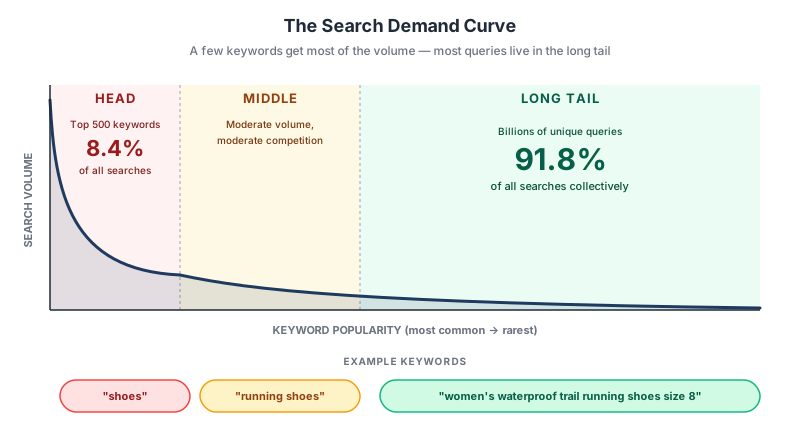
The name comes from the shape of the search demand curve. If you plot every search query by popularity, a handful of terms at the "head" capture an outsized share of attention, and an enormous "tail" of rarely-searched queries stretches out behind them. That tail is where most individual keywords live, even though each one gets very few searches.
The scale is striking. Backlinko's study of 306 million keywords found that the top 500 keywords account for 8.4% of all search volume, while the remaining billions of queries split the rest. Search demand is concentrated at the head, but keyword diversity is concentrated in the tail.
A related fact from Google helps explain the phenomenon. In 2018, Google's then VP of Search, Ben Gomes, wrote that 15 percent of queries are ones Google has never seen before, and the company has reaffirmed that figure several times since. At Search Central Live NYC in 2025, Google's John Mueller confirmed the share has held steady even as AI search introduced new query patterns. That means a meaningful portion of every day's searches are effectively brand new phrases, which is structurally impossible without a very long tail of unique, specific queries.
Why Long-Tail Keywords Matter for SEO
Three reasons make long-tail keywords disproportionately valuable, especially for smaller sites.
Lower competition. Broad head terms are typically dominated by sites with massive backlink profiles and years of topical authority. Long-tail phrases attract far less competition because fewer pages are explicitly written to answer them. A new site has a realistic chance of ranking for "best budget pickleball paddles for beginners over 50" in a way it never will for "pickleball paddles." For more on identifying these opportunities, see our guide on low-competition keywords.
Higher intent. Specificity signals where someone is in their decision process. Someone searching "running shoes" could be researching, browsing, or just curious. Someone searching "best trail running shoes for narrow feet under $150" has narrowed the problem to a purchase decision. That clarity of intent tends to produce higher engagement metrics and better conversion, which also helps rankings over time. Understanding this connection is core to matching content to search intent.
Collective traffic adds up. No single long-tail keyword drives serious volume, but a site that ranks for hundreds or thousands of them accumulates meaningful traffic. This is the practical reason that sites focused on long-tail keywords often outperform their head-term-focused competitors in total organic traffic over time.
There is also a newer reason worth naming. AI-powered search surfaces like Google's AI Overviews, ChatGPT search, and Perplexity tend to retrieve and synthesize content that directly answers specific questions. Pages written around long-tail, question-style phrases are structurally well-matched to how these systems pull information. Google's BERT update in 2019 was an early signal of this shift; announcing it, Google's Pandu Nayak noted it would especially help longer, more conversational queries. The direction has only continued.
Head vs Long-Tail: Key Differences
The practical differences matter when deciding where to invest content resources.
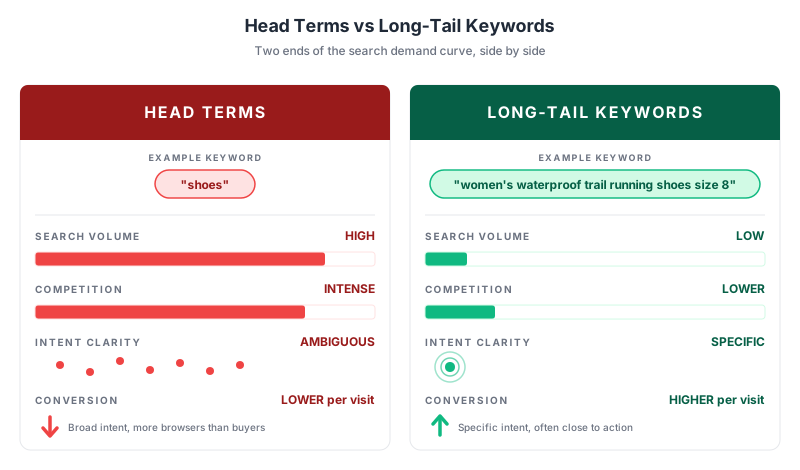
| Dimension | Head terms | Long-tail keywords |
|---|---|---|
| Search volume | High (thousands to millions monthly) | Low (often under 100 monthly) |
| Competition | Intense, often dominated by authoritative sites | Lower, often rankable for newer sites |
| Intent clarity | Ambiguous, could be any stage of the journey | Specific, usually late-stage or precise |
| Conversion behavior | Lower per-visitor, requires funnel depth | Higher per-visitor, often close to action |
| Content requirement | Deep, comprehensive, high-authority | Focused, targeted, answers a specific question |
Neither category is inherently better. A mature SEO strategy targets both: long-tail keywords build the foundation and generate early traffic, while head terms become realistic targets once topical authority is established.
How to Find Long-Tail Keywords
You do not need expensive tools to find long-tail keywords, though they speed the process considerably. The highest-leverage sources are free and come directly from Google itself.
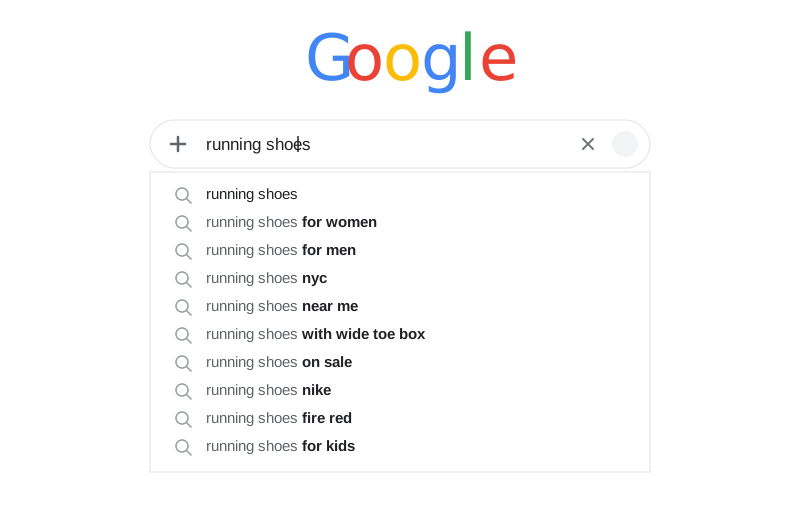
Google Autocomplete. Start typing a seed keyword and watch the suggestions. These reflect queries Google sees often enough to predict. Cycle through letter combinations ("seo a," "seo b," "seo c") to surface more. The "alphabet soup" method works because autocomplete is driven by actual search behavior, not an editorial list.
People Also Ask. The PAA boxes that appear in most SERPs are essentially a list of related long-tail questions Google has seen enough times to group together. Click one to reveal more, and each expansion loads additional questions. A few minutes of PAA mining on a seed term will produce dozens of usable long-tail ideas.
Related Searches. At the bottom of the SERP, Google lists related queries. These are less specific than PAA but still useful for mapping the broader topic.
Modifier additions. Take a seed keyword and layer on modifiers: commercial ("best," "cheap," "top"), qualifier ("for beginners," "for small business," "under $50"), format ("guide," "tutorial," "checklist"), and location ("near me," "in Austin"). Each layer cuts the audience smaller and the intent sharper. This is a manual but reliable method when tools come up dry.
Google Search Console. For existing sites, GSC is often the fastest path to long-tail opportunity. Filter queries by impressions with low clicks: these are phrases where Google already associates your content with the query but you are not ranking well enough to capture traffic. Better optimization around those queries is typically a quick win.
Forums, Reddit, and Q&A sites. Communities where your audience hangs out expose the actual language they use, which rarely matches marketing-speak. Reddit, Stack Exchange, industry-specific forums, and Quora all surface genuine long-tail phrasing that keyword tools sometimes miss entirely.
Keyword research tools. Tools add scale. A seed like "pickleball paddle" can produce hundreds or thousands of long-tail variations in seconds, each with volume and difficulty estimates. SEOForge can cluster long-tails into ready-to-write content groups and carry them into a content calendar.
A full walkthrough of the discovery and filtering process lives in our dedicated guide to doing keyword research.
Long-Tail Strategy for New Sites
For a site with limited authority, long-tail keywords are not just an option. They are the only realistic path to early organic traffic.
Start with the easiest relevant keywords. Filter your keyword list by difficulty and relevance, then pick terms where you have both a real chance of ranking and a real reason to rank. Irrelevant low-difficulty keywords are a trap: they may bring traffic, but that traffic will not convert or engage, and Google will eventually notice.
Build topical depth before breadth. Ten thorough articles in one niche will typically outperform thirty shallow articles spread across unrelated topics. Rankings for long-tail keywords tend to come faster when the surrounding site demonstrates expertise on the broader subject.
Graduate to harder keywords as authority grows. As a site earns backlinks and starts ranking for its initial long-tails, medium-difficulty keywords become feasible targets. After that, some head terms come into reach. The progression is rarely linear, but the direction is consistent: from long-tail out toward the head of the curve.
This pattern is why long-tail strategy is particularly powerful for small business SEO, new blogs, and niche B2B sites.
Content Approaches: One Keyword Per Page vs Clustering
There are two valid ways to translate long-tail research into actual pages. The right choice depends on how related the keywords are.
One long-tail per page works when each keyword represents a distinct question or problem. "How to clean leather boots" and "how to waterproof leather boots" are related but different enough that most searchers expect separate, focused answers. One precise page per keyword is the traditional approach.
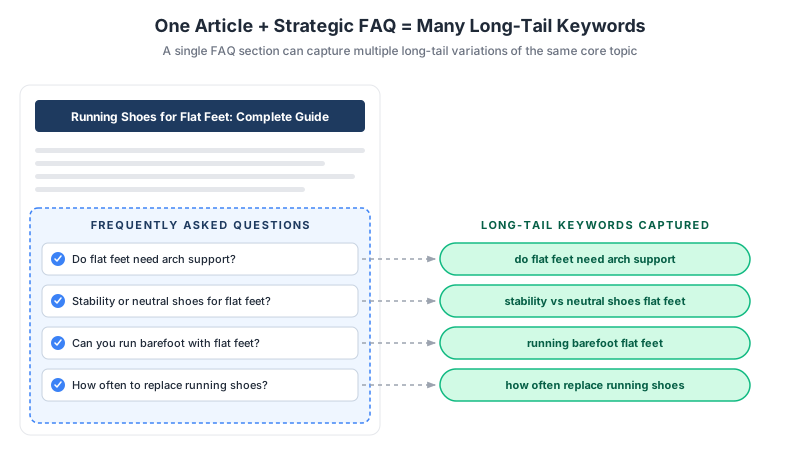
Clustered pages work when multiple long-tail keywords are variations on the same underlying intent. "Best running shoes for flat feet," "running shoes flat feet support," and "top arch support running shoes flat feet" are effectively the same question. A single comprehensive page can realistically rank for all of them, and often outranks pages that split the topic into thin variations. Modern SEO generally favors this approach. Our dedicated article on keyword clustering goes deeper on grouping methodology.
FAQ sections on longer-form content are a particularly efficient way to capture additional long-tail variations. A single article with a well-built FAQ can rank for dozens of related long-tails without fragmenting the site into thin pages.
The connection between long-tail strategy and content structure is close enough that it is hard to do long-tail SEO well without thinking about both.
Where Long-Tail Strategy Goes Wrong
A few patterns show up repeatedly in teams that struggle with long-tail strategy.
Confusing length with long-tail status. As noted above, some long keywords are competitive and some short keywords are easy. Check search volume and difficulty before assuming word count tells the story.
Ignoring business relevance. Easy-to-rank keywords that no one cares about produce vanity traffic. A keyword should be both rankable and meaningful to your business.
Skipping intent analysis. A keyword like "how SEO works" has informational intent. Writing a sales page for it will not rank, no matter how long-tail the phrase is. Always confirm what searchers actually want before writing.
Publishing thin content to chase volume. Hundreds of 300-word pages targeting individual long-tails used to work. It no longer does. Google rewards pages that answer a question completely, even when that question is narrow.
Abandoning long-tail strategy too early. A site that ranks for 500 long-tails has a strong organic foundation. The temptation to pivot to head terms as soon as a few rankings land is worth resisting until topical authority is genuinely established.
Frequently Asked Questions
Are long-tail keywords always longer than head keywords?
Not always. The defining feature is low search volume, not word count. Most long-tails do happen to be three or more words because specificity usually requires more words, but there are low-volume one-word keywords and high-volume five-word keywords. Judge by volume and competition, not length.
How many long-tail keywords should I target per page?
If the keywords are genuine variations of the same question, a single page can target a cluster of dozens. If they represent different questions or intents, use separate pages. The practical rule: if a searcher for keyword A would be satisfied by a page that also answers keyword B, cluster them. If not, split them.
Do long-tail keywords still matter with AI search?
Yes, arguably more than before. Generative answer engines like AI Overviews and ChatGPT search pull content that directly answers specific questions. Pages optimized around long-tail, question-style phrases are structurally well-suited to how these systems retrieve information.
What is the average conversion rate for long-tail keywords?
Specific numbers vary widely by industry and keyword, so be skeptical of single-figure claims. The directional pattern is consistent: more specific queries tend to convert at higher rates than broad head terms because the searcher's intent is clearer. Measure your own conversion rates by keyword type to see how the pattern holds for your site.
Can long-tail keywords drive enough traffic to matter?
Individually, no. Collectively, yes. A site ranking for several hundred long-tail keywords can easily exceed what a single head-term ranking would produce, and the combined traffic tends to be higher-intent. Long-tail strategy is additive by design.