
Most SEO advice for newer sites boils down to "target low competition keywords." Very little of it explains what that actually means in practice, or how to separate keywords that are genuinely easy to rank for from ones that just look easy on a keyword tool dashboard.
Low competition keywords are search terms where a site without huge domain authority has a realistic chance of ranking on page one. They tend to be longer and more specific than head terms, they often carry clear intent, and they can be the difference between a new blog gaining traction in three months or disappearing into the 96.55% of pages that receive no Google traffic at all, based on a large-scale study of roughly 14 billion web pages.
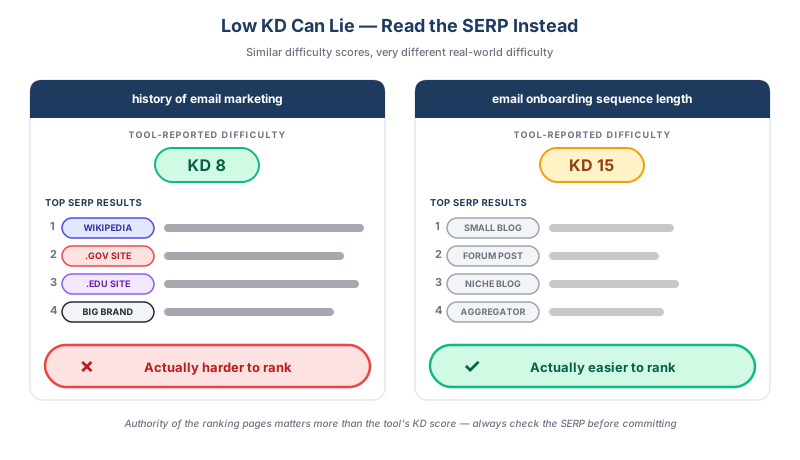
But the "low KD equals easy win" assumption misses a lot. A keyword with a difficulty score of 5 can still sit in a SERP dominated by Wikipedia, a government domain, or a retailer no affiliate blog will displace. This playbook walks through how to find low competition keywords worth your time, how to validate the competition is actually low, and how to turn individual wins into compounding topical authority.
Finding them well is one slice of a broader keyword research process that runs from discovery through prioritization and mapping.
Key Takeaways
- Low competition is relative, not absolute: A KD that's easy for an established site may be unrealistic for a new one. Calibrate to your own authority, not a universal threshold.
- KD scores are a starting point, not a verdict: Manual SERP analysis reveals competition signals that tool metrics miss, including intent mismatch and brand dominance.
- Long-tail queries dominate search volume: Roughly 94.74% of keywords get 10 or fewer monthly searches, which is where most low competition opportunities live.
- Mine free sources first: Google Autocomplete, People Also Ask, and Search Console queries surface low competition ideas that paid tools miss.
- Business relevance is non-negotiable: An easy keyword that attracts the wrong audience is worse than a hard keyword that attracts buyers.
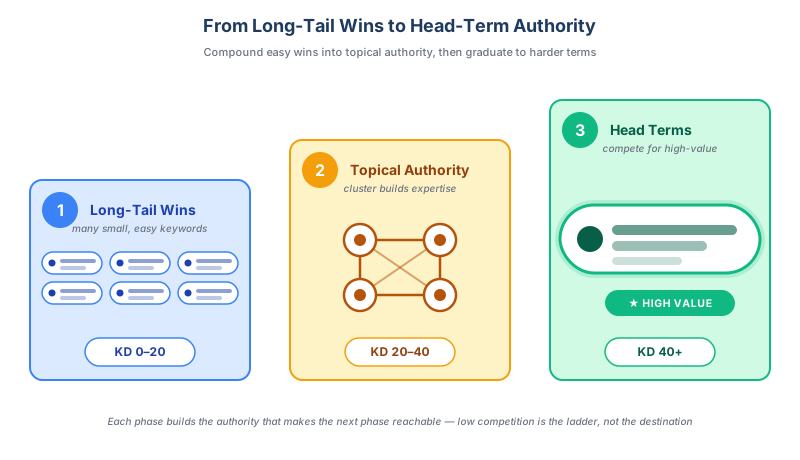
- Build topical clusters, not one-offs: Stringing together multiple low competition wins around the same theme compounds authority and unlocks harder terms over time.
What Makes a Keyword "Low Competition"
A low competition keyword is one where the pages currently ranking in the top 10 don't have a significant authority or content advantage you'd need to overcome. In practice, that usually shows up as:
- Low keyword difficulty (KD) scores in tools like Ahrefs, Semrush, or Moz
- Ranking pages with modest referring domain counts
- A SERP with thin or outdated content
- Smaller sites and independent blogs holding positions, not just major brands
Most keyword tools build their KD score primarily from the backlink profile of the top-ranking pages, typically the number of referring domains pointing at them, which makes it a useful proxy for how many backlinks you'd likely need to compete. The exact formula varies by platform, though: Semrush, for instance, also weighs factors like the authority of the ranking domains, not just referring-domain counts. That's why KD numbers differ between tools for the same keyword.
Here's the part that trips people up: low competition is not the same as long-tail. Plenty of mid-tail and even short-tail keywords have surprisingly weak SERPs in niche industries, and plenty of long-tail keywords sit inside SERPs that a new site can't touch because the top results are all from domains with decades of trust. Length is a heuristic, not a rule.
Why Target Low Competition Keywords
There are four practical reasons low competition keywords earn their reputation as "low-hanging fruit," especially for newer sites:
Faster ranking timelines. A 2025 ranking study found only 1.74% of newly published pages rank in the top 10 within a year, down from 5.7% in an earlier 2017 study. Targeting less competitive SERPs compresses that timeline significantly because you're not waiting on a backlink profile to mature before you can compete.
Higher conversion intent. Specific queries often signal a reader further down the buying cycle. "Running shoes" is a research query. "Best trail running shoes for wide feet under $150" is someone reaching for a credit card. That specificity is where low competition and commercial value often overlap.
Compounding traffic from many small wins. The long tail is where most of search lives: one analysis of a large keyword database found that 94.74% of keywords get 10 or fewer monthly searches, and only 0.0008% get more than 100,000 monthly searches. No single low-volume query moves the needle, but ranking for dozens of them does.
Authority signals for harder keywords later. Google's ranking systems reward sites that demonstrate topical depth. Ranking for a cluster of low competition terms around the same subject builds the foundation for competing on harder keywords in the same space. This is a stepping-stone strategy, not a permanent ceiling.
How to Find Low Competition Keywords: A 5-Step Process
Step 1: Start with long-tail and question-based seeds
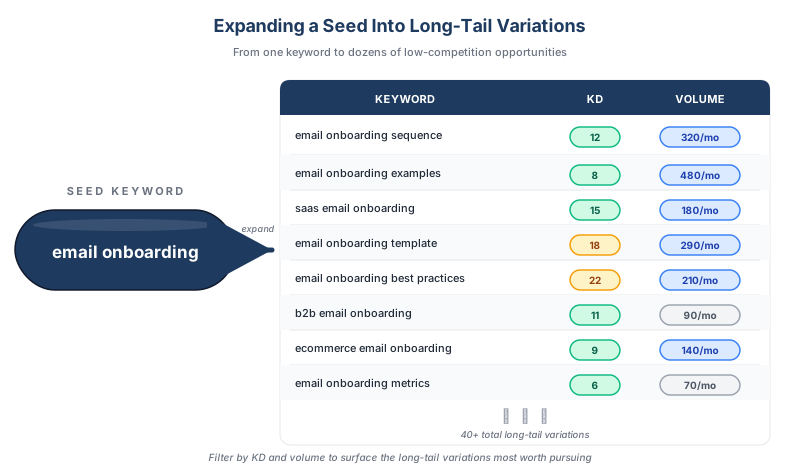
Before opening any tool, list the specific problems your audience has and the way they phrase those problems. Generic seeds like "marketing" or "fitness" produce generic, competitive keyword lists. Specific seeds like "email onboarding sequence for SaaS trials" or "hip mobility for desk workers over 40" surface lists with far more low competition entries.
Good seed directions:
- Questions your customers or readers actually ask (gathered from sales calls, support tickets, or community forums)
- Problem statements phrased as the user would phrase them
- Product or service variations with modifiers (use case, industry, audience, location, price range)
- Comparisons between tools or approaches in your space
Step 2: Filter by KD in a keyword tool
Plug seeds into a keyword research tool and generate variations. Then filter aggressively:
- Set a maximum KD threshold based on your site's current authority (often 0–20 for new sites, 0–40 for established ones)
- Set a minimum volume threshold low enough to catch long-tail (often 10–50 monthly searches, not 500+)
- Sort by traffic potential rather than raw volume when available, since a keyword with 100 searches can send far more traffic if the ranking page captures related queries
A note on KD calibration: there's no universal threshold. A KD of 30 is trivial for a site with thousands of referring domains and unreachable for a three-month-old blog. Calibrate to your own backlink profile and the difficulty of keywords you currently rank for. If you're unsure how the metric works, our keyword difficulty guide walks through the scoring logic in detail.
Step 3: Mine Google Search Console for hidden wins
Google Search Console is the most overlooked low competition keyword source because it shows queries where you're already ranking somewhere, often on pages 2 to 5. These are keywords Google has already decided you're relevant for, and moving from position 15 to position 8 is usually easier than ranking for something cold.
What to look for in GSC:
- Queries with impressions but few clicks: Often sitting in positions 11–20, a signal you're close but not visible enough
- Queries ranking on pages where you didn't explicitly target them: A hint that a lightweight optimization or dedicated page could capture more traffic
- Queries appearing on multiple pages (possible cannibalization): Consolidate or clarify which page should own the keyword through deliberate keyword mapping
A 2025 analysis of 22 billion GSC clicks across 887,534 properties found that anonymized queries account for 46.77% of website traffic (up from 46.08% in a 2022 study), which means the visible data is already a significant underestimate of what you're ranking for. Treat GSC as a starting point for manual expansion.
Step 4: Extract ideas from Autocomplete, PAA, and related searches
Google's own SERP features are a free, real-time source of low competition ideas. Search a seed keyword and document:
- Autocomplete suggestions: What Google shows as you type, drawn from actual search behavior
- People Also Ask (PAA): Question-based queries, many with very low KD because they're newer or more specific
- Related searches at the bottom of the SERP: Adjacent topics searchers explore after the initial query
- "People also search for" in the image and video carousels: Surface variations the main list misses
The "alphabet soup" technique works well here: type your seed plus each letter of the alphabet into Autocomplete ("seed + a", "seed + b", and so on) to surface variations you wouldn't have guessed. For question keywords specifically, clicking to expand a PAA item usually triggers more PAA entries, letting you mine dozens of related questions from a single starting query.
Step 5: Explore forum and community discussions
When people can't find good answers on Google, they ask on Reddit, Quora, Stack Exchange, niche Discord servers, or industry-specific forums. Those questions often become keywords with very low competition because no one has built dedicated content around them yet.
A practical workflow: search your topic on Reddit, sort by top posts of the past year, and note recurring questions in thread titles. Run those phrases through a keyword tool to check volume and difficulty. The ones with meaningful volume and low KD are often genuine gaps in the indexed web.
Evaluating True Competition (Beyond the KD Score)
Tool-based difficulty scores are useful but incomplete. Before committing to a keyword, analyze the SERP manually.
Check who's ranking. If the top 10 is dominated by Wikipedia, YouTube, Reddit, major retailers, or government and university domains, a low KD score is misleading. You won't outrank them with a single blog post regardless of what the tool says.
Check search intent alignment. Google's ranking systems are increasingly focused on serving the intent behind a query, not just keyword matches. If the SERP shows product pages and your plan is a 2,000-word guide, intent is mismatched and your content won't rank even if KD is low. Our search intent guide covers how to diagnose this in detail.
Check content quality of ranking pages. Do they actually answer the query well, or are they thin, outdated, or structurally weak? A SERP full of mediocre content is a real opportunity. A SERP where every page is comprehensive and well-cited is a warning, even at low KD.
Check SERP features. An AI Overview, featured snippet, or large local pack can crush organic click-through rates. A 2025 study of AI Overviews found they correlate with a 58% lower average clickthrough rate for the top-ranking page (up from 34.5% eight months earlier), so a position-one ranking in an AI Overview SERP is worth far less than it used to be. Worth knowing before you invest in a keyword.
Check your own ability to compete. Google's guidance on creating helpful, reliable, people-first content emphasizes demonstrating first-hand experience and depth of knowledge, the core of E-E-A-T, not just covering a topic. If you can't credibly match or exceed the expertise already ranking, even a "low competition" keyword may be out of reach.
Building a Low Competition Keyword Strategy
Individual low competition wins are useful. A strategy built around them is transformative. The difference is intentional topical coverage.
Cluster, don't scatter. Instead of writing one article on "email onboarding sequence length" and the next on "best running shoe brands," group low competition keywords into tight topical clusters. Publishing five to ten pieces on related email onboarding subtopics builds the topical authority Google's ranking systems reward, whereas one-off articles across unrelated themes don't compound.
Create content that earns its ranking. Low KD does not license thin content. Google's Helpful Content System is designed to identify and deprioritize pages written primarily for rankings rather than readers, and it evaluates quality at the site level, meaning unhelpful content can drag down your entire domain. Write the most useful piece in the SERP, not the shortest one that hits the keyword.
Graduate to harder terms deliberately. As you accumulate rankings in a topical cluster, your domain's topical authority grows. Periodically revisit medium-difficulty keywords in the same space that were previously out of reach. The sites that treat low competition keywords as a ladder rather than a ceiling are the ones that eventually compete on head terms.
Revisit your GSC data every 4–6 weeks. New low competition opportunities appear constantly as Google surfaces your site for queries you didn't target. Treat the query report as an ongoing source of ideas, not a one-time audit.
For sites just starting out, the low competition approach is often the only realistic path to organic growth in the first 6–12 months. Our guide to small business SEO covers how this fits into a broader resource-constrained strategy. For teams ready to automate the discovery and clustering work at scale, SEOForge's keyword research surfaces low competition variations and groups them into publishable clusters.
Where Easy Keywords Trip You Up
Targeting irrelevant keywords because they're easy. "Easy to rank for" and "worth ranking for" are different tests. A keyword with KD 2 and 500 monthly searches that attracts readers who will never buy anything in your category is worse than an unattempted hard keyword. Business relevance comes first.
Ignoring volume entirely. A keyword with 3 searches per month isn't a strategy, it's a rounding error. Long-tail works because the cumulative total across many rankings is meaningful. Individual keywords still need enough demand to matter.
Publishing thin content to chase speed. A 400-word post targeting a low-competition keyword might rank briefly, but it's more likely to get classified as unhelpful, underperform from launch, or drag down neighboring pages. Match content depth to what the SERP demands, not to the keyword's KD.
Treating low competition as a destination. The goal is to use low competition wins to build authority, then compete on harder and more valuable terms. Sites that stay in the low-volume tail indefinitely cap their own growth.
Skipping SERP analysis. Trusting KD without looking at the actual search results is the single most common reason "easy" keywords fail to rank. The SERP always tells a more complete story than the score.
Forgetting to validate keywords against AI search surfaces. Increasingly, zero-click and AI-summarized results affect whether a ranked page actually gets clicks. Our keyword gap analysis guide can help diagnose these patterns before you commit.
Frequently Asked Questions
What counts as a low keyword difficulty score?
There's no universal threshold because KD is relative to your site's authority. A rough guide: new sites typically target KD 0–20, established sites with meaningful backlink profiles can target KD 20–40, and high-authority sites can go after KD 40+. Calibrate to keywords you already rank for, not to an absolute number.
Do low competition keywords actually drive meaningful traffic?
Yes, but through aggregation. Any single long-tail keyword might send 20 to 100 monthly visits. Fifty of them around a tight topic cluster can send more qualified traffic than ranking on page 2 for one competitive head term. The math favors low competition for newer sites because the alternative (not ranking at all) sends zero traffic.
Can I just look at keyword difficulty scores and skip the SERP analysis?
Not reliably. Tool-reported KD is based mostly on the backlink profile of ranking pages, which is a decent proxy but ignores content quality, search intent alignment, and SERP features like AI Overviews. Two keywords with identical KD can have wildly different actual difficulty once you look at who's ranking and how.
How many low competition keywords should I target per month?
It depends on capacity, but publishing quality matters more than volume. A well-researched, comprehensive article on a single low competition keyword will usually outperform five thin articles on five keywords. Most sites in early-stage SEO see better results publishing two to four high-quality pieces per month than ten rushed ones.
Are low competition keywords still worth targeting with AI Overviews taking clicks?
In general, yes, though the answer has gotten more nuanced. Informational queries with AI Overviews now send fewer clicks to the top-ranking page, so low competition keywords with strong commercial or transactional intent have become relatively more valuable than purely informational ones. SERP analysis before committing to a keyword is more important than it was two years ago.