
Every site you compete with ranks for keywords you don't. Some are accidental, some are strategic, and a surprising number represent real traffic you could capture with the right content. A keyword gap analysis is how you find those opportunities systematically instead of guessing what to write next.
The process is simple in theory: compare your rankings against two or three competitors, list the terms they rank for that you don't, and decide which ones are worth pursuing. The hard part is doing it in a way that produces a usable content roadmap rather than a spreadsheet full of noise. Too broad a list and you drown in irrelevant keywords; too narrow and you miss the opportunities that actually matter.
This guide walks through the full workflow: choosing the right competitors, pulling the data, filtering for genuine opportunities, prioritizing by impact, and turning the output into content decisions. It's a core technique in any serious keyword research process, and it pairs especially well with search intent analysis and keyword difficulty scoring.
Key Takeaways
- Keyword gap analysis finds the terms your competitors rank for that you don't. It turns competitor rankings into a concrete list of content opportunities with proven search demand.
- Gap analysis is not the same as content gap analysis. Keyword gaps surface specific search terms; content gaps surface broader topics and journey-stage coverage. Both matter, and they complement each other.
- Three types of gaps exist: missing (no ranking at all), weak (you rank but poorly), and shared-but-outranked (you compete but lose). Each one calls for a different action.
- Competitor selection is where most analyses go wrong. Pick search competitors, not just business competitors. The sites ranking for your money keywords matter more than the brands you pitch against in sales calls.
- Prioritization is the whole game. Raw gap lists can run into the thousands. Filtering by relevance, difficulty, volume, and intent turns that list into a ranked roadmap.
- Run gap analysis quarterly at minimum. SERPs shift constantly, and what was a gap six months ago may now be covered, while new gaps appear as competitors publish.
What Keyword Gap Analysis Actually Is
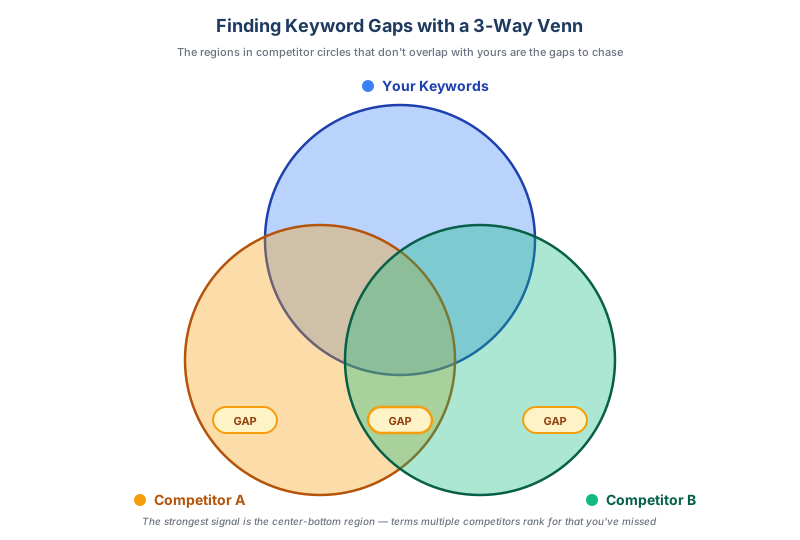
A keyword gap analysis compares your domain's keyword rankings against one or more competitors and surfaces the search terms where they appear in results and you don't. The output is a list of keywords, each tagged with metadata like search volume, keyword difficulty, and competitor rankings, that you can filter and prioritize.
The value isn't in the list itself. It's in the signal: if three of your competitors rank for a term and you don't, that term has demonstrated search demand, proven ranking viability at your competitive level, and clear relevance to your niche. You're not guessing whether the topic matters. The data already told you.
Keyword Gap vs. Content Gap Analysis
These terms get used interchangeably, but they surface different things.
Keyword gap analysis focuses on specific search queries. The output is a list of terms: "email automation tools," "how to segment email lists," "best email platform for small business." It's tactical and keyword-specific.
Content gap analysis zooms out. It looks at topical coverage, customer journey stages, content formats, and whether you're addressing the same questions your audience is asking. A content gap might be "we cover comparisons but have no buyer's guides," even if no single keyword shows up as a gap.
In practice, most strong SEO teams run both. The keyword gap analysis tells you what to write; the content gap analysis tells you whether your overall coverage is complete.
Why Gap Analysis Matters for SEO Strategy
Most content calendars are built from brainstorms, team opinions, or whatever felt important in the last strategy meeting. Gap analysis replaces that guesswork with evidence. You're not speculating about whether a topic has demand; you're watching competitors capture it in real time.
A well-run gap analysis also exposes blind spots that come from working inside your own niche too long. Your competitors have researchers, writers, and SEOs making different bets than you. Some of those bets work. Looking at their keyword sets is one of the fastest ways to inherit good decisions without making them from scratch. Since Google's ranking systems serve results based on relevance to the query, a competitor consistently ranking for a term signals that Google has validated their page as a relevant answer for that intent, making it a useful reference point for your own content planning.
Finally, gap analysis feeds directly into topic cluster planning. Comparing multiple competitors at once, rather than looking at each in isolation, often reveals entire subtopic areas where you lack coverage, not just individual terms. That clustering insight is usually worth more than any single keyword.
The Three Types of Keyword Gaps
Before you start, it helps to know what you're looking for. Not every gap is the same, and each type suggests a different response.
| Gap Type | Definition | Action |
|---|---|---|
| Missing | Competitors rank, you don't rank at all | Create new content targeting the keyword |
| Weak | You rank (pages 2-10), competitors rank higher | Optimize existing content, improve depth or link equity |
| Shared-but-outranked | You both rank in the top 10, but below them | Improve on-page optimization, content quality, or internal linking |
Missing keywords typically drive the biggest new-traffic opportunities since you're starting from zero. Weak keywords are often faster wins because you already have pages indexed. Shared-but-outranked keywords are the slow grind, often decided by backlinks and content depth rather than keyword targeting alone.
How to Do a Keyword Gap Analysis: Step-by-Step
Step 1: Identify the Right Competitors
This is where most gap analyses produce garbage data. The trap is picking the businesses you compete with commercially instead of the sites you compete with in search. A B2B SaaS company might compete with three other SaaS vendors on sales calls but lose organic traffic primarily to affiliate review sites, publications, and Reddit threads. Those are the competitors your gap analysis needs to include.
A practical approach:
- Search your top 5-10 money keywords in an incognito window
- Note which domains appear in the top 10 repeatedly
- Cross-reference with your own organic competitors in Ahrefs, Semrush, or Google Search Console data
- Pick 2-4 domains that show up consistently and have comparable authority to yours
Avoid the temptation to include sites with dramatically higher domain authority. If you compare a year-old startup blog against Investopedia, every missing keyword will technically be a "gap" but almost none will be winnable. Pick competitors in your realistic ranking league.
Some teams also benefit from ongoing competitor monitoring, since the sites winning your SERPs change over time. Competitor-tracking tools can help you keep tabs on which domains consistently appear in your category, including in AI-generated answers where traditional rank trackers don't reach.
Step 2: Pull the Keyword Data
Any major SEO platform with a keyword database can run a gap analysis. Enter your domain plus 2-4 competitors and pull the full list of keywords where at least one competitor ranks.
For the data to be useful, you generally want:
- Keyword (the search query)
- Search volume (monthly searches, with location specified)
- Keyword difficulty (platform-specific but directionally useful)
- Your current ranking (often "not ranking" or "N/A")
- Each competitor's ranking position
- SERP features present (featured snippets, AI Overviews, People Also Ask)
- Search intent classification if the tool provides it
If you don't have a paid tool, you can approximate this with Google Search Console performance data (your current rankings) plus a free rank checker for individual competitor keywords, but this gets tedious past a handful of terms.
Step 3: Identify the Real Gaps
Most tools output three primary buckets:
- Missing: Competitors rank, you don't rank anywhere
- Weak: You rank (typically positions 11-100), competitors rank higher
- Shared: Both you and competitors rank in the top 10
For a true gap analysis, focus on missing and weak keywords first. Shared keywords can be part of a later optimization pass but are rarely the priority output of this exercise.
If you're using Semrush's Keyword Gap tool or Ahrefs' Content Gap report, both will let you filter to show only keywords where multiple competitors rank (the "intersection" filter). A keyword that three competitors rank for and you don't is a stronger signal than one where a single competitor ranks, since intersections tend to surface subtopics central to your niche rather than one-off rankings tied to a single site's quirks.
Step 4: Filter for Relevance, Difficulty, and Volume
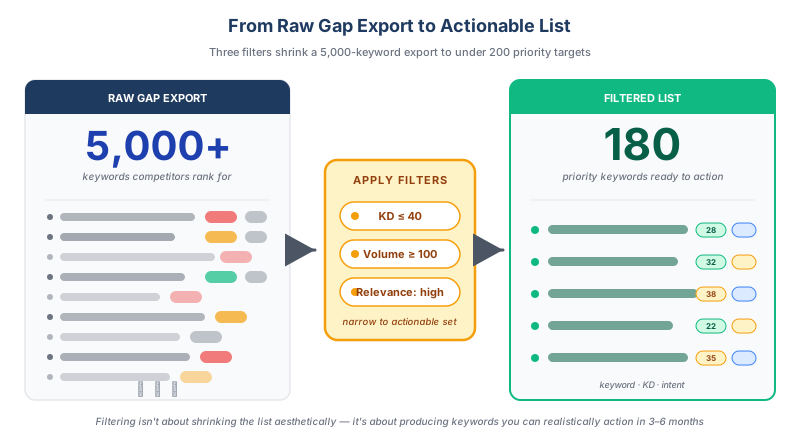
A raw gap list can return tens of thousands of keywords. Most are irrelevant, too difficult, or too low-volume to bother with. The filtering pass is where the list becomes usable.
Typical filters to apply:
- Keyword difficulty: For most sites, cap this at 30-50 depending on your domain authority. Established sites can push higher.
- Search volume: A floor of 50-100 searches/month usually filters out pure noise, but don't write off low-volume terms in B2B or niche verticals, where 20 searches a month can be valuable.
- Keyword containing: Exclude competitor brand names (you won't rank for "Semrush review" if you're not Semrush).
- Position filter: To find quick wins, filter for keywords where you rank 11-30 and competitors rank in the top 10. These are your fastest optimization targets.
The goal of filtering isn't to shrink the list aesthetically; it's to produce a set of keywords you can realistically act on in the next 3-6 months.
Step 5: Assess Search Intent and SERPs
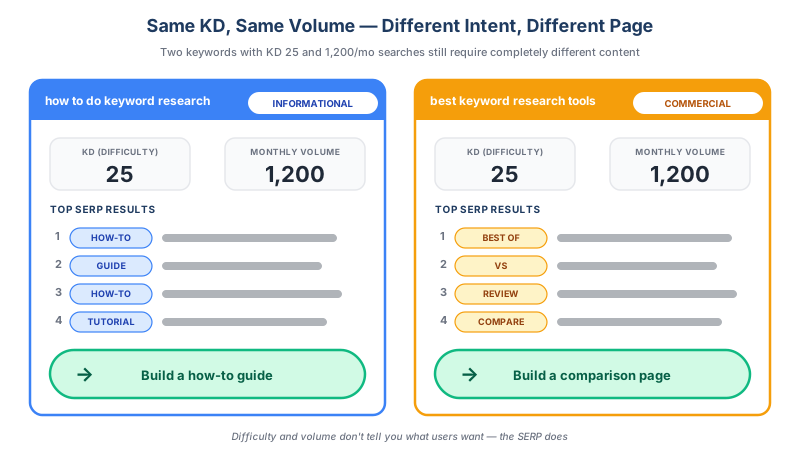
This is the step that separates mediocre gap analyses from good ones. Difficulty scores and volume numbers don't tell you what users want when they search. A keyword might look like a perfect gap until you check the SERP and realize every top result is a product page, not a guide, or a Reddit thread, not a commercial site.
For each high-priority keyword, open the SERP and check:
- Dominant content format: Listicles, how-tos, product pages, comparisons, tools, calculators
- SERP features: Featured snippets, People Also Ask, AI Overviews, video carousels, local packs
- Competitor content type: Are ranking pages blog posts, landing pages, or documentation?
- Freshness signals: Are results recent? Is freshness a ranking factor for this query?
If you plan a listicle for a keyword where eight of the top ten results are product pages, you're fighting search intent. Either change your format or move on. Google's own guidance on people-first content is explicit that matching what users are looking for is a baseline expectation, not a bonus.
This is also where search intent shapes your content brief. Two keywords with identical volume and difficulty can require completely different pages. Treating them the same is a common mistake.
Step 6: Prioritize Opportunities
Prioritization is where the analysis becomes a roadmap. A simple scoring model works well:
| Factor | Weight | What to Score |
|---|---|---|
| Business relevance | High | Does this keyword describe what we sell or an audience we want? |
| Commercial intent | High | Is the searcher close to a buying decision? |
| Keyword difficulty | Medium | Can we realistically rank given our authority? |
| Search volume | Medium | How much traffic if we rank? |
| Competitor strength | Medium | Is the current top-10 weak enough to displace? |
| Existing content | Low | Do we have a page to optimize, or do we need new content? |
You don't need to make this complicated. Rate each keyword on each factor (1-3 or 1-5) and sum or weight the results. The output is a ranked list you can commit to a content calendar.
One pattern worth watching for: clusters of related keywords. If five of your top-scoring gaps all revolve around the same subtopic, plan them as one coordinated topic cluster rather than five standalone posts written in isolation. That usually means a pillar page on the core subtopic with supporting pages for the narrower keywords, all interlinked so they build authority together instead of competing.
Closing the Gaps: From Spreadsheet to Rankings
A prioritized gap list is worthless until content gets shipped. Three approaches, usually combined:
Create new content for missing keywords where you have no page at all. Match the dominant SERP format, cover the subtopic deeply, and interlink to related pages in the cluster.
Optimize existing content for weak keywords. This is often faster than creating from scratch. Look at your current page, compare it against the top-ranking pages, and address whatever's missing: depth, structure, freshness, internal links, entity coverage, media.
Build topic clusters when gaps cluster around a subtopic. A pillar page on the core term plus 4-8 supporting pages on sub-keywords usually outperforms a single long post trying to cover everything. This is especially valuable for competitive niches where topical authority drives rankings. The same clustering logic applies in paid search, which is one reason gap analysis has become shared vocabulary across SEO and PPC teams.
Before you assign every gap to "create new content," audit what you already have. A lot of weak-keyword gaps can be closed by improving existing pages, which is cheaper and often ranks faster than net-new content.
Pitfalls That Derail a Gap Analysis
Chasing every gap. A 5,000-keyword gap list looks comprehensive, but no team can action it. Prioritize ruthlessly and ignore the long tail until the high-impact gaps are closed.
Copying competitor approaches. If your competitor ranks for a keyword with a thin 800-word post, don't publish a similar thin post. Use the gap as confirmation the topic matters, then build something meaningfully better. Matching them without differentiating doesn't typically displace them.
Ignoring keyword difficulty. High-volume keywords with low difficulty are rare and often hide complications (seasonal demand, unclear intent, strong brand SERPs). Check difficulty scores against your domain's actual ranking ability before committing.
Forgetting differentiation. A gap analysis tells you what to write, not how to win. If you produce content identical to what's already ranking, you'll struggle to outrank it. Use the analysis as a starting point and add your own angle, depth, or format advantage.
Treating it as one-and-done. Competitors publish weekly. SERPs shift constantly. A gap analysis from six months ago is already partly stale.
How Often to Run a Keyword Gap Analysis
For most sites, quarterly works well. Fast-moving niches (AI, crypto, consumer tech) may warrant monthly. Stable niches (local services, evergreen B2B) can do fine with biannual reviews.
Between full analyses, track:
- Pages newly ranking in positions 11-30 (these are close to quick wins)
- Keywords where competitors gained positions (signals they published or optimized something)
- New SERP features on your target keywords (especially AI Overviews)
One efficient pattern: run a full gap analysis quarterly, then do lighter "what's changed" checks monthly using your ranking data. This keeps the workload manageable while catching fast-moving opportunities.
Frequently Asked Questions
What's the difference between keyword gap analysis and competitor keyword analysis?
Competitor keyword analysis looks at everything a competitor ranks for, including keywords you already rank for. Keyword gap analysis specifically filters for terms where they rank and you don't. Gap analysis is a subset of the broader competitor analysis workflow, focused on opportunity identification.
How many competitors should I include in a gap analysis?
Two to four is the practical range. One competitor gives you a narrow view and risks inheriting their mistakes. More than four and the intersection data gets messy, with too many keywords where only one or two competitors rank. Three is often the sweet spot for producing clear signal. Tool limits can also shape this: Ahrefs' Content Gap report allows up to 10 competitors, and Semrush's Keyword Gap tool caps at four, so your chosen platform may nudge you toward a specific range.
Can I do a keyword gap analysis for free?
Partially. Google Search Console shows your existing rankings, and you can manually check competitor rankings for specific keywords using free rank checkers. However, pulling the full list of keywords a competitor ranks for generally requires a paid SEO platform with an index of its own. Free tools work for small-scale spot checks but not comprehensive analysis.
Should I include long-tail keywords in gap analysis?
Yes, and often they're where the best opportunities hide. Long-tail gaps have lower competition, clearer intent, and are frequently easier to rank for quickly. Don't filter them out just because volume is modest. Ten long-tail keywords at 50 searches each can outperform one head term at 500.
How do I use gap analysis results for AI search optimization?
Traditional keyword gap tools don't show AI Overviews or LLM citations. To address AI search, layer in separate checks: review which competitors appear in AI Overviews for your target keywords, and monitor where your brand is cited in AI-generated answers. This is a distinct gap analysis layer that traditional SEO tools are still catching up to.