
Most keyword research projects end with the same problem. You have a spreadsheet with 500, 1,000, or 5,000 keywords, and you have no clear way to turn that list into a content plan. Treating each keyword as its own page wastes effort and creates internal competition. Ignoring the variations leaves traffic on the table.
Keyword clustering solves this. By grouping keywords that share the same search intent and trigger similar search results, you decide which terms belong on the same page, which need their own pages, and how those pages connect. The result is fewer articles, broader rankings, and a content plan that mirrors how search engines actually evaluate topics.
This guide walks through the three main clustering methods, a step-by-step process you can apply today, and the edge cases that trip up most teams. If you are still building your underlying keyword list, start with our keyword research guide before clustering, since the quality of your clusters depends entirely on the quality of your input.
Key Takeaways
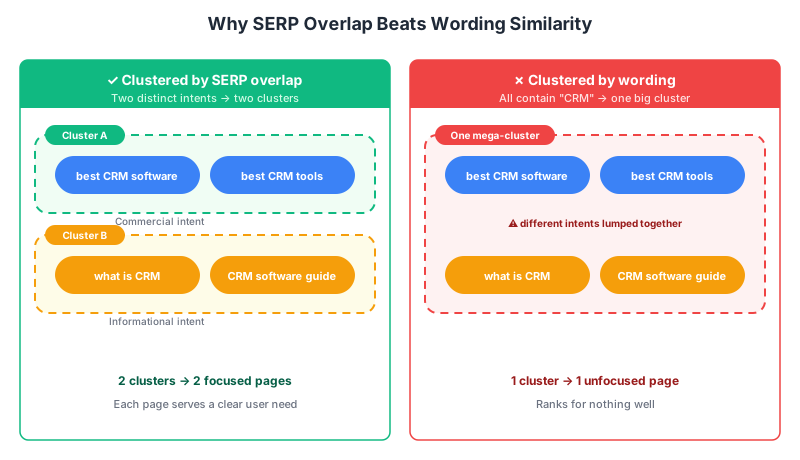
- Cluster by SERP overlap, not similarity in wording. Two keywords that look identical can have completely different search results, while two that look unrelated can share the same ranking pages.
- One search intent equals one keyword cluster equals one page. This is the core rule that prevents cannibalization and forces a clear decision about whether keywords actually belong together.
- The average top-ranking page already ranks for hundreds of related keywords. Clustering is not a hack, it is the natural pattern Google uses to evaluate pages.
- Three methods complement each other: SERP-based clustering for accuracy, semantic clustering for scale, modifier-based clustering for fast first passes.
- Cluster size should match intent depth, not arbitrary numbers. Some clusters hold three keywords, others hold fifty. The deciding factor is whether one comprehensive page can satisfy them all.
- Clusters become the foundation for site architecture. Each keyword cluster maps to one URL, and the relationships between clusters determine your internal linking strategy.
What Keyword Clustering Is (and Isn't)
Keyword clustering is the process of grouping keywords that share the same search intent and can be targeted by a single page. The grouping is based on observable evidence, primarily the overlap of search results between keywords, rather than on how the keywords look or sound.
A common point of confusion is the difference between a keyword cluster and a topic cluster. A keyword cluster is the set of search terms a single page targets. A topic cluster is a group of related pages organized around a central pillar page, with internal links connecting them. Keyword clustering happens first; the resulting clusters then become the building blocks of topic clusters and your wider site architecture.
The grouping mechanism that matters most is search intent. Two keywords belong together when a user searching either one would be satisfied by the same page. "Best running shoes for women" and "top women's running sneakers" share the same intent, even though the wording differs. "Running shoes" and "how to choose running shoes" look related, but the first is a commercial query likely to show product pages, while the second is informational and likely to show guides. They belong in separate keyword clusters, since no single page can satisfy both, even though they sit in the same topic cluster and should link to each other.
Why Keyword Clustering Matters
Search engines have moved well beyond exact-match keyword matching. Google's guidance on creating helpful content prioritizes pages that demonstrate expertise, experience, authoritativeness, and trustworthiness (E-E-A-T), with depth of coverage being a key signal of all four. Pages that comprehensively cover a topic outperform pages that target a single narrow query.
Data from Ahrefs supports this. Their study of three million search queries found that the average top-ranked page also ranks in the top 10 for nearly a thousand additional relevant keywords. In other words, ranking pages already function as clusters whether you plan for them or not. Clustering deliberately means choosing which related queries you want to win, rather than leaving the outcome to chance.
The practical benefits compound:
- Fewer pages, broader coverage. One well-clustered page can rank for dozens of variations, freeing your team to publish across more topics rather than splitting effort across thin pages.
- No internal competition. Without clustering, two pages on closely related queries cannibalize each other and dilute the authority of both. Cannibalization happens when two of your own pages compete for the same query, splitting clicks and signals and often leaving neither page in the top results.
- Topical authority signals. A coherent set of clustered pages signals to search engines that you cover a domain in depth, which aligns with Google's emphasis on demonstrated expertise across a topic rather than on isolated pages.
- Better performance in AI search. When AI systems generate answers, they pull from sources that comprehensively cover related sub-questions. A clustered page is more likely to be cited because it answers the surrounding questions, not just the headline query.
Three Methods of Keyword Clustering
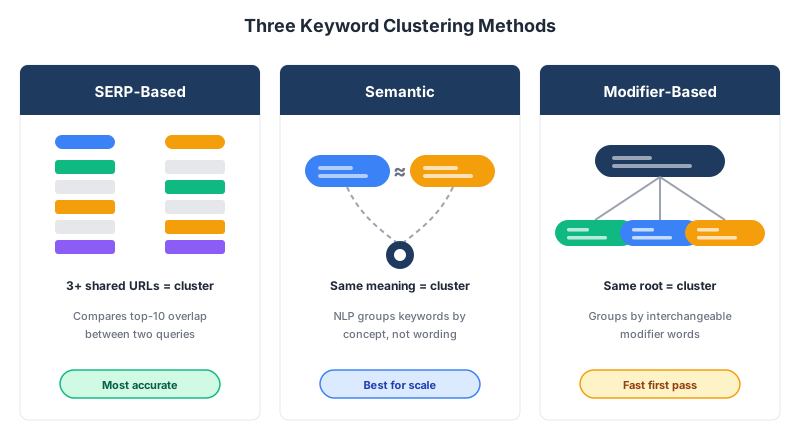
There are three reliable methods, each with strengths and weaknesses. Most experienced practitioners combine all three rather than relying on one.
SERP-based clustering
The most accurate method. Two keywords cluster together if their search results overlap significantly. The logic is straightforward: if Google ranks the same pages for both queries, Google considers them to share intent.
A common threshold is three or more shared URLs in the top 10. If "keyword research process" and "how to do keyword research" both have five identical URLs in the top 10, Google is treating them as the same intent, so they almost certainly belong in the same cluster. If they share zero URLs, they do not, regardless of how similar the words look.
The downside is speed. Manually checking SERP overlap for hundreds of keywords is slow. Most teams use automated tools for the initial pass, then validate borderline cases manually.
Semantic clustering
Semantic clustering groups keywords by meaning. Natural language processing models read the keywords and identify those that refer to the same concept, even when no words overlap. "How long does it take to learn Spanish" and "Spanish learning timeline" cluster together semantically.
Semantic methods work well at scale and catch variations that SERP-based clustering can miss, particularly for newer keywords with sparse SERP data. The risk is over-grouping. Two keywords can be semantically similar but serve different intents, so semantic clusters should always be validated against SERP data before being treated as final.
Modifier-based clustering
The fastest method, useful as a first pass. Group keywords that share the same root term but differ only by modifier words. "Best CRM software," "best CRM tools," and "best CRM platforms" cluster together because the modifiers (software, tools, platforms) are interchangeable in this context.
This method works for obvious synonym variations but fails on intent-shifting modifiers. "Cheap CRM" and "best CRM" share the same root, but the buyers behind these queries want different things. Use modifier-based clustering as a starting point, then validate with one of the other methods.
In practice, combining all three methods gives the best results. Start with modifier grouping to sort the obvious cases, apply semantic clustering for scale, then validate the borderline groups against SERP overlap before finalizing.
The Keyword Clustering Process (Step by Step)
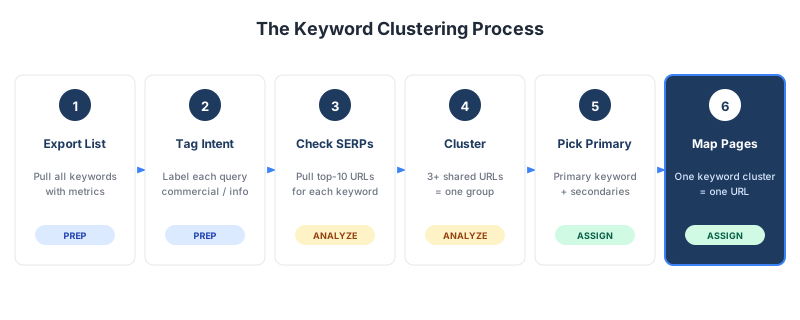
Here is the process that works for most projects, whether you are clustering 50 keywords or 5,000.
Step 1: Export your keyword list
Pull every relevant keyword from your research into a single spreadsheet. Include search volume, keyword difficulty, and any intent classification you already have. If you skipped this stage, our walkthrough on how to do keyword research covers the full discovery process. Do not pre-filter aggressively at this stage. Even long-tail keywords with low individual volume can add meaningful traffic when they cluster with higher-volume terms.
Step 2: Validate intent for each keyword
Most keyword tools already include an intent label in the export (informational, commercial, transactional, or navigational), so this step is usually a validation pass rather than labeling from scratch. Skim the list and confirm each call rather than trusting it blindly, since automated intent labels are approximate and miss context. This pre-filter prevents the most common clustering mistake, which is grouping keywords that look related but serve different intents.
You do not need a sophisticated framework here. The question is simple: would someone searching one of these keywords want the same kind of page as someone searching the other?
Step 3: Analyze SERP overlap
This is the step that turns intent from a guess into evidence. For every keyword, record the URLs ranking in its top 10. Then compare those lists across keywords: the more pages two keywords share, the more strongly Google is treating them as the same intent, and the more confidently they belong in one cluster.
Checking a few keywords by hand is fine, but at scale you want a tool that pulls and compares SERPs for you. Ahrefs (Clusters by Parent Topic in Keywords Explorer) and Semrush (the Keyword Manager clustering feature) both group keywords by shared ranking URLs, so you can feed in a list and get SERP-based clusters back automatically.
However you gather the data, read the overlap with this rule of thumb:
- Three or more shared URLs: strong signal the keywords belong in the same cluster
- One or two shared URLs: likely related but borderline, so check manually
- Zero shared URLs: different clusters, even if the keywords sound similar
Step 4: Group keywords into clusters
Create a column in your spreadsheet labeled "Cluster ID." Assign each keyword to a cluster based on the SERP analysis. A simple naming convention works fine: cluster_01, cluster_02, and so on, with a short descriptor like cluster_01_keyword_research_basics.
If you are clustering manually, sort the spreadsheet by cluster ID periodically to spot inconsistencies. If you are using a tool, export the results and review them rather than treating the output as final.
Step 5: Assign primary and secondary keywords per cluster
Within each cluster, identify one primary keyword and the rest as secondary. The primary should be the term with the strongest combination of:
- Search volume that matches your traffic goals
- Clear, unambiguous intent
- Wording that reads naturally in titles and headers
The secondary keywords inform subheadings, body content, and supporting context. They should appear naturally throughout the page, not be forced into awkward sentences.
Step 6: Map clusters to content
Each keyword cluster becomes one URL. New clusters mean new pages; clusters that match existing content mean optimization opportunities. This bridge from clusters to specific page assignments is its own discipline, covered in our guide on keyword mapping.
Cluster Size and Common Edge Cases
The most common question after running this process is: "How many keywords should be in a cluster?"
There is no fixed answer. Some clusters hold three keywords, others hold fifty. The deciding factor is whether a single comprehensive page can genuinely satisfy all of them. If covering every keyword in the cluster would require a 12,000-word page that tries to be everything to everyone, the cluster is too broad and should be split.
A few edge cases come up repeatedly:
Same words, different intents. "Apple" can mean the fruit or the company. "Java" can mean the language or the coffee. SERP analysis usually resolves these instantly because the search results are completely different. Trust the SERPs.
Different funnel stages on the same topic. "What is email marketing" and "email marketing software" share the topic but serve different stages. The first wants definition and context, the second wants product comparisons. These are separate keyword clusters on separate pages, but they belong to the same topic cluster and should link to each other.
Branded variants. "HubSpot CRM features" and "Salesforce CRM features" are not the same keyword cluster, even though both are CRM feature pages. Branded queries almost always need their own pages.
Plural and singular variations. Usually the same keyword cluster. Occasionally not. If "running shoe" returns product pages and "running shoes" returns category pages, they are different keyword clusters. SERP overlap will tell you which case applies.
When in doubt, err toward keeping clusters tight. Splitting a single overloaded page in two later, after it already ranks, is harder than merging two thin pages into one comprehensive piece.
Tools and Approaches
Three approaches cover almost every use case.
Manual SERP checking works for small lists, typically under 100 keywords. Open each query in an incognito browser, record the top 10, and compare overlap in a spreadsheet. Slow but accurate, and it builds intuition you cannot get from a tool.
Spreadsheet-based clustering scales to a few hundred keywords. Combine modifier grouping (sort by root word) with manual SERP checking on borderline cases. Most agencies and in-house SEO teams use some version of this hybrid approach.
Automated clustering tools become necessary at scale. They typically use SERP overlap, semantic similarity, or both, to group thousands of keywords in minutes. AI-powered keyword research tools such as SEOForge can take you from a raw keyword list to a clustered content calendar in a single workflow, which removes most of the spreadsheet labor.
Whatever tool you use, treat the output as a draft. Automated clusters always need human review for the borderline cases, and the manual review is where most of the strategic value comes from.
From Clusters to Content (and Internal Links)
A finished cluster is not the end of the work, it is the start of content planning. Three principles make the transition smooth.
One keyword cluster, one page. Every keyword cluster gets exactly one URL. If you find yourself wanting to write two pages for the same cluster, the cluster is probably too broad and needs to be split before you write either one.
Comprehensive coverage per page. A clustered page should answer every meaningful sub-question implied by the keywords in the cluster. If your cluster contains "keyword research process," "keyword research steps," and "keyword research methodology," the resulting page should cover process, steps, and methodology, ideally as labeled sections so each query lands on a relevant part of the page.
Connect the related pages. Once each keyword cluster is a published page, those pages do not exist in isolation. The page for the "keyword clustering" cluster and the page for the "keyword mapping" cluster serve different intents and live on separate URLs, but they are tightly related. Linking them is what turns a set of individual pages into a topic cluster: internal links reinforce topical authority and give readers natural pathways through your content. Pages that fail to link to their natural neighbors leave both ranking signals and user experience on the table.
Clusters are also not permanent. SERPs shift over time, sometimes dramatically. A cluster that was valid eighteen months ago may now contain keywords that have drifted into different intents. A quarterly or biannual review of your most important clusters catches these shifts before they cost rankings. As Google's guidance on people-first content emphasizes, the goal is content that genuinely satisfies what users are searching for, which means revisiting your assumptions as search behavior evolves.
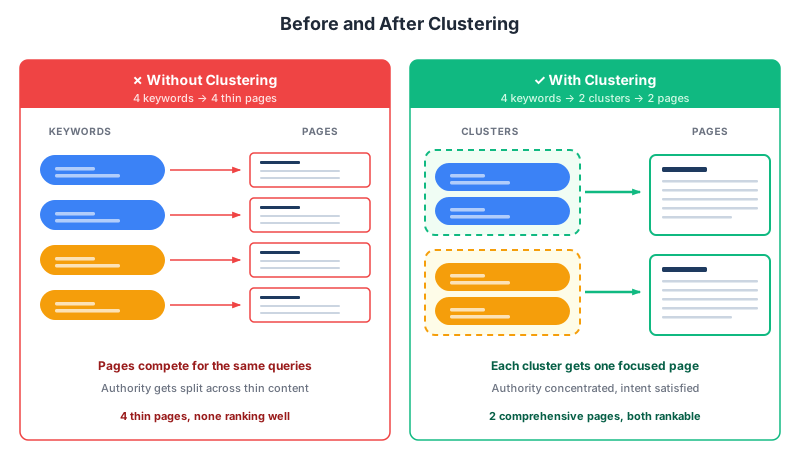
Done well, keyword clustering removes the guesswork from content planning. You stop wondering whether two articles will compete, you stop missing obvious topic gaps, and you start building pages that rank for the dozens of variations they were always going to rank for anyway, just with deliberate intent.
Frequently Asked Questions
How many keywords should be in a single keyword cluster?
There is no fixed number. Clusters can hold three keywords or fifty, depending on how much sub-topic depth they require. The right size is whatever lets a single comprehensive page satisfy every keyword in the cluster without becoming unwieldy. If you cannot reasonably cover every keyword on one page, split the cluster.
What is the difference between keyword clustering and topic clustering?
Keyword clustering groups search terms that share intent and can target one page. Topic clustering organizes those individual pages into a connected set, typically a pillar page with supporting articles linking back to it. Keyword clustering happens first; topic clustering is the broader content architecture built from the resulting clusters.
Can I do keyword clustering without paid tools?
Yes, especially for smaller lists. Manual SERP checking and spreadsheet-based grouping work well for a few hundred keywords. The challenge is scale: clustering thousands of keywords manually is impractical, which is when automated tools become worth the cost. Free clustering tools handle small to medium projects without a subscription.
How often should I re-cluster my keywords?
Review your most important clusters every six to twelve months. Search results evolve, new keywords emerge, and intent for established queries can shift. A cluster that was accurate at launch may need adjustment after Google rolls out a major update or after AI features change which queries surface which content. Annual review is a reasonable minimum.
Does keyword clustering help with AI search and ChatGPT visibility?
Yes, in a meaningful way. AI systems generate answers by drawing from pages that comprehensively cover a topic and its surrounding sub-questions. Clustered pages tend to perform better here because they already answer the related queries that AI systems decompose larger questions into. The structural advantage that helps with traditional ranking also helps with citation in AI-generated responses. For a deeper treatment of how to optimize for generative systems, see our guide to AI search optimization.