
Not all keywords are equal. Ten thousand monthly searches for "what is a CRM" and one thousand for "best CRM for small business" can look like an easy choice on paper, but the second keyword will usually generate more revenue. The difference is commercial intent: the signal that a searcher is moving from curiosity toward a buying decision.
Commercial intent keywords are the queries people use when they are considering a purchase but have not yet committed. They sit between pure research and checkout, and they are some of the most valuable real estate in search. For marketers, they represent the exact moment when content can influence a decision rather than simply educate an audience.
This guide explains what commercial intent keywords are, how to identify them, how they differ from purely transactional or informational terms, and how to build content that ranks for them. They are one slice of a broader keyword research process that runs from ideation to prioritization, and this article zooms in on that slice.
Key Takeaways
- Commercial intent keywords signal consideration, not just research: Users are evaluating options, not simply learning. They are closer to buying than informational searchers but not yet ready to check out.
- Modifier words reveal intent fast: Terms like "best," "top," "review," "vs," "alternative," and "pricing" are strong signals of commercial or transactional intent.
- The SERP is your most reliable intent test: If Google serves comparison posts, roundups, and reviews, the keyword has commercial intent. If it serves product pages and ads only, it is transactional.
- CPC is a useful proxy for commercial value: High cost-per-click on Google Ads means advertisers see clear revenue potential from the traffic.
- Commercial keywords work best as part of a funnel: Targeting only bottom-of-funnel terms leaves you invisible to people earlier in their journey. Build informational content that leads into commercial and transactional pages.
What Commercial Intent Keywords Are
Commercial intent keywords are search queries that show an intention to buy, subscribe, hire, or otherwise convert, but without a fully formed decision about what or from whom. A searcher typing "best project management software for agencies" has a problem, a budget, and a shortlist forming. They are not asking what project management software is. They are asking which one to choose.
The category overlaps with what Google's Search Quality Rater Guidelines call "Do" queries, which describe searches where the user is trying to accomplish a goal or engage in an activity, including buying something. In SEO practice, most professionals split "Do" intent into two groups: commercial investigation (evaluating options) and transactional (ready to act). Commercial keywords sit between research and purchase, where the searcher is evaluating options but isn't ready to buy yet. If you are new to the broader topic of how Google classifies queries, our guide to search intent walks through all four intent types and how they map to Google's own categories.
The practical test is simple. Ask whether the searcher wants to understand a topic, choose between options, or complete a purchase. Commercial intent lives in the middle bucket.
Why Commercial Intent Keywords Matter
Commercial keywords convert better than informational ones because the searcher has already done the upstream thinking. They know they have a problem, they know a solution category exists, and they are now comparing vendors or products. Your content has a shorter path to impact.
That conversion value is reflected in paid search. Google Ads advertisers pay more for commercial and transactional clicks than informational ones because the traffic is closer to revenue. If a keyword carries a $15 cost-per-click on Google Ads, someone has calculated that a click is worth roughly that much in expected value. That arithmetic applies to organic rankings too. A well-placed page on a commercial keyword can drive real pipeline, not just traffic.
The quality bar for commercial content has also risen since Google's 2023 reviews system update, which applies not just to product reviews but to articles, blog posts, pages or similar first-party standalone content written with the purpose of providing a recommendation, giving an opinion, or providing analysis. Google explicitly scrutinizes comparison and recommendation content, and thin commercial pages are more exposed than they used to be.
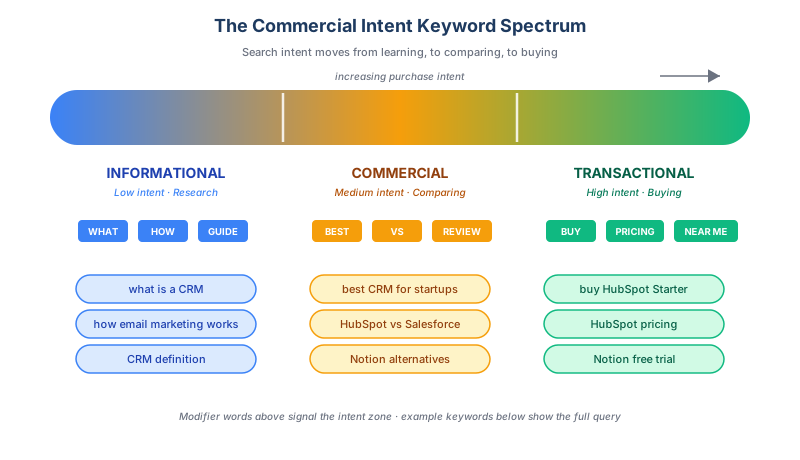
The Commercial Intent Spectrum
Intent is not binary. It sits on a spectrum, and commercial keywords occupy the middle stretch.
Low intent (informational): "What is a CRM," "how does email marketing work." The searcher is learning. They may never buy, or may not buy for months.
Medium intent (commercial investigation): "Best CRM for startups," "HubSpot vs Salesforce," "Notion alternatives," "ConvertKit review." The searcher is actively comparing. They have a problem and are weighing options.
High intent (transactional): "Buy HubSpot Starter," "HubSpot pricing," "Notion free trial," "CRM near me." The searcher is ready to act. The decision is essentially made.
Transactional keywords are a distinct bucket that sits one step past commercial investigation. They signal immediate purchase intent, like "buy Salesforce licenses," "Mailchimp pricing," or "ConvertKit free trial." They convert well but are competitive and expensive to rank for organically.
The practical implication is that your content type should shift with the intent. A middle-of-spectrum keyword wants a comparison article. A high-intent keyword wants a product or pricing page. Getting this mapping right is the point of keyword mapping, which assigns each keyword to a specific page and format.
How to Identify Commercial Intent Keywords
Three signals, used together, tell you whether a keyword has commercial intent.
Modifier words
Certain words are near-reliable signals. The most common commercial modifiers are:
- Evaluation modifiers: best, top, review, reviews, rating, recommended
- Comparison modifiers: vs, versus, compared, comparison, differences
- Alternative modifiers: alternative, alternatives, similar to, like
- Price modifiers: cheap, affordable, discount, deal, pricing, cost
- Purchase modifiers: buy, order, shop, for sale
- Location modifiers: near me, in [city], local
These modifiers are not foolproof. "Best" in "best way to boil an egg" is informational, not commercial. But when combined with a product or service category, they are strong signals.
SERP features
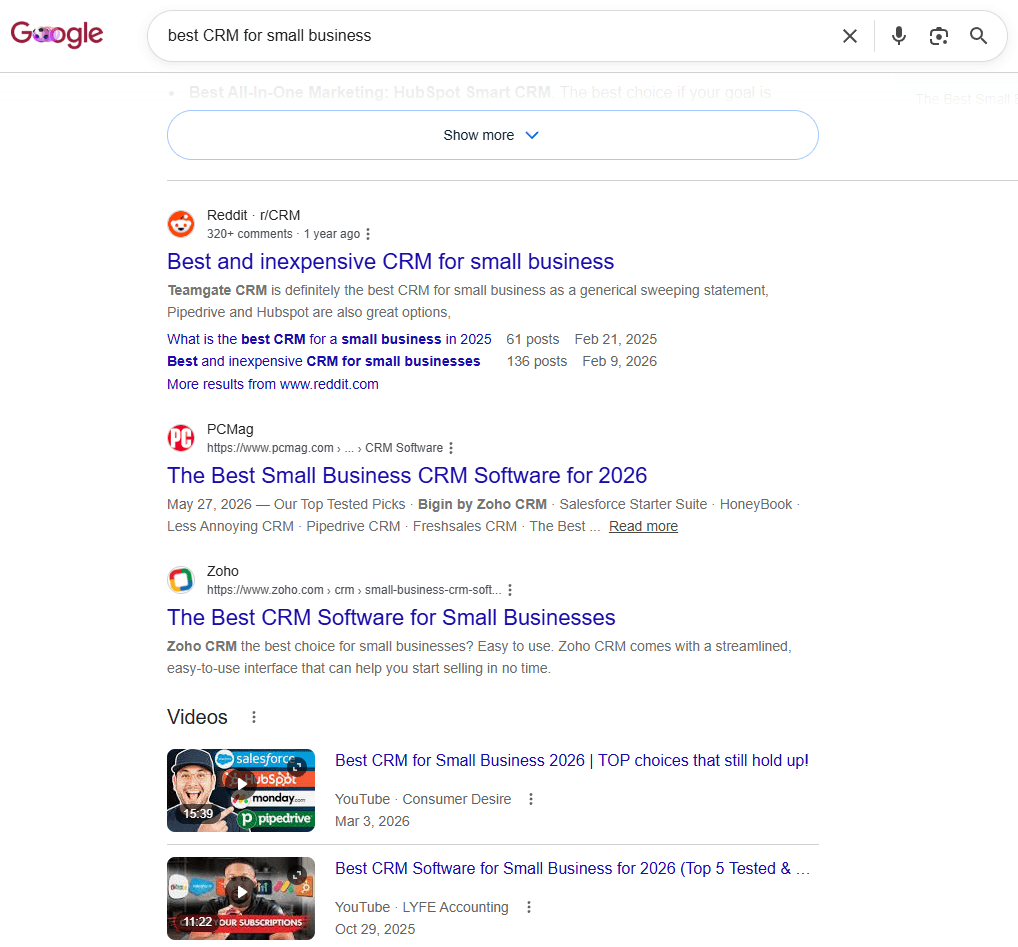
The search results page itself is the most reliable intent test. Google's entire business depends on matching intent correctly, so the SERP for a keyword reflects what Google believes searchers want. Google's own guidance makes this point: use words that people would use to look for your content, and place those words in prominent locations on the page, which assumes you have correctly identified what they want in the first place.
For a commercial keyword, expect to see:
- Comparison articles ("Best X for Y")
- Review posts and review aggregator pages
- "Alternatives" and "vs" posts
- Google Ads (commercial keywords almost always have paid competition)
- Shopping results for product categories
- Fewer knowledge panels and featured snippets than informational queries
If you search a keyword and the first page is dominated by product pages and shopping ads, the keyword is transactional, not commercial. If it is dominated by definitions, tutorials, and guides, the keyword is informational. Commercial keywords sit between these patterns.
CPC as a signal
Top of Page Bid (formerly called average CPC) in Google Keyword Planner shows what advertisers are willing to pay. High CPC keywords are high-commercial-intent keywords almost by definition, because Google Ads is a blind auction for ready-to-buy traffic.
A $12 top-of-page bid on "business insurance quotes" tells you advertisers see real revenue in that traffic. A $0.40 bid on "history of insurance" tells you they do not. CPC is not a ranking factor, but it is a reliable indicator of commercial value. This is one of the few times where paid search data directly informs organic strategy.
Categories of Commercial Keywords
Commercial keywords cluster into predictable categories. Each suggests a different content format.
| Category | Example | Best content format |
|---|---|---|
| "Best" lists | best email marketing software | Roundup article |
| Reviews | Semrush review | In-depth single-product review |
| Comparisons | SEOForge vs Arvow | Head-to-head comparison |
| Alternatives | Mailchimp alternatives | Alternatives roundup |
| Pricing | [product] pricing, how much does X cost | Pricing-focused page or guide |
| Use-case specific | best CRM for real estate agents | Vertical roundup |
| Location-modified | SEO agency in Seattle | Local landing page |
The use-case and location variants tend to have lower search volume but much higher conversion rates. They are typically long-tail and less competitive. If you are just getting started, these can be easier wins than broad "best X" terms. Our long-tail keywords guide covers the economics in more depth.
Content Formats That Match Commercial Intent
The format you choose should mirror what is already ranking. Matching the dominant format on the SERP is the single most repeatable tactic in search intent optimization. Google's guidance to create content primarily for people, and not to manipulate search engine rankings implies that the format that serves users best is also the one that will tend to rank.
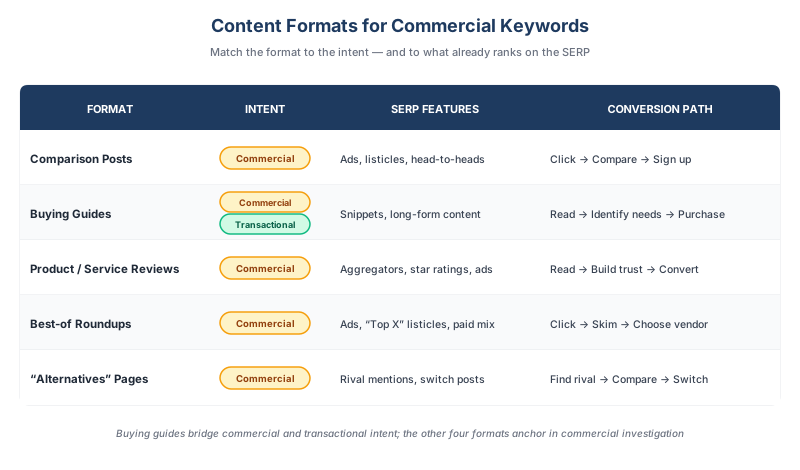
For most commercial keywords, the effective formats are:
Comparison posts. Structured around the decision itself, not the products. Lead with a quick recommendation, then break down the comparison across the dimensions the reader actually cares about.
Buying guides. Longer-form content that educates the reader on what to look for while framing the buying criteria in your favor. Strong for categories where buyers do not yet know what matters.
Product and service reviews. Under Google's reviews system, these must show in-depth research, rather than thin content that simply summarizes a bunch of products. First-hand use, original photos or screenshots, and specific pros and cons are required, not optional.
Roundups and best-of lists. Powerful for commercial investigation but heavily competed. Differentiation comes from a clear selection methodology, tight use-case targeting, and transparent exclusions.
Alternative pages. "X alternatives" posts typically have lower difficulty than "best X" terms and capture users unhappy with a known product. These are often the easiest commercial wins for smaller sites.
If you do publish review and comparison content, pair it with conversion tracking from day one. Commercial keywords are the most measurable content you will publish, and without conversion data, you cannot tell a winning roundup from a losing one.
Common Misconceptions About Commercial Keywords
Three assumptions quietly undermine commercial keyword strategy.
"Commercial is just transactional with a different label." It is not. Commercial investigation searchers are comparing options. Transactional searchers have decided. Serving a comparison article to someone who searched "buy X" is an intent mismatch, and vice versa. The SERP tells you which one the keyword is.
"High search volume equals high value." Informational terms often have enormous volume and almost no commercial value. A keyword with 500 monthly searches and buyer intent will typically outperform one with 50,000 searches and casual curiosity. Intent is the multiplier on volume, not an additive.
"You only need commercial keywords." This is the most expensive mistake. Commercial keywords capture people who are already in the market. Informational content captures the much larger audience upstream and gives you something to rank for while your commercial pages build authority. A site with no informational content has nothing to connect its audience's early questions to its paid offerings. Google explicitly recommends creating people-first content to be successful with Google Search, rather than search engine-first content made primarily to gain search engine rankings, which means serving the full journey, not just the checkout line.
How Commercial Keywords Fit Into a Balanced Strategy
A healthy content portfolio covers all three intent tiers: informational, commercial, and transactional. Informational content attracts top-of-funnel readers, builds topical authority, and earns backlinks. Commercial content converts readers who are ready to compare. Transactional pages close the loop.
The right mix depends on your business and your competitive position. A new site usually cannot rank for high-volume commercial terms immediately because the competition has domain authority and backlink profiles that take years to match. Starting with informational and long-tail commercial content builds the authority that makes competing for head terms realistic later. Our guide to keyword difficulty explains how to evaluate which terms are actually winnable at your current authority level.
Commercial keywords also matter for AI search, where generative results increasingly handle the evaluation phase. Google has noted that with AI Overviews and AI Mode, people are using Search more often, asking new and more complex questions, and are more satisfied with their results, which shifts where commercial decisions get made. Content that demonstrates genuine expertise, shows real comparisons, and avoids thin summarization is more likely to be cited by AI systems and pulled into AI-generated answers.
If you are building a portfolio from scratch, a reasonable starting mix is roughly 60 percent informational, 30 percent commercial, and 10 percent transactional. Established sites with clear product-market fit often flip that balance to favor commercial and transactional content, since the informational groundwork is already laid.
For help identifying commercial keywords in your category, SEOForge's content planner can surface intent-classified keywords alongside volume and difficulty data.
Frequently Asked Questions
What is the difference between commercial and transactional keywords?
Commercial keywords indicate a searcher is evaluating options before buying, such as "best CRM software" or "HubSpot vs Salesforce." Transactional keywords indicate the searcher has decided and is ready to act, such as "buy HubSpot" or "HubSpot pricing." Both fall under what Google calls "Do" intent, but they call for different content formats: comparisons for commercial, product or pricing pages for transactional.
How do I know if a keyword has commercial intent?
Check three signals together: the modifier words in the keyword (best, top, vs, review, alternative are strong commercial markers), the content types ranking on page one of Google (comparison posts and roundups suggest commercial intent), and the cost-per-click in Google Keyword Planner (higher CPC generally means higher commercial value). The SERP is the most reliable of the three because it reflects what Google has already learned about user intent for that query.
Are commercial keywords harder to rank for than informational ones?
Usually yes, because they have more direct commercial value, more advertiser competition, and attract stronger domain-level competitors. That said, long-tail commercial keywords (such as "best project management software for creative agencies") often have much lower difficulty than head terms and can be realistic targets for smaller sites. Alternative keywords ("[competitor] alternatives") are also often easier than the corresponding "best X" terms.
Should I only target commercial intent keywords if I want sales?
No. Targeting only commercial keywords leaves you invisible to the much larger pool of people earlier in their journey. It also makes it harder to build the topical authority that search engines use to rank your commercial pages. A balanced approach that includes informational content to attract and educate, commercial content to convert comparison-stage buyers, and transactional pages to close sales typically performs better than a narrow commercial-only strategy.
Does AI search change the value of commercial keywords?
It changes the execution, not the value. AI-generated answers in Google AI Overviews, ChatGPT, and Perplexity are increasingly handling the comparison phase that used to happen on commercial SERPs. Content that is thin, summarized, or templated is at higher risk of being replaced by AI answers. Content that provides genuine first-hand analysis, original data, and specific recommendations is more likely to be cited by AI systems, which is now a meaningful source of referral traffic and brand exposure.