
SEO advice has a shelf life. Tactics that worked a decade ago can actively hurt your site today, and misconceptions spread faster than corrections. The problem is that many of these outdated beliefs still circulate in blog posts, forums, and even conversations with well-meaning colleagues.
If you are newer to search engine optimization, separating fact from fiction is one of the most valuable things you can do before investing time and money into your strategy. Even experienced marketers occasionally catch themselves following advice that Google moved past years ago.
This article breaks down 10 of the most persistent SEO myths, explains the reality behind each one, and covers why it actually matters for your rankings and traffic.
Key Takeaways
- Keyword density is not a ranking factor. Google's algorithms understand topics and context, not keyword percentages.
- The meta keywords tag is completely ignored by Google and has been since 2009. Time spent on it is time wasted.
- Buying links violates Google's spam policies and can result in lost rankings or manual penalties.
- Social media does not directly influence Google rankings, though it provides valuable indirect benefits like brand visibility and link earning.
- SEO is never "done." Algorithms, competitors, and user behavior change constantly, making ongoing optimization essential.
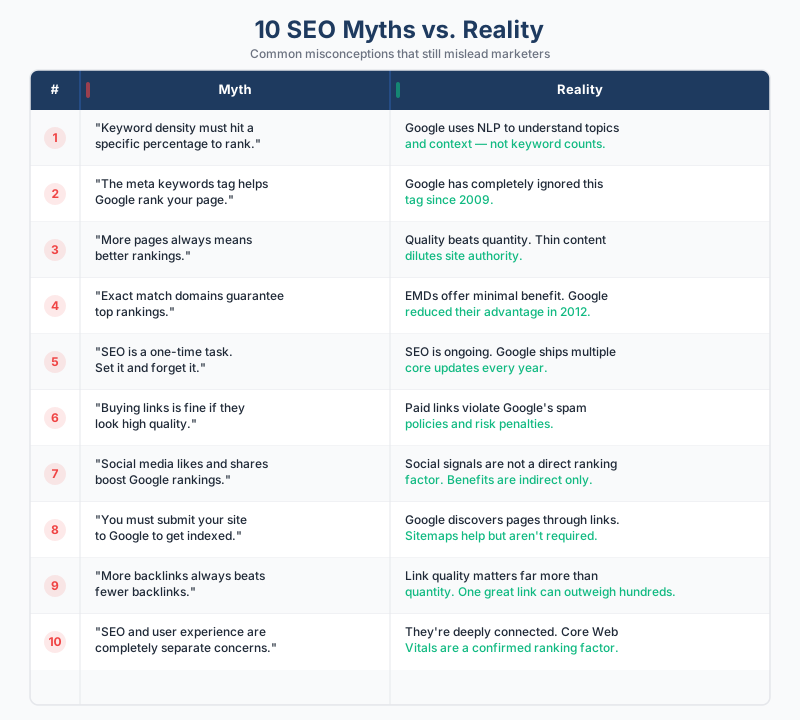
Myth 1: Keyword Density Matters
The myth: You need to repeat your target keyword a specific number of times, or hit a certain percentage, for Google to rank your page.
The reality: Google does not use keyword density as a ranking factor. Matt Cutts, a former Google engineer, was telling SEOs to stop worrying about keyword density as far back as 2011. Google's own documentation on creating helpful content focuses on quality and user value rather than keyword percentages. Modern search algorithms use natural language processing to understand topics, context, and meaning. They do not count how many times a word appears.
Why it matters: Chasing a keyword density percentage leads to awkward, repetitive writing that actually harms user experience. Instead of counting keywords, focus on covering the topic comprehensively and using natural language. If you write a thorough article about a subject, the relevant terms will appear organically. For practical guidance on getting this right, see our on-page SEO checklist.
Myth 2: The Meta Keywords Tag Helps Rankings
The myth: Adding keywords to the meta keywords tag helps Google understand and rank your page.
The reality: Google has completely ignored the meta keywords tag since 2009. Google Search Central confirmed this directly, stating that their web search "disregards keyword metatags completely" because the tag was "so often abused" by webmasters stuffing irrelevant terms. Google's John Mueller has reconfirmed this position multiple times since then.
Why it matters: Any time you spend adding or optimizing meta keywords is wasted. Focus instead on the meta tags that do matter: your title tag and meta description. These influence click-through rates from search results and help users decide whether to visit your page. You can test how your titles and descriptions look in search results with a meta tag checker.
Myth 3: More Pages Equals Better Rankings
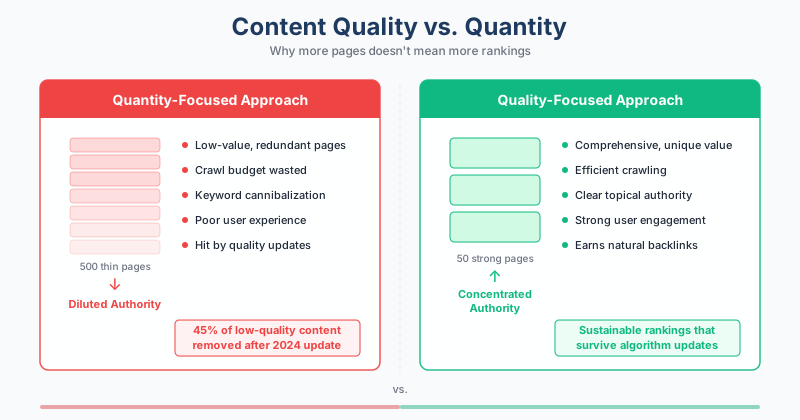
The myth: Publishing as many pages as possible will improve your overall site rankings. More content means more chances to rank.
The reality: Quality matters far more than quantity. Google's March 2024 core update specifically targeted low-quality content at scale, and Google reported it resulted in 45% less low-quality, unoriginal content in search results (Search Engine Land). Publishing thin or redundant pages can actually hurt your site by diluting your overall quality signals.
Why it matters: A site with 50 genuinely helpful, well-researched pages will outperform a site with 500 thin pages on the same topics. Before creating new content, ask whether the page provides genuine value that does not already exist on your site. Quality-focused content writing consistently outperforms volume-focused approaches.
Myth 4: Exact Match Domains Guarantee Rankings
The myth: If you buy a domain like "best-seo-tools.com," you will automatically rank for "best SEO tools."
The reality: Exact match domains (EMDs) provide minimal direct ranking benefit, if any. Google released an EMD update back in 2012 specifically to reduce the advantage of low-quality exact match domains in search results. Before that update, it was common to see thin, ad-heavy sites ranking well purely because their domain name matched the search query. Today, your domain name is a branding decision, not an SEO shortcut. Google evaluates the content, authority, and user experience of a site, not whether the domain matches a search query word for word. Consider that the most successful websites in nearly every industry, from Amazon to WebMD to HubSpot, built authority through brand recognition, not keyword-stuffed domain names.
Why it matters: Choosing a domain based purely on a target keyword often results in a forgettable, untrustworthy-looking brand. Users are more likely to click on and return to a recognizable brand name than a generic keyword domain. Invest in a memorable domain that builds brand recognition, and let your content and authority do the ranking work.
Myth 5: SEO Is a One-Time Task
The myth: Once you optimize your website, the work is done. Set it and forget it.
The reality: SEO is an ongoing process. Google rolls out multiple core updates per year. In 2025 alone, there were three confirmed core updates and one spam update (Search Engine Land). Beyond algorithm changes, your competitors are publishing new content, earning new links, and refining their strategies. User behavior evolves as well, with search queries shifting in language and intent over time.
Why it matters: Sites that treat SEO as a one-time project gradually lose ground to competitors who keep investing. Ongoing activities like content refreshes, keyword research, technical audits, and link building are what sustain and grow organic traffic. If you are wondering about realistic timelines, our guide on how long SEO takes covers what to expect.
Myth 6: Buying Links Is Fine If They Are Good Quality
The myth: As long as you buy links from reputable-looking sites, it is a safe and effective strategy.
The reality: Buying or selling links for the purpose of manipulating search rankings is a direct violation of Google's spam policies. Google's documentation explicitly lists "exchanging money for links, or posts that contain links" as link spam. Google has also stated that their algorithms now nullify the benefit of spammy links, meaning you can lose any ranking benefit those links once provided.
In a 2022 Google SEO Office Hours session, a Google representative was blunt about it, advising that "you probably should not waste your money in spamming links" and that the money is better spent on creating helpful content and a good user experience (Google Search Central).
Why it matters: Paid links carry real risk, from wasted budget to manual penalties. The sustainable alternative is earning links through quality content, outreach, and genuine relationships. Learn more about building links the right way in our backlinks guide. You can also use a backlink checker to audit your existing link profile.
Myth 7: Social Media Directly Affects Rankings
The myth: Getting more likes, shares, and followers on social media will boost your Google rankings.
The reality: Social signals are not a direct Google ranking factor. Google's John Mueller stated in 2015 that social signals do not directly help organic rankings, and he has reiterated this position multiple times since (Search Engine Journal). Google also noted that most social media links carry a nofollow attribute, meaning they do not pass ranking credit.
Why it matters: This does not mean social media is irrelevant to your SEO strategy. Social platforms help distribute your content to wider audiences, which can lead to genuine backlinks from people who discover and reference your work. Social profiles also contribute to your brand's overall online presence and can appear in search results. The key distinction: social media benefits SEO indirectly through visibility and link earning, not through likes and shares directly influencing the algorithm.
Myth 8: You Need to Submit Your Site to Google
The myth: You must manually submit your website to Google for it to appear in search results.
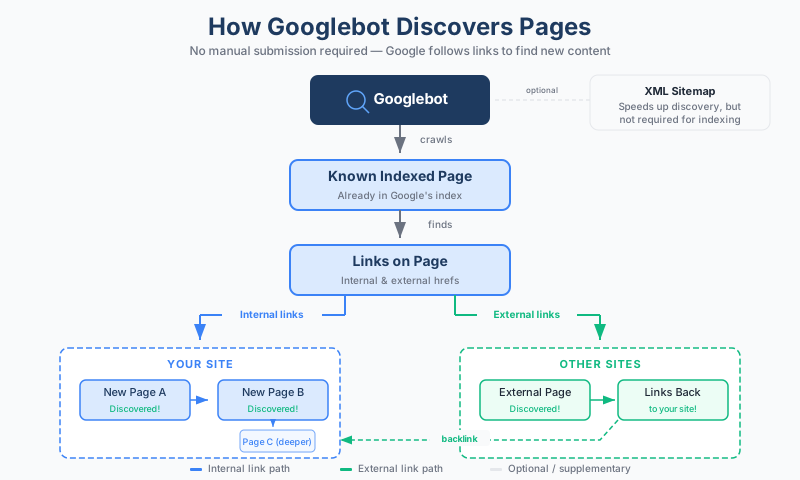
The reality: Google discovers websites primarily through links. When Googlebot crawls a page and finds a link to your site, it follows that link and discovers your content. You do not need to submit your site for it to get indexed. That said, submitting an XML sitemap through Google Search Console is a helpful practice. It gives Google a clear roadmap of your site's pages and can speed up discovery of new or updated content, but it is not a requirement for indexing (Google Search Central).
Why it matters: Instead of worrying about manual submissions, focus on building a well-linked site with a logical structure. Internal linking helps Google find and understand all your pages. A sitemap is a nice complement, not a necessity. Use our SEO audit tool to check whether your site structure supports efficient crawling.
Myth 9: More Backlinks Always Beats Fewer
The myth: The site with the most backlinks wins. Volume is what matters.
The reality: Link quality matters significantly more than quantity. A single link from a relevant, authoritative website can carry more weight than hundreds of links from low-quality or irrelevant sources. Google's algorithms have become increasingly sophisticated at evaluating link quality, and spammy links can be algorithmically ignored or even count against you. Google's link spam updates specifically target manipulative link patterns, and any ranking benefit from those links is permanently lost once detected (Google Search Central).
Why it matters: Chasing link volume leads to spammy tactics that waste resources and create risk. A focused link-building strategy that prioritizes relevant, editorial links from trusted sources is far more effective. For a deeper look at what makes a link valuable, see our guide on backlink quality.
Myth 10: SEO and User Experience Are Separate
The myth: SEO is a technical exercise focused on search engines, and user experience is a design concern. The two are unrelated.
The reality: SEO and user experience are deeply connected. Google has explicitly incorporated user experience signals into its ranking systems. Core Web Vitals, which measure loading performance, interactivity, and visual stability, are a confirmed ranking factor. Google has indicated that Core Web Vitals play a meaningful role in rankings beyond simply breaking ties between otherwise equal pages, and they also directly affect how users experience your site after they click through from search results.
Beyond Core Web Vitals, Google's overall approach to quality assessment, reflected in its E-E-A-T framework (Experience, Expertise, Authoritativeness, Trustworthiness), rewards sites that provide genuinely helpful experiences. Pages with clear navigation, readable content, fast load times, and mobile-friendly design tend to earn better engagement metrics and more natural backlinks.
Why it matters: Treating SEO and UX as separate silos means you are optimizing for only half the equation. The most effective approach is to build pages that serve users well, then ensure search engines can find and understand them. When you improve user experience, you improve SEO outcomes at the same time.
Frequently Asked Questions
Is SEO dead because of AI search tools like ChatGPT and Perplexity?
No. Google still processes billions of searches daily, and organic search remains one of the highest-traffic channels for most websites. AI search tools are growing, but they complement traditional search rather than replacing it. Smart marketers are optimizing for both.
Does Google penalize duplicate content?
Google does not have a specific "duplicate content penalty." However, when multiple pages have substantially similar content, Google will choose which version to show in search results and may filter out the others. This can reduce your visibility, but it is a filtering issue, not a penalty.
Is longer content always better for SEO?
No. Content length should match the depth needed to satisfy search intent. A 500-word answer can outrank a 3,000-word article if it answers the query more effectively. Google's own documentation advises against padding content to hit a word count.
Do meta descriptions affect rankings?
Meta descriptions are not a direct ranking factor. However, a well-written meta description can improve your click-through rate from search results, which drives more organic traffic. Google sometimes uses your meta description as the snippet shown in results.
Should I disavow all bad backlinks?
Not necessarily. Google's algorithms are generally good at ignoring low-quality links on their own. The disavow tool is intended for cases where you have a significant number of spammy links, such as from a past link-building campaign, and you believe they may be causing issues. Use it carefully and only when needed.
Sources
- Google Search Central — Google does not use the keywords meta tag in web ranking. https://developers.google.com/search/blog/2009/09/google-does-not-use-keywords-meta-tag
- Google Search Central — Spam policies for Google Web Search (link spam definition). https://developers.google.com/search/docs/essentials/spam-policies
- Google Search Central — Google Search's core updates documentation. https://developers.google.com/search/docs/appearance/core-updates
- Google Search Central — Google Search spam updates documentation. https://developers.google.com/search/docs/appearance/spam-updates
- Google Search Central — November 2022 SEO Office Hours (advice on buying links). https://developers.google.com/search/blog/2022/11/november-office-hours
- Search Engine Land — Google algorithm updates 2024 in review. https://searchengineland.com/google-algorithm-updates-2024-449417
- Search Engine Land — Google algorithm updates 2025 in review. https://searchengineland.com/google-algorithm-updates-2025-in-review-3-core-updates-and-1-spam-update-466450
- Search Engine Journal — Are social signals and shares a Google ranking factor? https://www.searchenginejournal.com/ranking-factors/social-signals-rankinng-factor/