
Most websites publish content based on what they think their audience wants. The sites that consistently win organic search do something different first: they look at what is already working for the competition, then build on it. Competitor keyword analysis is the structured way to do that, and it sits at the heart of any serious keyword research workflow.
The stakes are higher than people realize. A study of roughly 14 billion pages found that 96.55% of pages get no organic traffic from Google. Publishing without understanding what your competitors already rank for is one of the fastest ways to end up in that 96.55%. You write something, hope it ranks, and move on without ever checking whether the topic has demand or whether you have a realistic shot at the SERP.
This guide walks through a repeatable process for finding competitor keywords, separating signal from noise, and turning the analysis into a content plan you can actually execute. It is the practical companion to the broader keyword research guide and pairs naturally with formal keyword gap analysis once you are ready to systematize the work.
Key Takeaways
- Search competitors are not business competitors. The sites you compete against on Google are often different from the brands you compete against in sales. Identify them per topic, not per company.
- The goal is opportunity, not imitation. Competitor keyword analysis surfaces queries you should target, but you still need a differentiated angle. Copying blindly produces commodity content that struggles to rank.
- Look at three keyword buckets: gaps where competitors rank and you do not, close-behind keywords where you rank in positions 11 to 30, and weakly-defended terms where the top results are thin.
- Filter ruthlessly. Most exported keyword lists are 80% noise. Search volume alone is a poor prioritizer. Use intent, business relevance, and realistic difficulty together.
- The analysis is only useful if it produces a content plan. Output is a prioritized backlog of pages to create or improve, not a spreadsheet that lives in a tab forever.
Why Competitor Keyword Analysis Matters
In practice, competitor keyword analysis solves four problems at once. It expands your keyword universe beyond what you can brainstorm. It validates demand, because if multiple competitors rank for a term, there is real search volume behind it. It exposes weaknesses in your coverage. And it gives you a benchmark, so "ranking well" stops being a vague feeling and becomes a measurable position relative to specific peers.
The fourth point is what most teams miss. SEO without competitive context is just optimization in the dark. You can spend months improving a page and feel like nothing is happening, when in reality you have moved from position 24 to position 11 while a competitor jumped from 7 to 3. The relative picture tells the real story.
There is also an AI search dimension worth flagging. Traditional SEO research is great for content planning that addresses specific keywords, but it is no longer the whole organic picture today. The keywords your competitors rank for in Google are still the best leading indicator of where they will be cited in AI Overviews and large language model responses, since AI systems lean heavily on traditional search signals. Competitor keyword work feeds both surfaces.
Identifying Your Real SEO Competitors
Before you analyze a single keyword, you need the right competitor set. This is the step most teams rush, and it poisons everything downstream.
Business competitors versus search competitors
Your business competitors are the companies that lose deals to you and vice versa. Your search competitors are the sites that show up on Google for the queries you care about. They overlap, but rarely match. A B2B SaaS company might compete with three other vendors in sales conversations and against a completely different mix of blogs, marketplaces, and review sites on Google. For keyword analysis, search competitors are the ones that matter.
How to find search competitors
There are three methods, and you should use all of them.
The first is SERP-based. Take your five most important keywords, search them, and note which domains appear in the top 10 for multiple terms. The sites that repeat are your search competitors for that topic cluster.
The second is tool-based. Most keyword research tools have an "organic competitors" report that finds the domains with the highest keyword overlap with yours, though the results are not always perfectly accurate and should be double-checked manually.
The third is intent-based. Pick a single high-value keyword, look at the SERP, and ask which results actually satisfy the intent. Those are your real competitors for that query, even if they are not on your radar elsewhere.
Different competitors for different topics
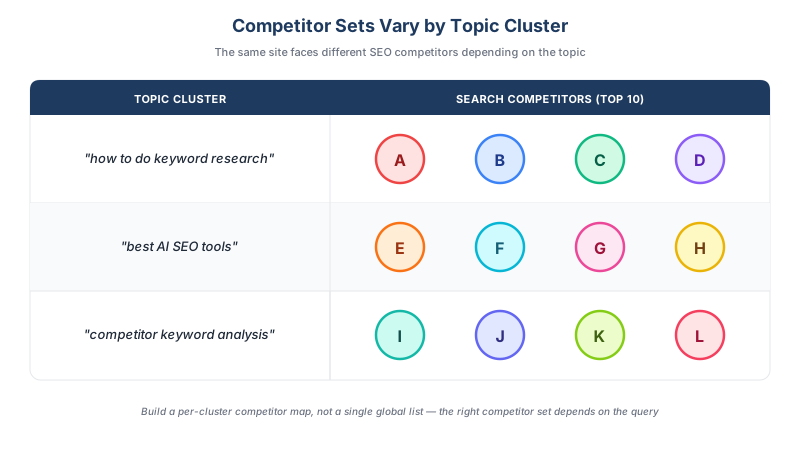
The key difference between hobbyist and professional analysis: a site's competitor set is not one list. It is many. The competitors you face on "how to do keyword research" are different from those you face on "best AI SEO tools" which are different again from those you face on "competitor keyword analysis." Build a per-cluster competitor map, not a global one.
The Competitor Keyword Analysis Process
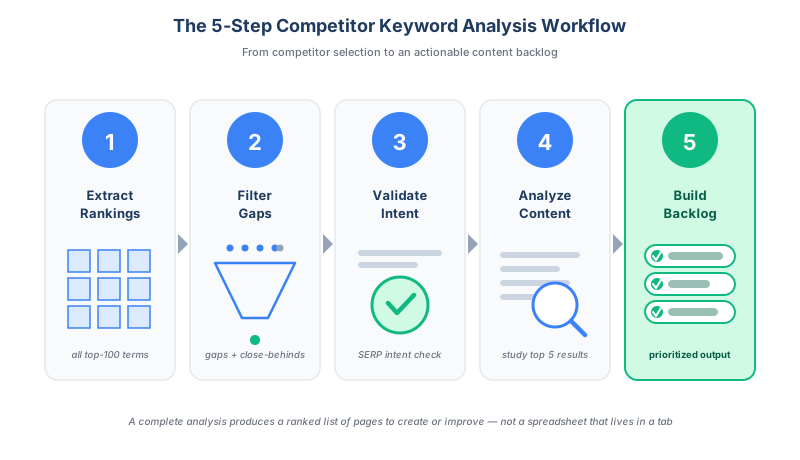
Once you have your competitor set, the process is five steps. Run them in order.
Step 1: Extract competitor keyword rankings
Pull a complete list of organic keywords for each competitor in scope. Most keyword research tools support this through a "site explorer" or equivalent report that returns every term a domain ranks for in the top 100, along with position, search volume, and an estimated difficulty score. Export to a single spreadsheet so you can compare across competitors.
If you do not have access to paid tools, the manual alternative is to identify a competitor's top content (usually visible in their site search, their blog index, or by browsing their sitemap) and then run those page titles through Google to see which keywords they rank for. Slower, but free.
Step 2: Filter for gaps and overlaps
This is where most exports become useful. Filter the list to surface three buckets:
- Gaps: Keywords where one or more competitors rank in the top 20 and you do not rank at all.
- Close-behind keywords: Keywords where you rank in positions 11 to 30. These are usually faster wins than chasing brand-new topics.
- Weakness keywords: Keywords where competitors rank in positions 5 to 10 with content that is visibly thin or outdated, which signals the SERP is not strongly defended.
For each, attach search volume, an estimated difficulty score, and the URL that ranks. The combination of metrics is what makes prioritization possible.
Step 3: Validate intent before you commit
Search volume is necessary but not sufficient. What kills more competitor keyword projects than anything else is targeting a term whose SERP is dominated by a content format you cannot produce. A keyword may have 8,000 monthly searches, but if the top 10 results are all calculators or product pages and you are planning a blog post, you will not rank.
Open the SERP. Look at the top five results. Classify the dominant format (guide, tool, listicle, comparison, video, product page). Confirm your planned content matches before you add the keyword to your backlog. The search intent guide covers the classification framework in depth.
Step 4: Analyze the content that ranks
For the keywords that survive filtering, pull the URLs ranking in positions 1 to 5 and study them as a set. You are not looking to clone them. You are looking for the patterns: which subtopics they all cover, which they all omit, what kind of supporting media they include, and where the consensus position is wrong or out of date. That third bucket, the wrong or outdated consensus, is where competitive content actually wins.
Step 5: Build a prioritized content backlog
The output of competitor keyword analysis is not a spreadsheet. It is a list of pages to create or improve, ranked by expected impact. A simple scoring framework works:
| Factor | Weight |
|---|---|
| Search volume | 25% |
| Business relevance to your offer | 30% |
| Estimated keyword difficulty relative to your authority | 25% |
| Number of competitors already ranking (validates demand) | 10% |
| Quality of current top results (gap to beat) | 10% |
Anything above a threshold goes into the backlog. Everything else gets shelved or grouped into keyword clusters for future consideration.
Free Competitor Keyword Analysis Template
Map competitors by cluster, sort keywords into gap, close-behind, and weakness buckets, then let the built-in scoring calculator rank your content backlog automatically.
One email. No spam. Unsubscribe anytime. Privacy policy.
What to Look For Beyond High-Volume Terms
Here is what most guides miss: the highest-volume competitor keywords are usually the wrong place to start. They are the most contested, the hardest to rank for, and the ones every other site running this analysis has already targeted. The opportunities sit elsewhere.
Long-tail clusters competitors are ranking for incidentally
Many competitors rank for long-tail keywords accidentally, through pages that target a head term and happen to capture related queries. These long-tail terms are usually under-optimized in the ranking pages, which means a dedicated piece of content targeting the long-tail directly can outperform them quickly.
Their decaying content
Pages that ranked well a year ago and have slipped to positions 6 through 15 are vulnerable. If a competitor's traffic to a specific page is declining, that is a SERP you can take with a focused, well-researched piece. Tools that show estimated traffic trends per URL make this visible.
The questions they never answer
When you study the top 5 results for a keyword, you will see a pattern of subtopics all of them cover. You will also see questions that none of them address. Those unanswered questions are where differentiated content lives. People-Also-Ask boxes and Reddit discussions on the topic are gold for surfacing them.
Keywords where multiple competitors rank but no one ranks well
If three competitors all rank for a term but the best position is page 2, that SERP is undefended. A high-quality, intent-matched page can usually take it.
Tools and Approaches
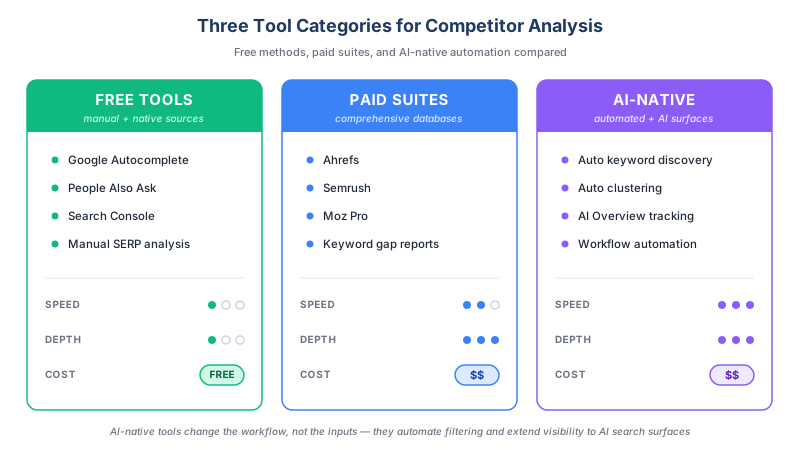
The competitor keyword analysis market has consolidated around two patterns: comprehensive SEO suites with keyword gap reports, and AI-driven tools that automate parts of the workflow.
The comprehensive suites (Ahrefs, Semrush, and similar) offer the deepest data and the most flexible filtering. Their content gap and keyword gap reports are the standard reference for this kind of work. A single competitor can distort your view; a broader set shows which gaps repeat across the market.
The free path is workable but slower. Google's autocomplete, "People Also Ask" boxes, and related searches expose the long tail. Manual SERP analysis surfaces formats and angles. A SERP simulator helps you test how your titles and meta descriptions will appear against competitors. Tools like Google Search Console show you keywords where you rank in positions 11 to 30, which is one of your two close-behind opportunity sets.
AI-native tools change the workflow rather than the inputs. They automate the filtering, clustering, and prioritization that used to take a half-day in spreadsheets, and they extend the analysis to AI search surfaces.
From Analysis to Action
A finished analysis means nothing if it does not change what you publish next month. Three habits separate teams that compound from teams that just produce spreadsheets.
Match topics to your authority, not your ambition
A site with a Domain Rating of 30 should not be opening its plan with the same high-difficulty terms a DR 80 competitor ranks for. Filter prioritization by realistic difficulty given your current authority. Quick wins build the authority that lets you compete on harder terms later.
Differentiate, do not duplicate
What most guides miss: if your content is just a slightly better version of what already ranks, Google has no reason to displace incumbents. You need a genuinely different angle. Original data, a different audience perspective, a contrarian position backed by evidence, or a depth of execution the current ranking pages cannot match. Competitor analysis tells you what to write about. It does not tell you what to say.
This connects directly to E-E-A-T. Google's ranking systems aim to reward original, high-quality content that demonstrates experience, expertise, authoritativeness, and trustworthiness. Content that imitates the top-ranking page on a competitor keyword fails the originality test by definition.
Track the right metrics
Once you publish against a competitor keyword, track three things: your position relative to the competitor you targeted, the click-through rate on your result, and whether your page is being cited in AI Overviews. The first two tell you if you are winning the SERP. The third tells you if you are winning the surface beyond it.
Where Competitor Analysis Backfires
A few patterns sink otherwise-decent competitor analyses.
Copying competitors blindly. If five competitors all rank for a keyword, do not assume that means you should write the same article. Sometimes it means the SERP is saturated and a new entry will not break through. Sometimes it means the topic is irrelevant to your business.
Ignoring your unique strengths. Competitor analysis is inherently backward-looking. It tells you what has worked. The terms where you have a genuine experience or data advantage may not appear in any competitor's keyword list, because no one else can write the article. Do not let the analysis crowd out your own founder-led, expertise-driven content.
Tunnel vision on high volume. A keyword with 100 searches per month from a clearly commercial-intent audience can outperform a keyword with 10,000 searches per month from a vague informational audience. Volume is one input, not the input.
Skipping the differentiation step. This is the failure mode that produces the 96.55% of pages that get no organic traffic. The plan exists, the keyword is real, the page gets published, and it looks exactly like the four pages already ranking. Without an angle, ranking is gravity working against you.
Frequently Asked Questions
How many competitors should I analyze?
Three to five for any given topic cluster, and ten at the absolute outside. Beyond that, the data becomes noisy and the analysis takes more time than it generates value. If you genuinely need to cover more, segment your analysis by topic rather than running one giant comparison.
Are paid tools necessary for competitor keyword analysis?
For systematic work at scale, yes. Free methods can surface specific opportunities, but the comprehensive keyword databases and gap reports in tools like Ahrefs and Semrush are difficult to replicate manually. For a small site running one analysis per quarter, you can get reasonably far with Google Search Console, manual SERP analysis, and a free tier from one of the major suites.
How often should I run competitor keyword analysis?
Quarterly for active SEO programs, with light monthly check-ins on the close-behind keywords you are already targeting. SERPs move slowly enough that running this analysis weekly is wasted effort. They move quickly enough that a yearly cadence misses opportunities.
Should I prioritize keywords where competitors rank in position 1, or keywords where they rank in position 5 to 10?
Generally, position 5 to 10. Those rankings indicate a SERP that is not strongly defended, which means a better-executed page has a realistic shot. Position 1 means a competitor has invested heavily and likely has authority signals you will struggle to match in a single piece.
Does competitor keyword analysis still work in the AI search era?
Yes, more than people expect. The keywords competitors rank for in Google remain the leading indicator of where they will appear in AI Overviews and LLM responses, since AI systems lean heavily on traditional search rankings as input. The analysis itself is the same. What changes is that you now monitor visibility on both surfaces rather than just one.